“What are you doing here?” I asked the little group of people milling around my pasture.
“We’re looking for buried treasure,” the big fellow scanning the ground with a metal detector said with a laugh. He glanced around at his five or six cohorts for assurance.
“Why here?” I asked.
“You never know what you’ll find where an old trading post used to be,” he answered.
Perplexed, I asked, “What old trading post?”
“Why, the old Falk’s Store. Don’t you know?” he said.
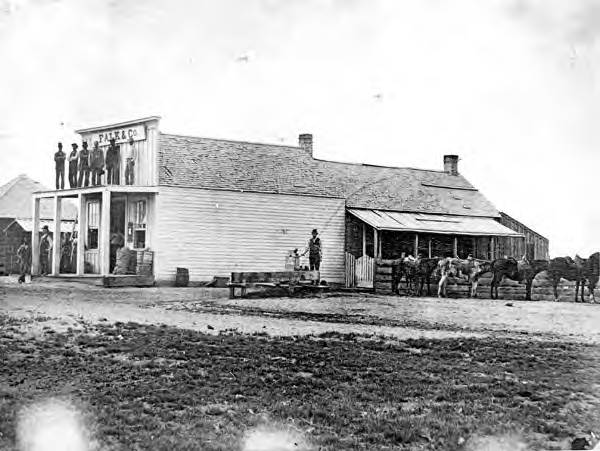
I didn’t know, but I didn’t let on. New to the neighborhood, I didn’t want to seem unneighborly. “Well, okay, but please don’t leave a mess,” I admonished them and stalked back across the field to the house. That was my introduction to the fact that my new homestead held more than a passing historical significance. It was, in fact, the home of a vanished pioneer community. It was the site of Falk’s Store, Idaho.
In the fall of 1969, I took a job with Boise Cascade and moved my family (wife Kathy and sons Frank and Rob, ages 12 and 11) away from the urban madness of the 1960s San Francisco Bay Area to the relative sanity of Boise, Idaho. Boise still had a small-town feel and, to me, offered a much better lifestyle than San Jose, California. However, it was still a city, not a place where you could grow your food, raise livestock, and experience the freedom of a rural lifestyle. We set up housekeeping in a rented house in Boise and began searching for our piece of paradise.
Following many weekends of canvassing the countryside and looking at small acreages, we finally found the answer to our quest—sixty acres of irrigated pasture in the Payette Valley near the small farming town of New Plymouth. The location involved a 35-mile commute to my job in Boise. But after suffering commutes of similar distances on the crowded freeways of California, thirty-five miles of open country road presented no problem. We replaced the old ramshackle farmhouse that came with the property with a modern Boise Cascade Manufactured Home, replaced the outhouse with a modern septic system, hooked up the well and electricity, and moved in.
While an invasion by local amateur archaeologists was not exactly to my liking, it did pique my curiosity. I grew up in Eastern Oregon, and for as long as I could remember, the name Falk had been synonymous with quality merchandise. Falk Mercantile Company, headquartered in Boise, had stores scattered over most of Idaho and Eastern Oregon. To discover that I owned the site of the original Falk Store seemed peculiar.
Nathan Falk was born in Eggenhausen, Bavaria. He emigrated to New York City when he was fifteen, then took passage to San Francisco via the Isthmus of Panama. He joined his brother David in the frontier town of Boise in the spring of 1864.
The brothers opened a store they named Falk & Co. in the Payette Valley near the Placerville-Umatilla stage stop. The Falk Store post office soon followed, and the town of Falk grew up around it. By 1877, the town had developed into a thriving community, boasting two stores, a hotel, a saloon, a meat market, and a blacksmith shop. According to one account, “Everything that the pioneer family needed was carried in stock or could be ordered by stage from Boise. Customers came from as far as Malheur River in Oregon, Weiser River, Middle Valley, and Indian Valleys in Idaho.” In the 1870s, the gossip said that Falk’s store alone did an annual business of $60,000.
During the Nez Perce and Bannock Paiute wars and intermittent raids of the late 1870s, the locals erected a fort at the store. When Indians were spotted, and signal fires burned on the hills surrounding the valley, settlers would turn the cattle and hogs loose, hide the most valuable pieces of furniture in the sagebrush, and hightail it to the fort with all the women and children.
Even though the community continued to grow, Nathan Falk moved back to Boise and joined his brothers, David and Sigmund. They created the Falk Mercantile Company, which went on to dominate merchandising in Idaho and Eastern Oregon for more than a hundred years.
The coming of the railroad at the turn of the century marked the end of the stage stop at Falk Store. The town fell into decline even as other towns in the valley, Emmet, New Plymouth, and Payette, continued to flourish. On February 7, 1922, fire gutted the last general store at the settlement. The other buildings fell into disrepair and either burned or were torn down. When we moved there, the little clump of trees near the county road was all that remained—mute testimony to the temporary nature of man’s footprint on planet Earth.
As a farm family of the 1960s, we LaRues quickly adjusted to the rural lifestyle our new home had to offer. We stocked our place with a small herd of cattle and horses and raised chickens. The plot we fenced and had a neighbor plow for a garden somehow never reached fruition. But we did keep the pastures irrigated and even milked a few cows and shipped milk to the creamery in Payette. The boys were good athletes and matriculated into the New Plymouth school system without incident.
In the beginning, our neighbors viewed us with a degree of suspicion. I suppose seeing a guy going off to work in a business suit came as something of a surprise. But with time, we gained acceptance. I traded my sports car for a pickup truck and my Florsheim oxfords for a pair of Tony Lama boots. However, I could not shed the business suit, and the employees at the Farmers Feed & Seed in Emmet viewed me with some degree of amusement when I pulled up for a load of grain on my way home from work.
We lived in the Payette Valley for about four years and eventually sold out and bought a real working ranch near my parents’ place in North Central Oregon. When they say, “You can take the boy out of the country, but you can’t take the country out of the boy,” they may have been talking about me.

3 responses to “Falk’s Store, Idaho”
Another interesting and historical story.
LikeLike
Damn, Lash another similarity between us. You worked for Boise Cascade I worked for International Paper. Nice little essay. I do think you should find a way to tie them all together. You are a story teller.
LikeLike
I love these little vignettes, Bob. And learning about your life is truly fascinating!
Gay
LikeLike