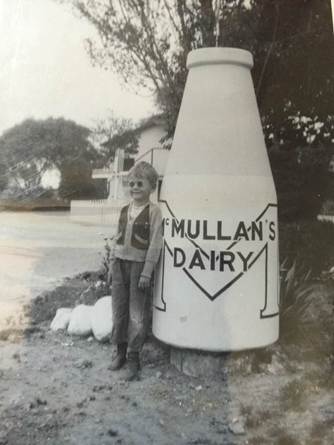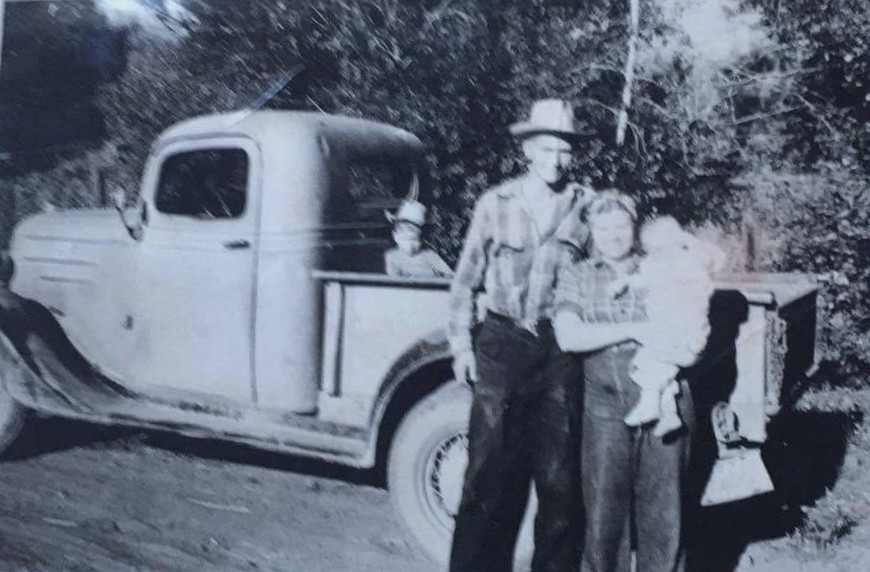
A new family moved onto the old Wheelock place at the head of our valley. Les and Marie Sager had four children. Rusty was a freckled-faced kid two years older than me. He was the baby of the family. He had two teenage sisters and a grown older brother that we did not see much of. Rusty and I soon became friends. In my memory, that summer seems to mark the end of my carefree days. I must have been nine that year.
That was the summer the three of us (Rusty, Chip, and I) built our own model farm. Early each day, after we finished our chores, we loaded our Radio Flyer wagon with tools and pulled it down to the lower pasture where the canyon narrowed, and the brush grew thick. There, we would hack and dig until we had a series of paths through the thick undergrowth we called our ranch. It mostly existed in our own minds, but such is the magic of youthful imagination. We built lean-tos for our house and barn. We built a corral of the brush we slashed to hold our imaginary animals. We cleared sections for what we called fields of pasture, hay, and grain. As we finished each project, we would think up another and launch it. Sometime in late summer, we ran out of ideas for new projects. We declared the job done; we could now relax and enjoy it. I still remember the sinking feeling that reality brought on for me. Enjoy what? The fun was in the building. The rest was just boredom. My carefree days had ended. It was time to take on real tasks.
Summer passed, and school started once again. The Sager kids joined Chip and me on our daily hikes to the bus and back. The company made the trips more festive than when it was just Chip and me. The girls wore colorful dresses, and we all passed the time laughing and playing through our half-hour jaunts. Then winter set in.
As the snow piled up and the days grew short, our daily hikes grew less festive. We were now all bundled up with heavy coats, stocking caps, mittens, and galoshes. We trudged through the dusky light with our heads down, muttering to ourselves each time we slipped on the icy ground. Our homes at night were dimly lit by kerosene lamps and warmed by wood stoves that needed constant feeding. This must have come as a surprise to Marie Sager, who had moved from the much milder climate of southeastern Idaho. She soon packed up and moved to town with the girls. Now it was just Rusty, Chip, and me making the two-mile hike. But without the harping and complaining of our teenage female companions. We were relieved.
Les Sager had a big chestnut gelding which he both saddled and worked in harness. We had Tommy. Sometime during that year, Dad arranged with the neighbor who lived near our bus stop to let us stable our horses in his barn during the school day. After that, until I grew big enough to drive, Tommy carried Chip and me to the bus and back each school day. Rusty rode with us on the big chestnut. Our school transportation problem was solved.
One autumn day, two years later, when I was in sixth grade, Rusty, Chip, and I rode home from school as usual. It was October, and the ground began freezing at night. About halfway home, Rusty announced he wouldn’t be going with us the next day. When I asked why, he said that Bert Huff, a neighboring rancher, had asked him to help move his cattle to the railroad pens at Robinette.
When the mines at the upper end of Hells Canyon were in operation, the Oregon Short Line Railroad ran from Huntington along the Snake River to Homestead. When mining ended in the 1930s, they tore up the rails below Robinette, and Robinette became the railhead. Some of the ranchers in Pine Valley still drove cattle to Robinette to ship by rail instead of trucking them.
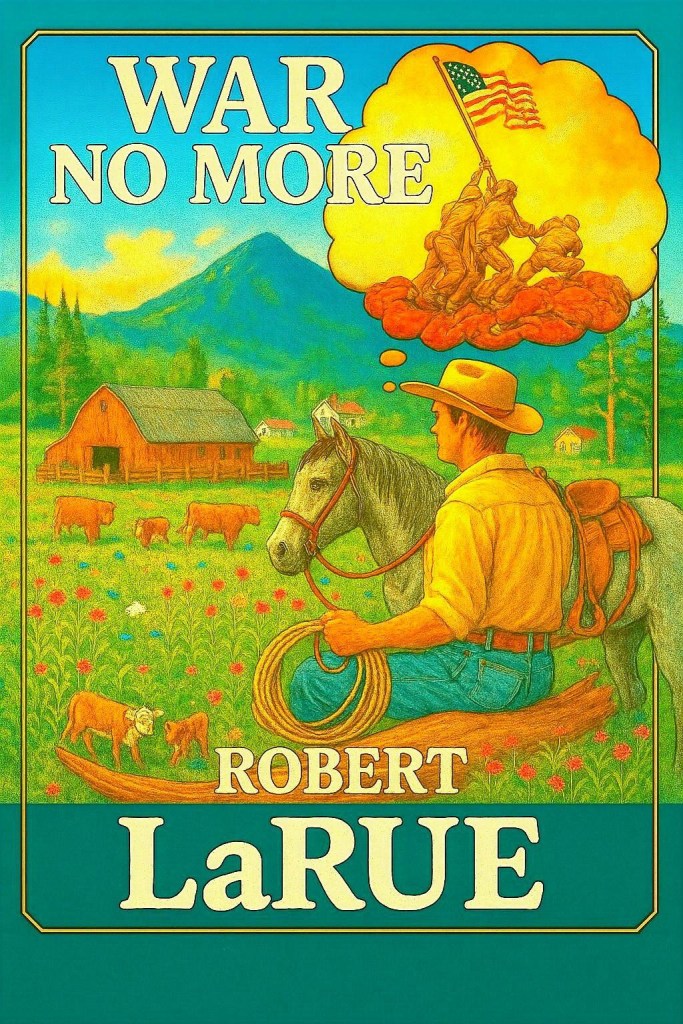
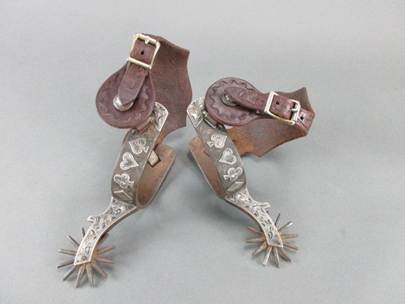
A set of silver-mounted Garcia spurs that Dad picked up at an estate auction and gave me was one of my proudest possessions. When Rusty asked to borrow them for the cattle drive, I felt a pang of jealousy that he’d been invited instead of me, but I couldn’t say no. When we got home, I took off the spurs and reluctantly handed them over to him.
Word traveled fast in our little valley. It shocked the whole community the next day to learn that young Rusty Sager was dead. His horse slipped and fell on a frozen roadway and got back up and ran. Rusty’s boot hung up in the stirrup, and he was dragged to death. When they brought my spurs and his saddle home, I could see the rowel marks dug into the seat. When the horse got up, Rusty must have been slung over the saddle, one of my spurs digging into the seat and his toe in the stirrup. He did not have cowboy boots. His wide-toed work boots didn’t come free of the stirrup. His head must have bounced off the frozen ground until someone caught the runaway horse.
They had an open-casket funeral at the Christian church a few days later. You could still see the abrasions under the makeup on his pale, freckled face. That image has never left me. If only I had refused to loan him the spurs.