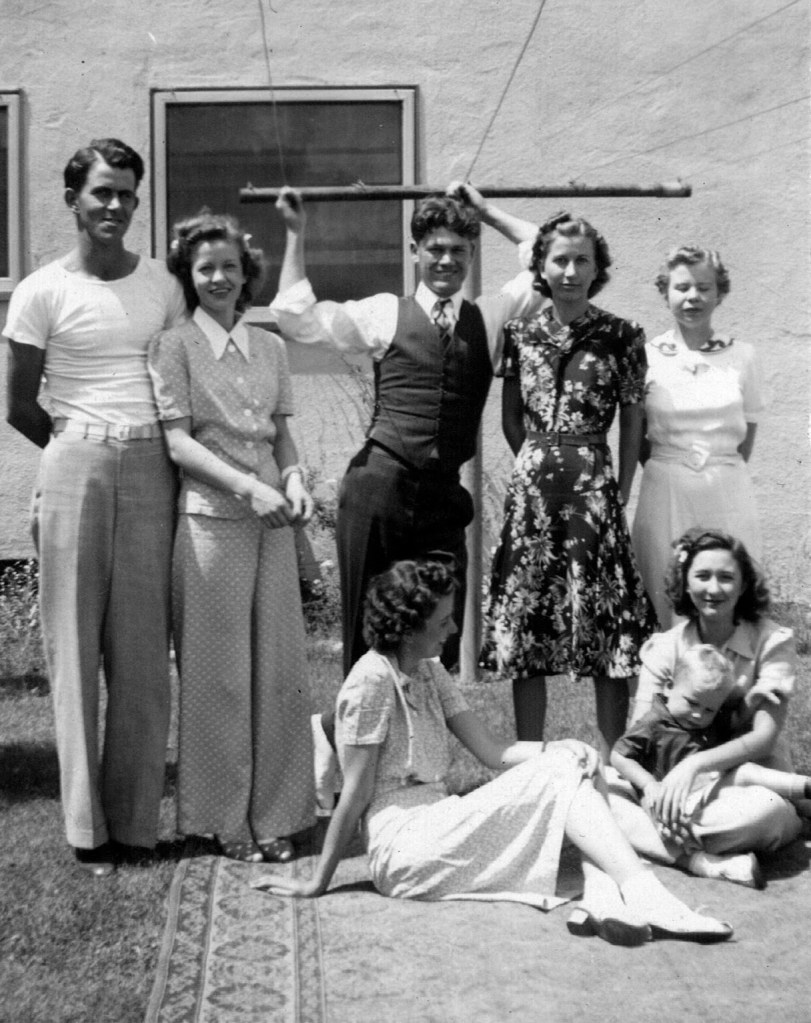
Standing L to R: Uncle Len, Aunt Lee, Uncle Joe, Aunt Fran, My Mom Dee. Seated L to R: Aunt Sue, Aunt Rae, Me
As World War II wore on, life on the home front became increasingly chaotic. Everything was in short supply. Ration stamps came into being. The “black market” raised its ugly head. Outside forces were taking over people’s lives. Unwelcome regimentation was extending from the military down into the civilian population.
The magician we call memory has many tricks up his sleeve. Trivial things often stand out ahead of major events. His sleight of hand hides some experiences and makes others clear. Perhaps we choose what we remember; perhaps what we remember chooses us.
As a firstborn son and grandson, love and security surrounded me. A doting grandmother watched over me while my mom went to business school. Three aunts, ages 17, 19, and 21, the year I was born, spoiled me. My world was safe.
I remember bits and pieces. Aunt Sue’s idea of babysitting was to strap me in the front seat of a Piper Cub and fly around Southern California as she built up flight hours. She let me take hold of the stick and bank and turn and climb and dive. At least I thought I was in control. I loved it. Aunt Fran had married, and her father-in-law lived with them. He had a handcart that he pushed around the neighborhood, selling fruit and vegetables door to door. I delighted in tagging along as his “helper.” Aunt Rae was busy with nursing school, but always had time for a hug and a kiss for Bobby.
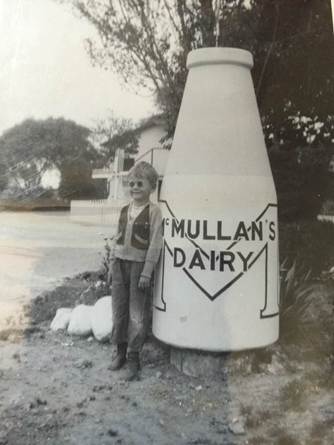
My memory of the attack on Pearl Harbor and our entry into the war does not stand out. Maybe my parents shielded me from the details. Sometime during those early years, we moved out from the town of Baldwin Park to the foreman’s house on McMullan’s Dairy. Scary things like the blackout sirens and the disappearance of the Japanese people next door stand out in my memory. Even so, the daily routines of the dairy kept me occupied and maintained my sense of security.
In 1942, kindergarten caught up with me. I reveled in it. My grandfather was the Baldwin Park School Superintendent. If I received any celebrity or favoritism from that fact, I was unaware of it. I fell in love with Miss Rice, my teacher. At the end of the school year, our parting was heart-wrenching.
Even so, my sense of bliss was not being shared by the world at large. The world was at war. Lives everywhere were in a state of flux. Governments were intruding on people’s lives and becoming more and more controlling. My world was about to come apart.
When war broke out, my dad tried to enlist. He was deferred because he worked on a dairy farm and had two children. Three of his siblings did join up. Uncle Len joined the Navy and completed Officer Candidate School. Aunt Sue became a Women’s Army Service Pilot. Aunt Rae became a Navy Nurse. Dad and Aunt Fran stayed home.
In 1943, an event occurred that remains a mystery to me. But it changed my life forever. For reasons that were never made completely clear, we were suddenly uprooted and moved from Baldwin Park, 500 miles away, to Chico, California. It had something to do with the draft board and someone wanting Dad’s deferment. Whatever the reason, Dad was transferred from McMullan’s Dairy to a dairy on a large farming operation in the Sacramento Valley.
The move was traumatic for the whole family. My parents were none too happy. We moved from a cozy bungalow on a showcase dairy to a shack in a row of farm workers’ quarters. Our new home could have been right out of John Steinbeck’s novel, “The Grapes of Wrath.” Dad was demoted from Dairy Foreman to common milker. I was torn away from everything I had known for the first six years of my life.
I started first grade in strange surroundings, knowing no one, afraid, and lonely. War on the home front had taken its toll. Miss Rice and my paths would never cross again.
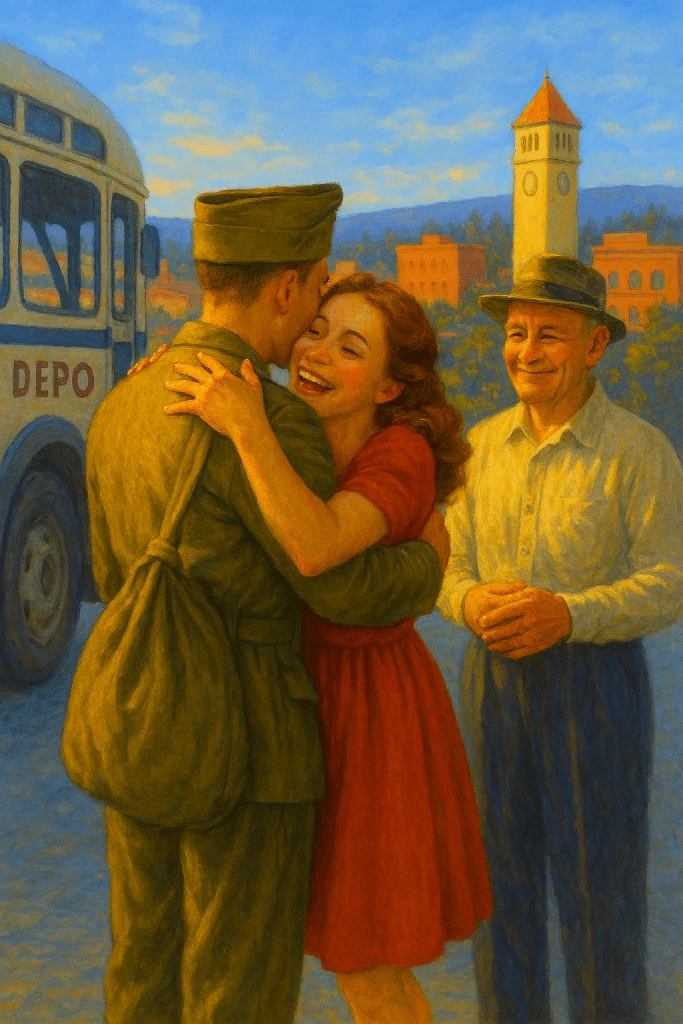
Paul watched through the windshield as the bus descended Sunset Hill and the buildings of Spokane came into view. Late afternoon summer solstice sunshine bathed the scene. They pulled into the depot, and he stepped down into the arms of his waiting sister. The two hugged unashamedly, something they had not done since they were children. Paul spotted his father over his sister’s shoulder. The two men shook hands around the clinging girl. “You’re looking mighty fine there, soldier,” Sam Harper beamed with uncommon emotion.
“Thanks, Dad. You’re looking pretty fit yourself. Here, here, Sis, easy does it. People will talk,” Paul said with a grin as he pried Barbara Harper’s arms from around his neck.
“I don’t care if they do. I’m just happy you’re home alive and safe.” Barbara gave him a big kiss, leaving red lipstick marks on his cheek as she reluctantly let go.
Paul gathered his gear from the baggage handler and shouldered his duffel bag. Sam grabbed Paul’s ditty bag and led the way across the parking lot to a shiny new Ford sedan parked off by itself. He opened the trunk and set the ditty bag on one side. Paul dumped his duffel bag next to it. “Nice car, Dad,” he exclaimed.
“Yeah, it’s brand new. We just got it about a month ago. Willie put us on the waiting list a while back, and our name finally bubbled up to the top, I guess. It drives real nice. I parked it away from the other cars so it won’t get dented. She’s been a long time coming. Here, you give her a test drive, see what you think.” Sam proffered a key ring to his son.
Paul pushed the hand holding the keys aside. “Nah, you drive. I haven’t had much practice lately. Wouldn’t want to wreck your new ride.”
Sam pressed the keys into Paul’s extended hand and used his other hand to close it around them. He held his son’s fist in both his work-hardened hands and looked straight into his eyes. “Welcome home, Son,” he said evenly. He broke the spell with a warm Sam Harper smile and released the hand. “Now this is your Old Man speaking, and if I say you drive, war hero or not, you’ll by God drive. Now get in there and take us home before your Ma has a conniption fit from waiting.”
“Okay, okay,” Paul relented. He opened the driver’s door and crawled behind the steering wheel. His sister took the back seat, and his father took the passenger side. After a moment of orientation, Paul inserted the key and stepped on the starter. The V-Eight engine roared to life, idled back, and purred contentedly. He stepped on the clutch, shifted into low, and eased out of the parking lot.
Neither Paul nor his passengers were surprised at how he threaded through downtown traffic onto Trent Avenue. Shortly after passing Millwood, his father waved his arm out the window at the large industrial complex that had grown up on the south side of the highway. “There she is, the old salt mine,” he announced. “It was just getting started when you left for the war. Look at her now.”
“Mom wrote and said that you’d went to work at Trentwood. I didn’t know what she meant by that. I never knew there was anything around Trentwood worth working for. What’s that all about?” Paul asked.
“Well, it’s kind of a long story, but here’s the shorter version. You remember that when you left in ‘42, I was still working on the Grand Coulee Dam. Only problem was that the project was finishing up, and work was getting pretty scarce. About that time, the government decided to build an aluminum plant over where you see it now. I hired on and worked construction there all the time the plant was going up. Then, when it went into operation, I got on with Alcoa and have been working there ever since. It’s been real nice working close to home and not having to chase construction jobs from here to hell and gone,” Sam explained.
“Yeah, but I hear that they’re going to shut the whole thing down now that the war is over,” Barbara added from the back seat.
“That’s the rumor. But there’s a new rumor going around the plant these days. It seems that Henry Kaiser might be about to take over and keep it running. If that happens, I should be able to stay on. I had a good enough record with old Henry J over at the Grand Coulee,” Sam continued.
“Yes, but Dad, what are they going to do with all of that aluminum with no war going on?” Barbara asked.
“That I don’t know. But I’ll tell you for sure, if there’s anybody around who can figure it out, it’d sure as hell be Henry J. Everything that man touches turns to gold,” Sam concluded.
They had reached the side road that led to the Harper place in Otis Orchards. Paul slowed and swung the car off the pavement onto the country lane he had known since childhood. The sound of gravel crunching under the car’s tires awakened a forgotten memory. Afternoon sunshine glistened off fresh leaves in trees lining the lane. Green grass filled the ditches alongside the road. Cattle, sheep, and horses grazed contentedly in pastures lush with spring growth. A farmer waved from the seat of a mowing machine drawn by a team of thick-bodied draft horses. The smell of new-mown hay filled the air. A brown Jersey cow stood mooing at a barn door, waiting for her afternoon milking. Paul felt an eerie sense of de ja vu. The sights, smells, and sounds surrounding him were just as he had left them four years and an eternity of experiences before. Nothing had changed. He was home at last.
Sam and Barbara remained silent as they watched Paul drink it all in. An almost magic spell hung over the shiny new Ford as it turned into the lane leading up to the Harper family home. Two-spotted Pointers rushed toward the car, their undocked tails wagging high in the air. Martha Harper stood at the bottom of the steps leading into the house. She clutched the railing tightly, resisting the urge to follow the dogs. As soon as the car stopped, she wrenched the car door open and gathered her son hungrily in her arms. She was crying, laughing, and smothering him with kisses all at the same time. Paul did not resist but hugged her tightly in return. He was home, safe at last.
Martha regained her composure and backed out of the car. She wiped her eyes with the corner of her apron as she dragged Paul from the car with her other hand. “Come on, stand up. Let me get a good look at you,” she urged.
Paul crawled out from under the steering wheel and stood. “My, how handsome you are in your uniform. Stay right there. I’m going to get a picture,” Martha turned and ran up the stairs into the house.
“She better make it quick, because this uniform is coming off for good in about two minutes,” Paul kneeled and roughed the hair of the bouncing dogs.
Martha reappeared, Kodak Brownie camera in hand. She snapped a picture of Paul standing next to the new car, then one of Paul with his dad and his sister. She handed the camera to Barbara, who dutifully took pictures of Paul with his mother and Paul with both parents.
With the picture-taking complete, Sam opened the car trunk, and the two men retrieved Paul’s gear. Martha led the way into the house. The aroma of frying chicken greeted Paul as he dumped his duffel bag in the foyer and roamed back into his favorite room—the kitchen. “Of all the things I’ve missed, I reckon this is what I’ve missed the most,” he announced.
“What’s that?” his mother questioned from the doorway.
“This,” he said as he lifted the lid from the frying pan warming on the stove. He grabbed a drumstick and took a big bite. “Um, um good,” he closed his eyes and sighed.
Sam walked across the room to a sparkling white refrigerator standing where the old brown icebox had stood when Paul left home. “How about a beer?” he asked as he opened the door.
“Sounds good to me,” Paul responded, followed by Martha’s “Me too, please,” and Barbara’s “Me three, let’s celebrate.”
Sam pulled four Olympia stubby bottles from the refrigerator and placed them on the counter. He lifted an opener from its nail above the counter and pried the cap from each bottle. He handed the bottles around and lifted his own. “Here’s to family,” he announced. They all clinked their bottles, took a sip, and sat at the kitchen table.
Sam pulled a pack of Camels out of his shirt pocket and lit up. Paul followed suit with Lucky Strikes. Barbara reached over, snatched the cigarette pack out of Paul’s hand, extracted a cigarette, and held it up between two fingers. Paul obediently lit it for her. Martha frowned at her daughter’s smoking but said nothing.
Paul took a long pull from his beer. “Um, boy, that’s good and cold. You got a new refrigerator there, I see. New car, new refrigerator; what else is new around here?”
“Not a whole lot. You couldn’t buy much of anything, even if you had the money during the war. If it wasn’t rationed, it just wasn’t available. Even now, you have to get on a list for just about anything you want. Your Mama’s got a new electric stove coming any day now. The only thing is, it ain’t going to do her much good unless we can get an electrician out here to put in the wiring for it. They say it takes two-twenty to run a stove, and we only got one-ten. Problem is that everybody and his brother wants to do the same thing at the same time. The electric shops don’t have enough people to keep up, and can’t get enough parts to do the job, even if they have the people. It’s a hell of a mess, but I reckon it’ll all even out when we all run out of war money. Then maybe we can get back to normal like the good old days when the Depression was on, and nobody had any money,” Sam stated with a hollow laugh.
“Well, anyway, things look a lot more prosperous around here than I remember. The job over at Trentwood must be treating you pretty good,” Paul observed.
“It’s hard and dirty work, but it’s steady, and the pay is good. The money was good enough on the Grand Coulee Dam, but it was tough living over there in a cockroach-infested barracks and only getting home weekends if at all. It’s nice working close to home. That’s why I hope Kaiser can come in and keep things going,” Sam replied.
“How about you, Sis, what are you up to these days?” Paul asked.
“Oh, I finally got through business school, and Uncle Johnny put me to work in his office. It’s kind of boring posting journals and ledgers all day long, but it sure beats my old job waiting tables down at the diner. At least I don’t have to put up with a bunch of idiots telling dumb jokes and trying to play grab ass all the time,” Barbara answered. “How about you? What are your plans, Brother? I hear you guys can go back to school on the GI Bill if you want to. Are you thinking of something like that?”
“Hell, I don’t know. Right now, I just want to shed this monkey suit and get into some decent clothes. I do know that I’ve seen all the Army green I want to see for the rest of my life,” Paul said with a grin.
“Your room is all set just as you left it, only neater. Your clothes are in the closet and the dresser just like always. I hope everything still fits you,” Martha volunteered.
“It should. I gained weight going through boot camp before we went overseas. After that, though, real meals got to be kind of few and far between. Then there’s this damned malaria bug I keep fighting. I think I’m probably skinnier now than I was when I left,” Paul answered.
“We’ll work on fattening you up now that you’re home. Dinner will be ready whenever you are. By the way, Willie called earlier and wanted you to give him a call,” his mother responded.
“Okay, I’ll call him later. Funny thing, I met a guy on the bus coming over the hill today who knows Willie. The guy works down at Paulsen’s Photography,” Paul said as he rose to leave the room.
“That’s not surprising. Willie’s quite the popular man about town these days. Everybody knows Willie Womack,” Martha called out as Paul disappeared down the hall.
***
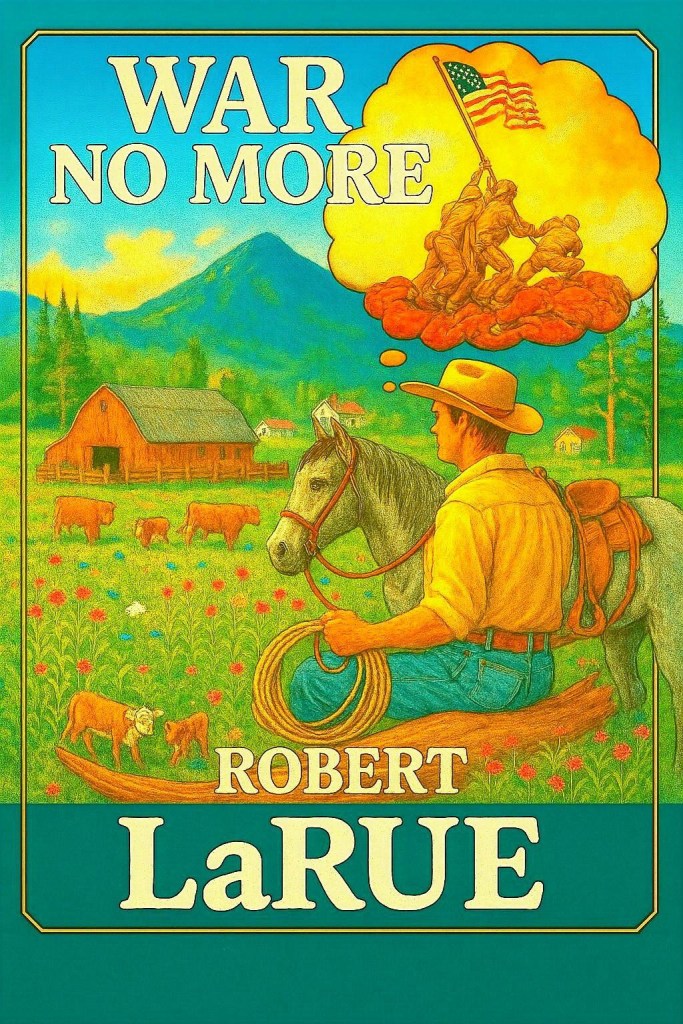
War No More is now available on Amazon: Free on Kindle Unlimited, $3.99 for the ebook, or $14.99 for the paperback. Click here to read a sample or order. https://a.co/d/0cZoVaS3
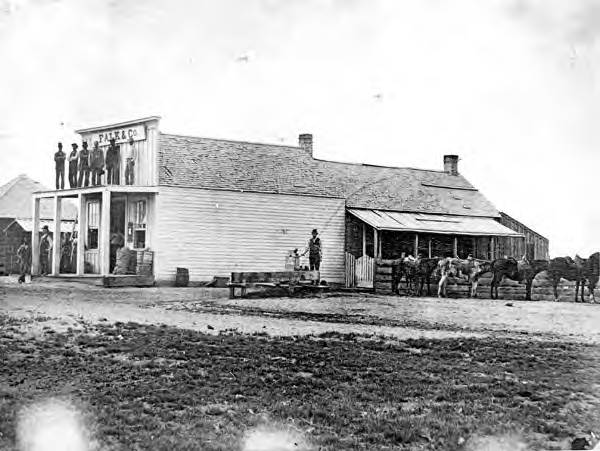
The Falk’s Store in Falk’s Store, circa 1892. Courtesy of the Idaho State Historical Society Digital Collection
“What are you doing here?” I asked the little group of people milling around my pasture.
“We’re looking for buried treasure,” the big fellow scanning the ground with a metal detector said with a laugh. He glanced around at his five or six cohorts for assurance.
“Why here?” I asked.
“You never know what you’ll find where an old trading post used to be,” he answered.
Perplexed, I asked, “What old trading post?”
“Why, the old Falk’s Store. Don’t you know?” he said.
I didn’t know, but I didn’t let on. New to the neighborhood, I didn’t want to seem unneighborly. “Well, okay, but please don’t leave a mess,” I admonished them and stalked back across the field to the house. That was my introduction to the fact that my new homestead held more than a passing historical significance. It was, in fact, the home of a vanished pioneer community. It was the site of Falk’s Store, Idaho.
In the fall of 1969, I took a job with Boise Cascade and moved my family (wife Kathy and sons Frank and Rob, ages 12 and 11) away from the urban madness of the 1960s San Francisco Bay Area to the relative sanity of Boise, Idaho. Boise still had a small-town feel and, to me, offered a much better lifestyle than San Jose, California. However, it was still a city, not a place where you could grow your food, raise livestock, and experience the freedom of a rural lifestyle. We set up housekeeping in a rented house in Boise and began searching for our piece of paradise.
Following many weekends of canvassing the countryside and looking at small acreages, we finally found the answer to our quest—sixty acres of irrigated pasture in the Payette Valley near the small farming town of New Plymouth. The location involved a 35-mile commute to my job in Boise. But after suffering commutes of similar distances on the crowded freeways of California, thirty-five miles of open country road presented no problem. We replaced the old ramshackle farmhouse that came with the property with a modern Boise Cascade Manufactured Home, replaced the outhouse with a modern septic system, hooked up the well and electricity, and moved in.
While an invasion by local amateur archaeologists was not exactly to my liking, it did pique my curiosity. I grew up in Eastern Oregon, and for as long as I could remember, the name Falk had been synonymous with quality merchandise. Falk Mercantile Company, headquartered in Boise, had stores scattered over most of Idaho and Eastern Oregon. To discover that I owned the site of the original Falk Store seemed peculiar.
Nathan Falk was born in Eggenhausen, Bavaria. He emigrated to New York City when he was fifteen, then took passage to San Francisco via the Isthmus of Panama. He joined his brother David in the frontier town of Boise in the spring of 1864.
The brothers opened a store they named Falk & Co. in the Payette Valley near the Placerville-Umatilla stage stop. The Falk Store post office soon followed, and the town of Falk grew up around it. By 1877, the town had developed into a thriving community, boasting two stores, a hotel, a saloon, a meat market, and a blacksmith shop. According to one account, “Everything that the pioneer family needed was carried in stock or could be ordered by stage from Boise. Customers came from as far as Malheur River in Oregon, Weiser River, Middle Valley, and Indian Valleys in Idaho.” In the 1870s, the gossip said that Falk’s store alone did an annual business of $60,000.
During the Nez Perce and Bannock Paiute wars and intermittent raids of the late 1870s, the locals erected a fort at the store. When Indians were spotted, and signal fires burned on the hills surrounding the valley, settlers would turn the cattle and hogs loose, hide the most valuable pieces of furniture in the sagebrush, and hightail it to the fort with all the women and children.
Even though the community continued to grow, Nathan Falk moved back to Boise and joined his brothers, David and Sigmund. They created the Falk Mercantile Company, which went on to dominate merchandising in Idaho and Eastern Oregon for more than a hundred years.
The coming of the railroad at the turn of the century marked the end of the stage stop at Falk Store. The town fell into decline even as other towns in the valley, Emmet, New Plymouth, and Payette, continued to flourish. On February 7, 1922, fire gutted the last general store at the settlement. The other buildings fell into disrepair and either burned or were torn down. When we moved there, the little clump of trees near the county road was all that remained—mute testimony to the temporary nature of man’s footprint on planet Earth.
As a farm family of the 1960s, we LaRues quickly adjusted to the rural lifestyle our new home had to offer. We stocked our place with a small herd of cattle and horses and raised chickens. The plot we fenced and had a neighbor plow for a garden somehow never reached fruition. But we did keep the pastures irrigated and even milked a few cows and shipped milk to the creamery in Payette. The boys were good athletes and matriculated into the New Plymouth school system without incident.
In the beginning, our neighbors viewed us with a degree of suspicion. I suppose seeing a guy going off to work in a business suit came as something of a surprise. But with time, we gained acceptance. I traded my sports car for a pickup truck and my Florsheim oxfords for a pair of Tony Lama boots. However, I could not shed the business suit, and the employees at the Farmers Feed & Seed in Emmet viewed me with some degree of amusement when I pulled up for a load of grain on my way home from work.
We lived in the Payette Valley for about four years and eventually sold out and bought a real working ranch near my parents’ place in North Central Oregon. When they say, “You can take the boy out of the country, but you can’t take the country out of the boy,” they may have been talking about me.
“Elgin, Elgin, come have a wee taste,” Mr. McMullen’s Scottish brogue rings out from his front porch. We climb the stairs, and I watch with the curiosity of a five-year-old as the two men share a glass of wine while discussing the status of the dairy and events of the day. I know my dad’s name is Eldon, and I wonder why Mr. McMullen always calls him Elgin.
We take our leave and walk on out toward the cow pasture. We pass McMullen’s walnut orchard. I listen curiously to men talking in Spanish as they tend the trees.
Dad opens the gate, and we follow the cattle down the lane to the holding pen outside the dairy barn.
The milkers take over and shout the cries of western herdsmen as they sort and move the milk strings into their respective stanchions.
Pete, the dairy operator, comes out of his house. He scoops me up, swings me around, and teases me in his Dutch-accented English. He sets me down, and he and my dad discuss the condition of the herd. When the cows are locked in their stanchions, Dad straps on his milking stool, sets his bucket under the first cow of his string, and the never-ending task of a dairy farm begins anew. Pete walks me back to our house and hands me over to my mom.
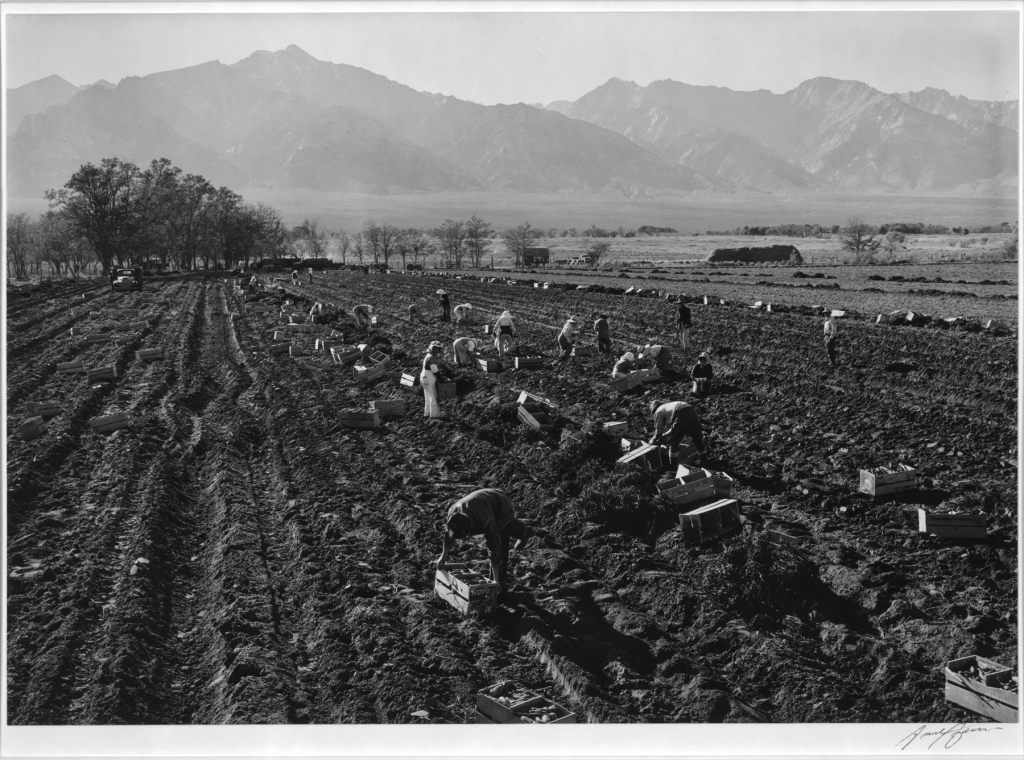
Mom is listening to the Hit Parade on the radio. She sends me out to play while she tends to her household chores. I approach the backyard fence and listen to the singsong voices of the orient coming from the truck farm next door. The people speaking are bent over tending their rows of plants. A pretty little girl about my age leaves the group and crosses the field toward me. She sits down across the fence from me, and we play in the dirt.
My parents have tried to explain that these people are Japanese and somehow different. I don’t understand. I can see that she is darker than Mr. McMullen’s redheaded granddaughter, Sharon. Her eyes are different. But she is just as fun to play with. We play with few words, but words are not needed. Still, the fence separates us. She does not come to my house, and I don’t go to hers.
The afternoon wears on. A woman comes and leads the girl away. The woman smiles and says something that I don’t understand. I watch as they walk toward their house. The girl turns, and her hand comes up in a small wave. I wave back.
Dad comes home from the afternoon milking. Mom sets out dinner, and we eat. After dinner, Dad and I go to the living room while Mom cleans up the kitchen and nurses my baby brother. Dad turns on the radio.
The smooth voice of Lowell Thomas comes over the airways. He tells us the news of the day. Most of what he has to say is about the war. The war is not news to me. Like the endless routine of the dairy, it has always been there. It is a part of our lives. We don’t feel it; it is far away. But we hear about it constantly. It is like the sound of the ocean when we camp on Laguna Beach. It rumbles in the background without end.
It is an afternoon like any other. Pete hands me off to Mother. I go out the back door to the yard. It is strangely quiet. I can hear the strains of the McGuire Sisters’ “Don’t Sit Under the Apple Tree” playing from inside the house. But no singsong voices come from the field next door. It is deserted. The plants still stand, green and growing. But no one is taking care of them. The people are gone. I sit by the fence for a while, alone. A death-like silence wraps around me.
I go back into the house and ask my mom where the people have gone. The Army took them away, she tells me. She tries to explain, but her words are not enough. Not enough to quell the fear welling up inside me. The first chink in my armor of innocence is gone.
December 7, 1941, may have been “A date which will live in infamy” for President Roosevelt, but for me, a four-year-old, it symbolized the beginning of all kinds of strange and scary events. The wailing sirens and darkness of blackout drills stand out in my mind.
We lived on a dairy in Baldwin Park, California. Baldwin Park is located only about twenty miles from downtown Los Angeles. In the days before supermarkets, it was not uncommon for dairies to be located near population centers. On-site retail marketing was a common practice. After the attack on Pearl Harbor, what had been considered a good location for dairy product retailing also came to be considered a prime target for a Japanese attack.
Before radar bomb sights, bombardiers relied on what they could see on the ground to figure out where to release their devastation. A primary means of civil defense against a night attack was the blackout. If there was no light on the ground, the attackers could not identify their targets. The sound of blackout sirens in the night became a fact of life for us.
Rationing also became a fact of life. Living on a dairy, we had plenty of milk, cheese, and butter, but meat was rationed even for us. To supplement our diet, Dad built some hutches and raised rabbits. He shared the fryers with the dairy’s owners, a Dutch family named Kohn, in exchange for alfalfa and grain. Mrs. Kohn also helped with caring for the animals.
One dark night, I was out by the hutches helping Mrs. Kohn when the sirens wailed, and the lights went out. She had come prepared for such an event with a flashlight. She handed me the flashlight to hold while she finished the chores. Like any kid of four, I proceeded to flash the light around and point it at the sky. Sweet, gentle Mrs. Kohn came unglued. She grabbed the offending torch from my little hands and explained to me in no uncertain terms that I could have caused us to be bombed. I suppose she was somewhat oversensitive about bombing since she still had family in Holland who had recently experienced the Blitzkrieg. But she scared the heck out of me. I quickly switched from being a carefree child piercing the night sky with a harmless flashlight to being a magnet for falling explosives.
To this day, I feel a stab of fright any time I allow a flashlight’s beam to wander above the horizon at night!
The sound of forty engines thunders off canyon walls as the serpentine procession of hogs and choppers roars through the twists and turns of the Feather River Highway. Like a swarm of locusts, they pass through sleepy towns and villages with Gold Rush names like Belden, Twain, Keddie, Quincey, Cromberg, and Blairsden. Near the river’s source at the top of the Sierras, an advance scout parks his bike in the dusty lot of the Portola Coffee Shop. He leans it on its kickstand, sticks his head in the door, and asks. “Can you handle thirty or forty hungry bikers?”
“Bring ‘em on,” Margaret, the shop’s owner, answers, standing alongside the grill.
“They’ll be along in a bit.” He moves his bike out front near the highway to signal that the place is cool.
Looking through the front window, a customer observes the Death’s Head patch on the back of the biker’s leather vest. “You got a bunch of Hells Angels on the way,” he announces.
The breakfast crowd grumbles about outlaw biker gangs invading their territory. The scout comes back in and takes over an empty booth. The crowd scatters. Their territory or not, they want nothing to do with the Hells Angels Motorcycle Club.
“Hell’s Angels” was a popular moniker for bomber squadrons in World Wars I and II, as well as the title of a 1930 Howard Hughes film about the Royal Flying Corps. Ralph “Sonny” Barger and Don “Boots” Reeves adopted the name when they founded the Oakland, California-based motorcycle club in 1957.
Sonny Barger, born in 1938, grew up in Oakland, California. His mother left him with his alcoholic father and an older sister when he was four months old. Growing up, he was suspended from school several times for assaulting teachers. His reputation for starting schoolyard fights was legendary. He dropped out of school at age sixteen and enlisted in the Army. He was discharged 14 months later when it was discovered that he had forged his birth certificate to join.
Barger joined his first motorcycle club, the Oakland Panthers, in 1956. After that club disbanded, he started riding with a group of bikers that included Boots Reeves. Reeves wore a patch with a small skull wearing an aviator cap set within a set of wings. The “Death’s Head” became the Oakland Hells Angels logo. A patch with the logo adorned the back of every member’s vest.
The founders were unaware at the time that there were several other, loosely affiliated, California clubs using the Hells Angels name. With Barger as president, the Oakland Hells Angels traveled to Southern California, met with the other Hells Angels chapters, divided territory, and formed club bylaws.
The advance scout in the Portola Coffee Shop on that late summer morning wears the patch of the Oakland Hells Angels Chapter.
A widower with two late teenage sons in the late seventies, I live in Portola, California, and operate a computer time-sharing service in nearby Reno, Nevada. Margaret, a single mom with a late teenage son and daughter, owns the Portola Coffee Shop. We recently started dating, and I hang out there, sometimes helping in a pinch. A diner full of hungry bikers is a pinch. I ask Margaret what I can do to help. She hands me a spatula and says, “Cook.”
My prior exposure to motorcycle gangs consists of watching Marlon Brando and Lee Marvin take over a town and terrorize it in the movie “The Wild One.” Even so, the name “Hells Angels Motorcycle Club” generates a picture of criminality and violence in my mind. I fear the worst.
We prep the kitchen as well as we can on such short notice. True to the advance scout’s warning, the empty parking lot soon fills with rows of neatly parked motorcycles. The riders cram into our dining room.
They come in all shapes and sizes—unkempt men, most with long hair and beards, some with hard-looking women at their sides, all wearing leather or denim vests with the Death’s Head patch on their backs—and they come hungry.
These renegades on two wheels are not picky about their food. They just want lots of it. Double biscuits and gravy, double hashbrowns, double stacks, four eggs to an order, both ham and bacon, four egg omelets—we heap their plates high. Thanks to Margaret’s devotion to keeping her shelves stocked, we don’t run out of anything.
It takes about two hours to get everyone served, but they are patient and polite. I am exhausted, as is the rest of the crew, when the last plate is delivered. But Margaret is happy. She charges them well for all the extras, and they pay without complaining. She is happy, so I am happy. And the fears I had harbored seem unjustified.
As the crowd thins and motorcycles roar out of the parking lot on the way to the gaming tables of Nevada, a surprisingly quiet and clean-cut man approaches me. He thanks me for the hospitality, hands me his business card, and says, “If any of these guys ever give you any trouble, just call this number. It’ll be taken care of.”
I thank him and put the card in my shirt pocket without examining it. He leaves, and the rest of the gang follows him out the door.
Later, when the locals returned to see how we fared, I showed the card to a customer I know who rides street bikes and asked him what it meant. His eyes pop open in surprise. “Why, that’s Sonny Barger’s card. He’s the head honcho of all the Hells Angels.”
You would think I just met the world’s greatest celebrity.