The end of World War II in 1945 brought many changes to the home front. Germany surrendered in May. In August, the world’s first atomic bombs were dropped on Hiroshima and Nagasaki, and Japan gave up. Living in the farmlands of the Sacramento Valley, I do not remember a lot about the celebrations that took place. I do remember that shortly thereafter, we were loaded up and off on a new adventure.
Migration from farm to city marked the American experience from the beginning of the Industrial Age. That movement accelerated during WWII. Although he would not have thought of it in exactly those terms, my dad determined to do the exact opposite. He decided to get as far away from city life as he could, own his own piece of land, and farm full-time. With the war over and the government’s control of his movements ended, Dad set about to fulfill his dream.
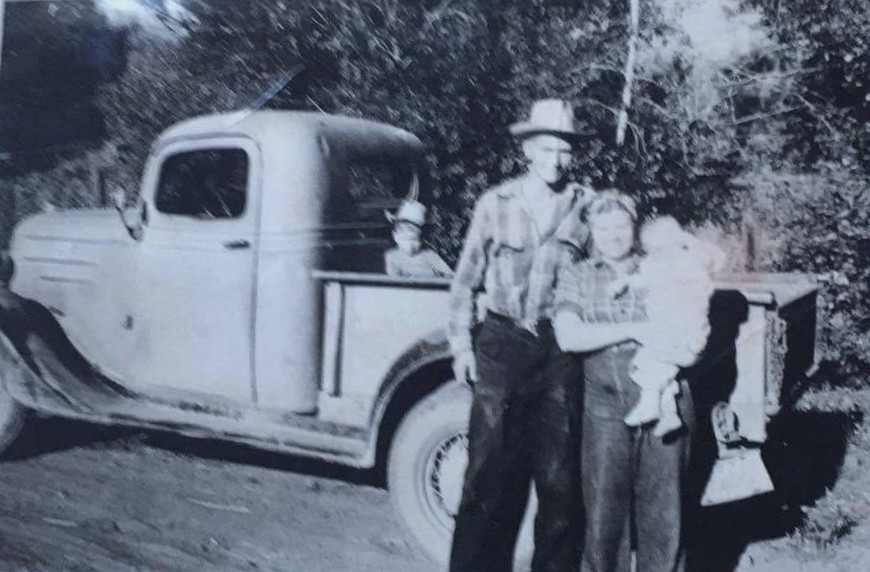
In short order, he sold our little farm in Chico, California, and quit his job at the air base. He loaded our belongings into the back of a 1937 Chevrolet pickup truck, loaded Mom and the three of us kids into the cab, and headed north. The young hobo of the depression had traded his knapsack in for a truckload of family and possessions. But he was determined to live by his own rules nonetheless.
Dad drove, Mom sat on the right side holding baby sister Deanne. I sat in the middle, straddling the gear shift lever. Little brother Wes variously stood and lay down at Mom’s feet. Our route over the Sierras remains unknown to me. I do remember stopping at a wayside, perhaps around Lake Almanor, for lunch. A cool breeze wafted through towering Ponderosa Pines, a welcome relief from the summer heat of the Sacramento Valley. The scent of the pines, combined with the delicious pan-fried pheasant Aunt Marie had packed in our lunch hamper, remains with me to this day.
We pressed on to Alturas, a small ranching center in the northeast corner of California. We arrived in the late afternoon. The town was in a festive mood with banners stretched across the main street announcing its annual fair and rodeo. Cowboys and cowgirls, afoot and horseback, lined the streets and sidewalks. We found this all very exciting until we discovered that there was no lodging available. The war was over, and it was time to celebrate. People coming out of the hills and valleys surrounding the town had taken every room available.
Lakeview, Oregon, is about 55 miles north of Alturas. It was dark by the time we got there. It too was full up with the overflow crowd from its neighbor.
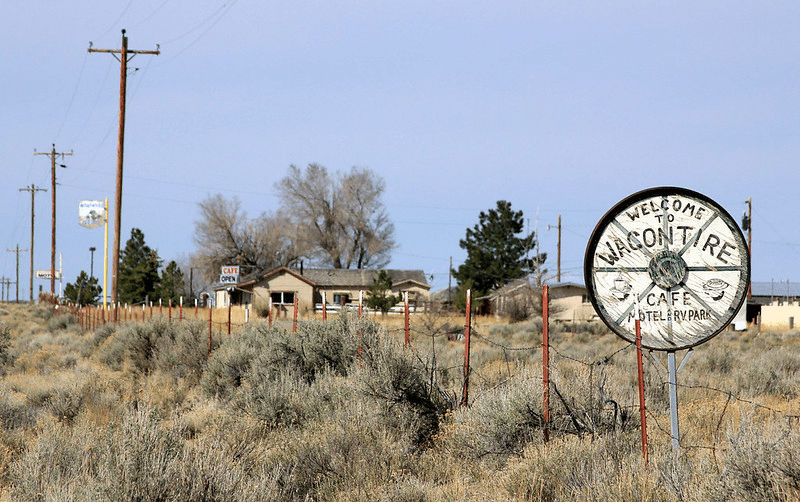
With the aid of a flashlight, Dad found a dot on the map about 85 miles north of Lakeview called Wagontire. We passed through the dark, starry night until a small sign and darkened buildings announced our destination. A gas pump, a café, and living quarters for the owners made up the entire town. A lighted window in the living quarters indicated that someone was still awake. Dad knocked on the door with the intention of asking if we could camp in their parking lot.
Perhaps it was learned behavior from his hobo days, or perhaps it was just in his makeup. My dad always exuded an air of quiet confidence and honesty. I like to think it was the latter. Anyway, he explained our plight to the man of the house. The man looked us over, invited us in, and put us up for the night. Who knows how often the Wagontire proprietors were called upon to tender such an act of charity along that lonely stretch of highway? I can only attest to this one event. And I have no way of knowing if any money changed hands. I am sure that we patronized their café before we departed.
That’s just the way things were done out in the country, on the home front, in 1945.
L to R 1937 Chev Pickup, Brother Wes, Dad, Mom, Sister Deanne
I don’t recall much about our move from the row of farm workers’ shacks, where Dad milked cows, to our own place. In my memory, it is as if one day we were there and the next we were at our new home.
Our new 20-acre homestead consisted of a house, a barn, a small nut orchard, and a good-sized plot of fertile Sacramento Valley row-crop land. The orchard consisted of almonds (or, as folks around Chico called them, ammonds) and walnuts. The cropland lay fallow. The house was much too small to accommodate two families. Grandma, Grandpa, and Jimmy needed a home of their own.
For Dad and Grandpa, building a house posed no problem. They were both good craftsmen. The problem arose when they tried to get their hands on framing lumber. Like everything else, lumber was in short supply. The war effort now devoured everything but life’s bare necessities. As happened all too often, they were put on a waiting list.
Once more, family came to the rescue. Dad’s uncle David and his family lived in Chico. Uncle David worked at a local sawmill. He knew how to cut through enough red tape to get the needed lumber delivered. Dad and Grandpa went to work.
The house went up rather quickly. I don’t think it was ever completely finished, but it was finished enough that Grandma reluctantly agreed to move in. At times, you just had to learn to make do on the home front.
In the meantime, Grandpa acquired an old horse and enough implements to start farming. Most folks during the war had small victory gardens. We soon had several acres of victory garden. Jimmy and I got our initiation into the meaning of hard work from that garden. At Grandpa’s direction, we learned to hoe around plants and nurture them into production. Lord help the offender who happened to uproot a watermelon seedling instead of a pigweed. Melons made up the main crop, but there were also beans, corn, tomatoes, and more. When each crop was ready, we picked and loaded it into Dad’s 1937 Chevrolet pickup truck and peddled it to stores around the valley. What we didn’t sell, Mom and Grandma canned. We were well fed.
When the nuts were ready in the orchard, we spread tarps on the ground under the trees. We shook the trees by pounding on the trunks with baseball bats padded with pieces of a rubber tire. The nuts fell to the ground, and we gathered them and put them in sacks. The almonds were easy to shake loose, the walnuts more difficult and required a lot of hand-picking on ladders. The whole family participated, even my brother Wes, who was three years my junior.
Dad continued working in the paint shop at the air base. He also continued with the ambulance and accident cleanup crew. In 1944, Chico Air Base switched from basic training to fighter pilot training in P-38 Lightnings. Crashes and deaths doubled from 14 crashes and 8 deaths during the two years of basic training to 35 crashes and 16 deaths during the 16 months of fighter pilot training. That’s more than 2 crashes a month. The ambulance and cleanup crew stayed busy. Dad tried not to show it, but even I could tell that he was under a great deal of stress.
Summers are hot in the Sacramento Valley. Air conditioning was not widely available in the early 1940s. Makeshift evaporative coolers consisting of wet burlap sacks hung from open window frames with fans in front were not very effective. The only real escape from the heat was finding cool water. There was a public swimming pool in Chico, but my parents were afraid of public pools. They believed them to be a likely place to contract the crippling disease polio. So we did not swim there. We did occasionally go down to the Sacramento River to fish, swim, and picnic. We were enjoying an outing with Dad’s friend from work, Les Robbins, and family, when I decided to take an unsupervised dip. I waded out from shore by myself with confidence. Suddenly, the current picked me up, and I bobbed downstream like a waterlogged cork. I remember looking up at a bluff, high above the river, and seeing my dad preparing to dive when I felt the welcome arms of Mrs. Robins envelope me. My movements were severely restricted following that incident.
Nineteen forty-three moved on into 1944. My sister Deanne was born in August. The war continued unabated. I started second grade in September. The world at war, farming the land, P 38’s from the base buzzing overhead, bickering with Uncle Jimmy, Dad shooting a rabid coyote lurking around our chicken coup, Grandpa trying to start his old car with a hand crank because batteries could not be had and his cussing at it and hitting it with the crank, talk that the war would never end; these things all seemed normal to me. As a seven-year-old, they were all I knew. I had no other frame of reference. As Harry Truman famously said, “The only thing new is the history we don’t know.” We of my generation knew no history yet. The canvas remained to be painted.
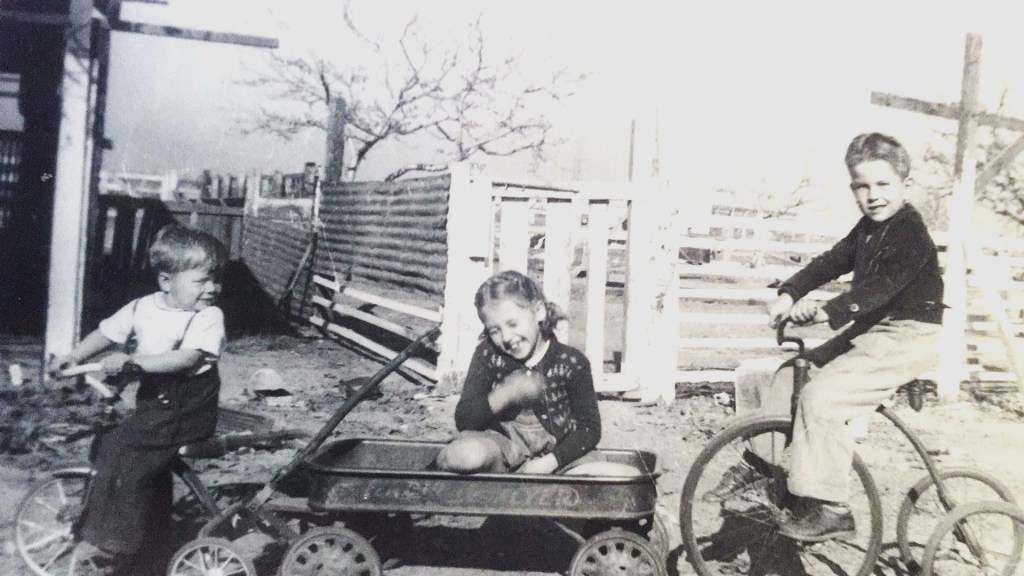
L to R: Brother Wes “Chip,” Neighbor Girl, and Yours Truly on the farming operation in Chico, California
Even as a six-year-old, I could sense the change in my parents. I understood my own anxiety. The move from Baldwin Park to Chico had toppled my entire world. But grownups were not supposed to have those feelings. I could only hope that our lives would somehow get back to normal.
I did not have long to wait. My dad was a very resourceful man. When the stock market crashed in 1929, he had just turned seventeen. He entered adulthood during very trying times. He was a product of the Great Depression.
His parents were schoolteachers. Thus, education was paramount in their lives. Dad tried to keep the peace in the family by remaining in school. But money was short, and he was of an independent nature. For the next seven years until he was 24, he alternated between academic pursuits at Northern Arizona State College in Flagstaff and Arizona State College in Tempe, and the “school of hard knocks,” riding the rails and living in hobo jungles throughout the United States. He learned at an early age to be “quick on his feet.” Survival required it.
The free life ended in 1936 when he married my mom. They were married on the first of June, shortly after Mom graduated from high school. I was born nine months later on March 24. Dad was now a family man.
Dad was up to the task. With the help of my grandparents, he bought a lot in Baldwin Park, California, and built a home for us. He went to work for McMullan’s Dairy milking cows. He worked his way up to foreman, and we moved into the foreman’s quarters on the dairy. My mom helped in the little store where they sold the dairy products they produced. Despite the war, their life seemed secure.
Therefore, it came as a shock when the government suddenly transferred my dad away from the life they had built. The consequences of war had robbed them of their independence. Their secure life had suddenly evaporated. They were reduced to living in a farm worker’s shanty. Dad was back to starting over as a common hand on a large farming operation, milking cows. The war had taken control of their lives.
Ever the man of action, Dad set about righting things. Over the next few months, he turned our life back around. He met with the draft board, or whoever controlled such things, and managed to transfer from the dairy to Chico Army Air Field. He bought a twenty-acre farm and moved us into the old house that came with it. Our new home was far from luxurious, but it was far better than the farm worker’s quarters we moved from. My parents were happier. They were regaining control.
The move was like an answer to my prayers. I hated the school I was enrolled in. I felt like I had been dropped into an alien world without a friend in sight. The move came with a change in schools. Whereas the old school had seemed large and impersonal, the new school felt warm and welcoming. It was a rural two-room facility that had grades one through four in one room and grades five through eight in the other. The teachers and other students made me feel at home. I could walk to school from our house without taking a bus.
Chico Army Airfield, called “the base” in everyday conversation, was established in 1941 to train pilots. Dad worked in the paint shop. He also rode on or drove the ambulance whenever there was an accident. I can remember him coming home visibly shaken following some of those accidents. He detested that part of his job. But like almost every citizen at the time, he pitched in and did what he had to do to help win the war.
It soon became apparent that being on ambulance call, working full-time in the paint shop, and trying to farm all at the same time formed an impossible task. I don’t know how it worked, but apparently, when you worked for the Army during World War II, you didn’t just up and quit because you had something you’d rather be doing. As a consequence, my mom’s parents, along with my uncle Jim, who was about five years older than me, came out from Arizona to live with us. Grandpa Thompson was a hard-rock miner and a farmer. Dad continued to work at the base, and Grandpa took over the farm. Sometimes it took a family’s teamwork to survive on the home front.
Eldon LaRue had not forgotten his survival skills. He was still “quick on his feet.”
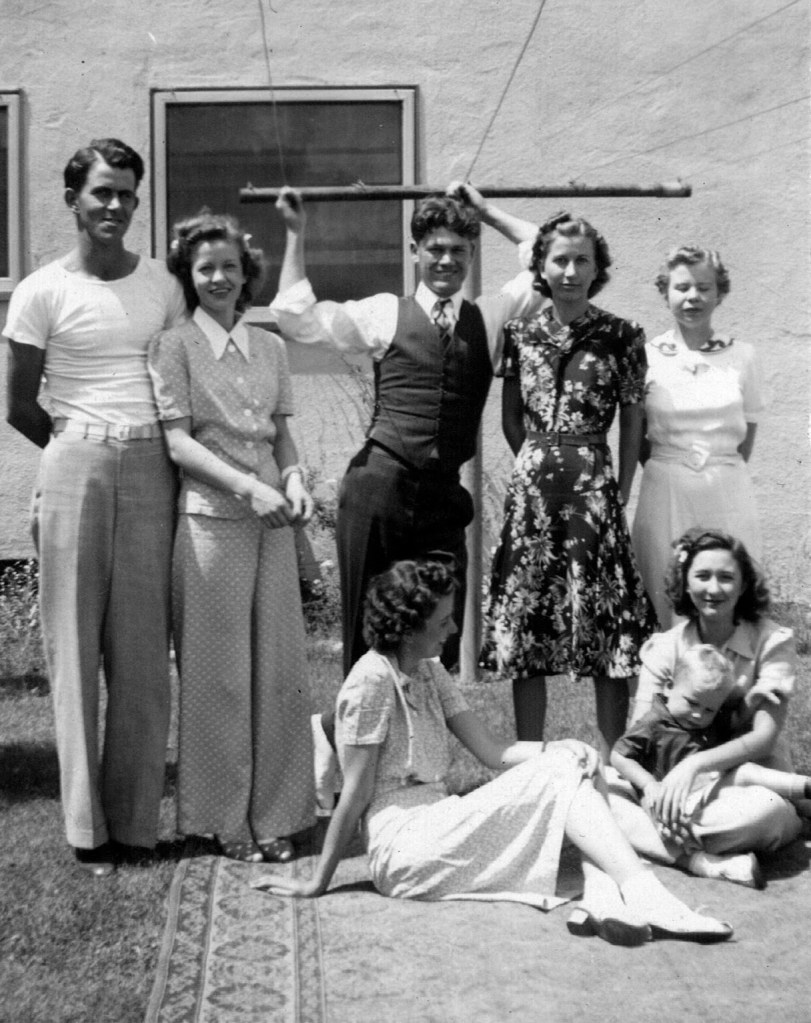
Standing L to R: Uncle Len, Aunt Lee, Uncle Joe, Aunt Fran, My Mom Dee. Seated L to R: Aunt Sue, Aunt Rae, Me
As World War II wore on, life on the home front became increasingly chaotic. Everything was in short supply. Ration stamps came into being. The “black market” raised its ugly head. Outside forces were taking over people’s lives. Unwelcome regimentation was extending from the military down into the civilian population.
The magician we call memory has many tricks up his sleeve. Trivial things often stand out ahead of major events. His sleight of hand hides some experiences and makes others clear. Perhaps we choose what we remember; perhaps what we remember chooses us.
As a firstborn son and grandson, love and security surrounded me. A doting grandmother watched over me while my mom went to business school. Three aunts, ages 17, 19, and 21, the year I was born, spoiled me. My world was safe.
I remember bits and pieces. Aunt Sue’s idea of babysitting was to strap me in the front seat of a Piper Cub and fly around Southern California as she built up flight hours. She let me take hold of the stick and bank and turn and climb and dive. At least I thought I was in control. I loved it. Aunt Fran had married, and her father-in-law lived with them. He had a handcart that he pushed around the neighborhood, selling fruit and vegetables door to door. I delighted in tagging along as his “helper.” Aunt Rae was busy with nursing school, but always had time for a hug and a kiss for Bobby.
My memory of the attack on Pearl Harbor and our entry into the war does not stand out. Maybe my parents shielded me from the details. Sometime during those early years, we moved out from the town of Baldwin Park to the foreman’s house on McMullan’s Dairy. Scary things like the blackout sirens and the disappearance of the Japanese people next door stand out in my memory. Even so, the daily routines of the dairy kept me occupied and maintained my sense of security.
In 1942, kindergarten caught up with me. I reveled in it. My grandfather was the Baldwin Park School Superintendent. If I received any celebrity or favoritism from that fact, I was unaware of it. I fell in love with Miss Rice, my teacher. At the end of the school year, our parting was heart-wrenching.
Even so, my sense of bliss was not being shared by the world at large. The world was at war. Lives everywhere were in a state of flux. Governments were intruding on people’s lives and becoming more and more controlling. My world was about to come apart.
When war broke out, my dad tried to enlist. He was deferred because he worked on a dairy farm and had two children. Three of his siblings did join up. Uncle Len joined the Navy and completed Officer Candidate School. Aunt Sue became a Women’s Army Service Pilot. Aunt Rae became a Navy Nurse. Dad and Aunt Fran stayed home.
In 1943, an event occurred that remains a mystery to me. But it changed my life forever. For reasons that were never made completely clear, we were suddenly uprooted and moved from Baldwin Park, 500 miles away, to Chico, California. It had something to do with the draft board and someone wanting Dad’s deferment. Whatever the reason, Dad was transferred from McMullan’s Dairy to a dairy on a large farming operation in the Sacramento Valley.
The move was traumatic for the whole family. My parents were none too happy. We moved from a cozy bungalow on a showcase dairy to a shack in a row of farm workers’ quarters. Our new home could have been right out of John Steinbeck’s novel, “The Grapes of Wrath.” Dad was demoted from Dairy Foreman to common milker. I was torn away from everything I had known for the first six years of my life.
I started first grade in strange surroundings, knowing no one, afraid, and lonely. War on the home front had taken its toll. Miss Rice and my paths would never cross again.
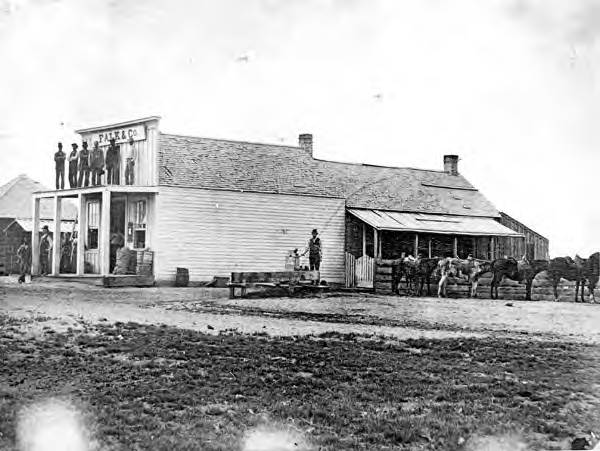
The Falk’s Store in Falk’s Store, circa 1892. Courtesy of the Idaho State Historical Society Digital Collection
“What are you doing here?” I asked the little group of people milling around my pasture.
“We’re looking for buried treasure,” the big fellow scanning the ground with a metal detector said with a laugh. He glanced around at his five or six cohorts for assurance.
“Why here?” I asked.
“You never know what you’ll find where an old trading post used to be,” he answered.
Perplexed, I asked, “What old trading post?”
“Why, the old Falk’s Store. Don’t you know?” he said.
I didn’t know, but I didn’t let on. New to the neighborhood, I didn’t want to seem unneighborly. “Well, okay, but please don’t leave a mess,” I admonished them and stalked back across the field to the house. That was my introduction to the fact that my new homestead held more than a passing historical significance. It was, in fact, the home of a vanished pioneer community. It was the site of Falk’s Store, Idaho.
In the fall of 1969, I took a job with Boise Cascade and moved my family (wife Kathy and sons Frank and Rob, ages 12 and 11) away from the urban madness of the 1960s San Francisco Bay Area to the relative sanity of Boise, Idaho. Boise still had a small-town feel and, to me, offered a much better lifestyle than San Jose, California. However, it was still a city, not a place where you could grow your food, raise livestock, and experience the freedom of a rural lifestyle. We set up housekeeping in a rented house in Boise and began searching for our piece of paradise.
Following many weekends of canvassing the countryside and looking at small acreages, we finally found the answer to our quest—sixty acres of irrigated pasture in the Payette Valley near the small farming town of New Plymouth. The location involved a 35-mile commute to my job in Boise. But after suffering commutes of similar distances on the crowded freeways of California, thirty-five miles of open country road presented no problem. We replaced the old ramshackle farmhouse that came with the property with a modern Boise Cascade Manufactured Home, replaced the outhouse with a modern septic system, hooked up the well and electricity, and moved in.
While an invasion by local amateur archaeologists was not exactly to my liking, it did pique my curiosity. I grew up in Eastern Oregon, and for as long as I could remember, the name Falk had been synonymous with quality merchandise. Falk Mercantile Company, headquartered in Boise, had stores scattered over most of Idaho and Eastern Oregon. To discover that I owned the site of the original Falk Store seemed peculiar.
Nathan Falk was born in Eggenhausen, Bavaria. He emigrated to New York City when he was fifteen, then took passage to San Francisco via the Isthmus of Panama. He joined his brother David in the frontier town of Boise in the spring of 1864.
The brothers opened a store they named Falk & Co. in the Payette Valley near the Placerville-Umatilla stage stop. The Falk Store post office soon followed, and the town of Falk grew up around it. By 1877, the town had developed into a thriving community, boasting two stores, a hotel, a saloon, a meat market, and a blacksmith shop. According to one account, “Everything that the pioneer family needed was carried in stock or could be ordered by stage from Boise. Customers came from as far as Malheur River in Oregon, Weiser River, Middle Valley, and Indian Valleys in Idaho.” In the 1870s, the gossip said that Falk’s store alone did an annual business of $60,000.
During the Nez Perce and Bannock Paiute wars and intermittent raids of the late 1870s, the locals erected a fort at the store. When Indians were spotted, and signal fires burned on the hills surrounding the valley, settlers would turn the cattle and hogs loose, hide the most valuable pieces of furniture in the sagebrush, and hightail it to the fort with all the women and children.
Even though the community continued to grow, Nathan Falk moved back to Boise and joined his brothers, David and Sigmund. They created the Falk Mercantile Company, which went on to dominate merchandising in Idaho and Eastern Oregon for more than a hundred years.
The coming of the railroad at the turn of the century marked the end of the stage stop at Falk Store. The town fell into decline even as other towns in the valley, Emmet, New Plymouth, and Payette, continued to flourish. On February 7, 1922, fire gutted the last general store at the settlement. The other buildings fell into disrepair and either burned or were torn down. When we moved there, the little clump of trees near the county road was all that remained—mute testimony to the temporary nature of man’s footprint on planet Earth.
As a farm family of the 1960s, we LaRues quickly adjusted to the rural lifestyle our new home had to offer. We stocked our place with a small herd of cattle and horses and raised chickens. The plot we fenced and had a neighbor plow for a garden somehow never reached fruition. But we did keep the pastures irrigated and even milked a few cows and shipped milk to the creamery in Payette. The boys were good athletes and matriculated into the New Plymouth school system without incident.
In the beginning, our neighbors viewed us with a degree of suspicion. I suppose seeing a guy going off to work in a business suit came as something of a surprise. But with time, we gained acceptance. I traded my sports car for a pickup truck and my Florsheim oxfords for a pair of Tony Lama boots. However, I could not shed the business suit, and the employees at the Farmers Feed & Seed in Emmet viewed me with some degree of amusement when I pulled up for a load of grain on my way home from work.
We lived in the Payette Valley for about four years and eventually sold out and bought a real working ranch near my parents’ place in North Central Oregon. When they say, “You can take the boy out of the country, but you can’t take the country out of the boy,” they may have been talking about me.
“Elgin, Elgin, come have a wee taste,” Mr. McMullen’s Scottish brogue rings out from his front porch. We climb the stairs, and I watch with the curiosity of a five-year-old as the two men share a glass of wine while discussing the status of the dairy and events of the day. I know my dad’s name is Eldon, and I wonder why Mr. McMullen always calls him Elgin.
We take our leave and walk on out toward the cow pasture. We pass McMullen’s walnut orchard. I listen curiously to men talking in Spanish as they tend the trees.
Dad opens the gate, and we follow the cattle down the lane to the holding pen outside the dairy barn.
The milkers take over and shout the cries of western herdsmen as they sort and move the milk strings into their respective stanchions.
Pete, the dairy operator, comes out of his house. He scoops me up, swings me around, and teases me in his Dutch-accented English. He sets me down, and he and my dad discuss the condition of the herd. When the cows are locked in their stanchions, Dad straps on his milking stool, sets his bucket under the first cow of his string, and the never-ending task of a dairy farm begins anew. Pete walks me back to our house and hands me over to my mom.
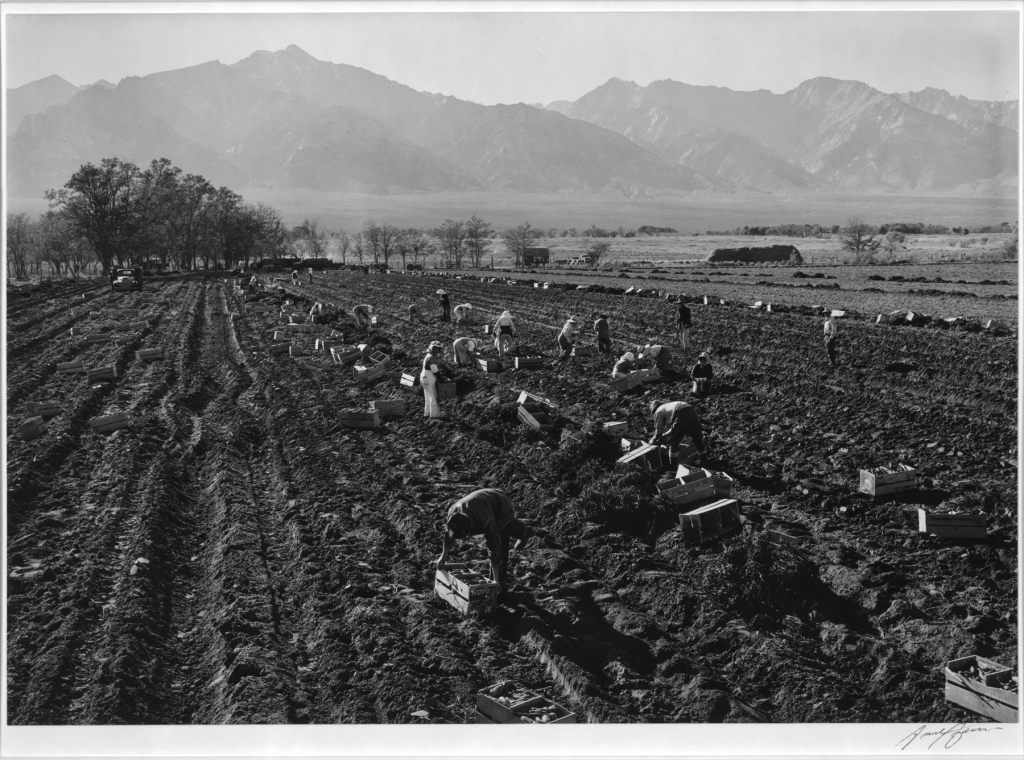
Mom is listening to the Hit Parade on the radio. She sends me out to play while she tends to her household chores. I approach the backyard fence and listen to the singsong voices of the orient coming from the truck farm next door. The people speaking are bent over tending their rows of plants. A pretty little girl about my age leaves the group and crosses the field toward me. She sits down across the fence from me, and we play in the dirt.
My parents have tried to explain that these people are Japanese and somehow different. I don’t understand. I can see that she is darker than Mr. McMullen’s redheaded granddaughter, Sharon. Her eyes are different. But she is just as fun to play with. We play with few words, but words are not needed. Still, the fence separates us. She does not come to my house, and I don’t go to hers.
The afternoon wears on. A woman comes and leads the girl away. The woman smiles and says something that I don’t understand. I watch as they walk toward their house. The girl turns, and her hand comes up in a small wave. I wave back.
Dad comes home from the afternoon milking. Mom sets out dinner, and we eat. After dinner, Dad and I go to the living room while Mom cleans up the kitchen and nurses my baby brother. Dad turns on the radio.
The smooth voice of Lowell Thomas comes over the airways. He tells us the news of the day. Most of what he has to say is about the war. The war is not news to me. Like the endless routine of the dairy, it has always been there. It is a part of our lives. We don’t feel it; it is far away. But we hear about it constantly. It is like the sound of the ocean when we camp on Laguna Beach. It rumbles in the background without end.
It is an afternoon like any other. Pete hands me off to Mother. I go out the back door to the yard. It is strangely quiet. I can hear the strains of the McGuire Sisters’ “Don’t Sit Under the Apple Tree” playing from inside the house. But no singsong voices come from the field next door. It is deserted. The plants still stand, green and growing. But no one is taking care of them. The people are gone. I sit by the fence for a while, alone. A death-like silence wraps around me.
I go back into the house and ask my mom where the people have gone. The Army took them away, she tells me. She tries to explain, but her words are not enough. Not enough to quell the fear welling up inside me. The first chink in my armor of innocence is gone.