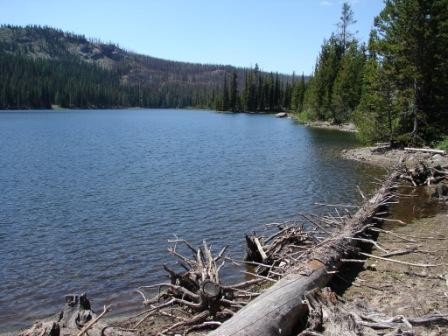
I’ll always remember the summer of ’52, the year we built the dam at Fish Lake. It changed my life forever.
I grew up on a ranch in a small valley at the southern foot of Eastern Oregon’s Wallowa Mountains. We raised cattle and farmed the land to feed them. Except for school, my world was that ranch until the summer of ’52—the year I turned fifteen.
I knew some of the history of my world. The Nez Perce Indians made their home among the peaks and valleys of the Wallowa Mountains until the Nez Perce War of 1877. The Indians put up a ferocious fight, but the U.S. Army ultimately won. Chief Joseph famously declared, “From where the sun now stands, I will fight no more forever,” and the tribe was shipped off to Oklahoma.
The Nez Perce called their home the Land of Winding Waters. After their removal, Oregon Trail pioneers rushed in and began farming the land. Their crops needed water, so they built dams and ditches to capture every drop they could find in the streams and lakes of the Land of Winding Waters.
They named one of the high-country lakes Fish Lake. In the 1880s, they erected an 800-foot-long earthen dam along with a spillway and headgate made of logs and planks across the lake’s natural outlet. Fish Lake was still supplying irrigation water for our neighbors and us in 1952.
Through the years, this structure was known to fail, flood the canyons below, and leave the irrigated fields dry. An often-repeated story tells of a band of 2,000 sheep drowned during one such dam burst. Fear of another failure, followed by a year without water, loomed over us.
From the time I was about ten, I shouldered a shovel each spring and joined my dad and the other ranchers when we cleaned and repaired the maze of ditches, creeks, and dams that carried the water to our fields. Crawling around on moss-slick logs repairing Fish Lake Dam presented a persistent, dangerous challenge. After one such repair, the assembled ranchers decided they needed a new dam.
U.S Soil Conservation Service engineers designed the new dam and assigned a project engineer. Labor was to be provided by the landowners. My dad volunteered me as our laborer. I jumped at the chance. Any excuse to get off the ranch and try something new was good by me. Armed with some food, a bedroll, a pup tent, and a fishing pole, I became a member of the Fish Lake Dam construction crew.
I joined a small tent camp where the crew stayed. The crew consisted of the SCS project engineer, an equipment owner/operator, his wife, who served as camp cook, their two preteen kids, and two other landowner laborers in their twenties. Other workers came and went as the job progressed. Some stayed, and others commuted from the nearest town, Halfway, 20 miles of dirt roads and almost an hour away.
The crew was clearing overgrowth from the old dam when I got there. The other two laborers felled the bigger trees and bucked them into truck-ready logs using an old Mall two-man chainsaw. My job was choker setter. A choker is a heavy cable you wrap around the butt of a log and hook to a caterpillar tractor that drags it to a log deck. The log can make unpredictable moves and slam you if you don’t pay attention. I paid attention. When the trees were cleared, the equipment operator brought in a bulldozer and pushed the remaining tree stumps, small trees, and underbrush into slash piles for later burning.
I grew up using a variety of hand saws and power saws, but the chainsaw was new to me. Fascinated by its operation. I itched to fire it up and fell some big trees.
Tired of lugging the heavy machine around, it didn’t take much coaxing to get my companions to let me spell them off. The old saw was a noisy, heavy, pulsating beast that blew acrid exhaust in my face. It was not the fun toy I thought it would be, but I loved yelling timber and watching a big tree crash to the ground.
The camp’s alarm clock was the smell of wood smoke from the cook’s black iron cook stove mixed with coffee brewing and bacon frying. We sat on wood stumps and ate our fill of bacon and eggs, fried potatoes, hotcakes, and biscuits. My teenage appetite created the source of much good-natured ribbing. “Leave some for the rest of us,” someone would shout as I slathered butter and honey on yet another biscuit.
Winter comes early in the high country. We raced to complete the job before the snow flew. A big Le Tourneau earth mover scraped up dirt and spread it on the new dam. A rolling device called a sheep’s foot packed it in place. I watched in awe as the sweeping arc of the dam took form.
The hours were long, but no one complained. We were well fed, and each day ended with a sense of accomplishment. At day’s end, the crew gathered around a campfire, drank beer, and told stories.
Too young to drink beer, I would dig some worms, row the project’s boat out on the lake, and fish for trout until I caught about a dozen big enough to keep. Then I would row back in, clean the fish, and turn them over to the cook. We all loved her fresh trout, rolled in cornmeal and fried in bacon grease, added to our breakfast fare.
As the job progressed, I became increasingly accepted by my fellow workers. They would even share a beer with me if I promised not to tell my dad. My duties varied. I held the survey rod and drove stakes for the engineer. I delimbed logs for the logging truck. I continued to dodge logs and set chokers. Near the end of summer, we bulldozed the old spillway and headgate and filled the gap with dirt. A concrete contractor brought in his portable cement mixer. His son Tom, whom I knew from high school, accompanied him. I finally had someone near my age to talk to.
Tom’s dad put us to work building forms and hauling concrete in wheelbarrows for the headgate and spillway. That is how I finished the summer until school started. It was nice to get back home and sleep in a real bed. But after a summer of working with a construction crew and holding down a man’s job, the return to being a schoolboy was a huge letdown. I was forever changed by the summer of ’52.
An old schoolmate recently told me the dam we built that summer is still in use. It made me feel good somehow.

2 responses to “Fish Lake Dam”
Once again Lash, you have packaged a great story. Compact, concise and relatable. Thank you.
LikeLike
Good story, Bob,
I left home (a smallish 40-acre farm with sheep, cows and hogs) to move to a much larger dairy farm located around the square mile from home. I was 14 at the time and lived there through high school. It was located next door to the old Satren farm where my dad grew up and he and my new boss, Arne Bjugan, were next door neighbors of about the same age.
One of the biggest compliments my dad ever made about me is that I wasn’t afraid of work, as he put it.
Regards,
Mike Satren
LikeLike