In 1945, the LaRue family leaves California and moves to the bucolic world of Northeastern Oregon.
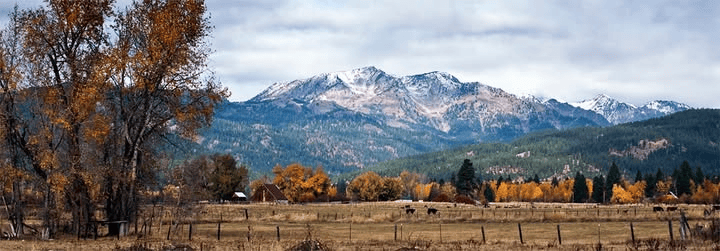
The Wallowa Mountains dominate the landscape of Oregon’s northeast corner. The Nez Perce Indians called this country The Land of Winding Waters. With the arrival of European settlers, these craggy mountains and picturesque valleys came to be known as the American Alps. To the east of the mountains, the Snake River slices through North America’s deepest river gorge, Hells Canyon. Nestled in one of the valleys above the canyon’s rim, the little town of Halfway is our destination.
Before Halfway, however, we make a stop at Nampa, Idaho. An old friend and fellow worker from McMullan’s Dairy had established a farming operation there. Dad wants to visit with his friend and check out the area.
Our host saddles a horse for me to ride. It is my first experience riding a real working saddle horse, and I am hooked. I spend every waking hours riding around the ranch until we leave.
The road leading from Nampa to Halfway follows along the old Oregon Trail to Baker, Oregon. Pioneers in covered wagons followed the same route starting in the 1840s. The route runs along the Snake River to a place called Farewell Bend. At Farewell Bend, the Snake turns north into Hells Canyon. The Oregon Trail, now called Highway 30, forks off northwest through the Burnt River canyon up to Baker Valley. We, pioneers of the 1940s, follow this historic route in our 1937 pickup truck.
From Baker, we turn east for the next sixty miles to our destination, Pine Valley. We cross the still visible wheel ruts of the Oregon Trail running through a dry sage-covered plain of Virtue Flat. The dry landscape gives way to a stretch of lush green irrigated pastures and farmed fields. The paved road turns into gravel. Passengers in occasional oncoming vehicles wave a friendly greeting as we pass. We seem to travel through time to an earlier era. Cowboys and ranchers still tend their cattle on horseback. Stout draft horses still draw farm implements. The twentieth century has largely eluded the countryside.
The road unexpectedly changes back to pavement. The landscape changes to a narrow canyon. We follow the Powder River through deep cuts and winding turns to Eagle Valley. Eagle Valley reveals another landscape of green pastures and farmed fields. We pass through the small cluster of homes and businesses called Richland. The valley closes back to a narrow canyon as we approach the Powder’s confluence with the Snake.
A lettered road sign points left toward Halfway. We follow the sign and climb a steep grade with sharp switchbacks. Our loaded pickup grinds along in low gear. We top the hill and travel down through a wide swale. Cattle graze on the dry yellow grass below farmsteads set back against the hills. The yellow landscape turns to green, and Pine Valley opens before us.
We turn left at an intersection near a sawmill and follow the valley’s only paved road to Halfway. Halfway boasts a bank, two grocery stores, two bars, several churches, three gas stations, a drug and liquor store, and other related businesses. The Gray Gables Hotel houses one of the bars and offers rooms to rent. Three housekeeping cabins behind a white picket fence and a manicured green lawn flank one side of the hotel. We rented one of the cabins and set up housekeeping. It is a welcome relief to get off the road and out of the cramped pickup cab.
My eight-year-old mind does not grasp the significance of our travels. At eight, you do not question your parents’ actions. You accept whatever they do as the norm. Even so, I could sense that this small world was a complete change from the world I had experienced in California. My dad’s motivation will always remain a mystery. Perhaps he was a throwback to his grandparents’ generation. Perhaps he was a precursor to the counterculture of the 1960s. Maybe he just wanted to escape the controls that a wartime culture had placed on society. The cold, hard facts were that we had arrived in the strangely named little town of Halfway, Oregon, and there I would remain for the next ten years until I graduated from high school. My Post-War Home Front had just begun.
Unmerciful sun beat down on the mountainside. A helicopter plucked a sunstroke victim off a shale ledge and flew away. We kept a slow, steady pace. None of us wanted to be the guy on the helicopter.
The Korean War was history. Few Americans had even heard of Vietnam. Peace ruled the land in the late 1950s. But readiness was still the mission of the U.S. Navy.
As a newly minted Naval Aviator with shiny new gold bars on my collar and shiny new gold wings on my chest, I was still getting used to being called “Sir” when new orders read: “Report to Survival School.”
About 30 Navy personnel assembled in a building on North Island Naval Air Station for a short series of lectures on survival and prisoner of war conduct. When the lectures ended, we marched down to the beach.
Guards dressed in uniforms right out of a Hollywood war movie set handed us C-rations and disappeared.
Our senior officer, a Navy Commander, took charge. He divided us into two companies with two squads. With the rank of Ensign, I was assigned to lead one squad of six enlisted men.
As evening approached, we all gathered driftwood and started a bonfire.
An abandoned barrel, half-filled with water from the only tap on the beach, became our cooking vessel. We each donated one can from our C-rations for a hobo stew.
Some citizens were digging for clams and diving for abalone nearby. Trading with the natives seemed within the rules of war. We struck a deal for their catch.
Supposedly stripped of personal property except the clothes on our backs, how a bunch of penniless sailors pooled enough money to cumshaw those illicit crustaceans can only be described as the Navy Way. We threw the catch in the pot. The stew turned out surprisingly well.
Ocean survival drills filled our days. Wrapped up in parachute panels as makeshift sleeping bags, we tried to sleep at night. For the final drill, our captors herded us onto a boat and dumped us overboard in the open sea with nothing but a Mae West for flotation.
After what seemed an eternity, a helicopter hovered over me. It released a sling dangling from a cable. I slid my arms through the sling. They hoisted me aboard. Wet and shivering, I joined my fellow survivalists. The helicopter crew delivered us back to the beach to await our next adventure.
It came in the form of a bus ride over narrow, winding roads to Warner Springs Survival School.
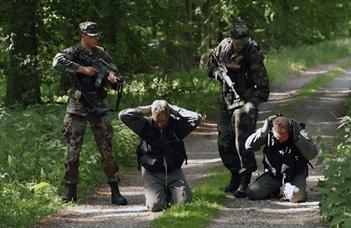
The camp could have passed for the set of the movie, The Bridge on the River Kwai. Guards escorted us from the bus into the chain-link fenced compound and sat us down on long benches. They lectured us on desert survival and laid out the schedule for the next two days.
A mountain hovered over the camp. We were to hike up that mountain to a campsite where C-rations and water would be issued and spend the night there. The next day, we would hike back down that mountain. Marines from Camp Pendleton would try to capture us on the way down. If we reached a flagpole outside the compound without capture, our survival training would be over. If captured, the Marines would return us to the compound for a round of interrogation.
The hike began on a well-worn trail in cool early morning air. As the day wore on, the terrain became steeper and the trail less defined. The temperature soared, and the small canteen of water we carried soon went dry.
My squad of late teens and early twenty-year-olds had by now become a tight little group. We saw little of our company commander. He was a Navy Lieutenant, a seaplane pilot. He hung out with the senior officers most of the time.
At a shale-covered rise near the bottom of a canyon, we stopped for a break. Just ahead, a patch of sand with a few green bushes contrasted sharply with the desert browns and reds around it. We made for the shade of the bushes and sprawled on the ground.
As a country boy not long off the farm, I knew that where there’s green, there’s water. I dug in the sand with my hands and, about a foot down, found moisture. My companions joined in, and we soon had a basin dug with water rising from the bottom. We waited anxiously for the sediment to settle.
The voice of our seldom-seen company commander suddenly demanded. “What are you doing here?”
“Oh, just practicing survival,” I answered dryly.
“What’s that?” he asked, pointing at our spring.
“Looks like water,” I answered.
“What are you going to do with it?” he asked.
“Drink it. Care to join us?” I responded.
“You can’t drink that. Cows might have peed in it.” With that, the Lieutenant sat down, pulled off his boots, and stuck his feet in our pool. “Aah, that feels good,” he said.
I held my tongue, got my squad up, and moved out, leaving the Lieutenant sitting there with his feet in our water.
He soon overtook us and started barking orders, telling us to form up. He must have decided that our little group needed to rejoin the military. We just tightened ranks and hiked on up the hill.
Eventually, the heat and lack of water took their toll on the old seaplane pilot. Out of shape and exhausted, he sat down on a rock, looked up at me, and said, “I can’t go on any farther.”
At that point, rank and privilege ceased to exist. I got him back on his feet and moving. My young, in-shape companions gladly hiked on ahead. My charge became the Lieutenant.
I picked up a stick and prodded him up the hill. We eventually made it to the campsite. He drank some water, seemed to recover from his delirium, and rejoined the senior officers. The breakdown of discipline on the trail was never discussed.
The campsite had trees, and it was cooler. The guards issued C-rations. We ate hungrily. Tents made of parachutes hung from the trees. There was no singing around the campfire that night. Exhausted, we crawled into the tents and slept.
Reveille came early. A quick muster, and we were on our own. I took the evasion part of Survival, Evasion, Resistance, and Escape (SERE) seriously. I wanted none of the resistance part. We started down the hill. It was every man for himself.
I could see the line of Marines working their way up the mountain and the compound with its flag off in the distance. Some of the evaders took off running down the hill, hurrying to reach the flag. Soon, the pop-pop of M1 blank cartridges filled the air as the Marines captured them.
I decided to take “a path less traveled” and drifted away from the crowd. A barbed wire fence soon blocked my progress. A sign on a fencepost announced, “California Department of Corrections. Keep Out.”
It was decision time. I suspected that what awaited me if captured would not be pleasant. The question was, what would happen if the prison authorities caught me trespassing on their property?
What could they do? They certainly wouldn’t put me through the torture of the interrogation the SERE guards had in mind. What the heck, all’s fair in love and war. I crawled through the barbed wire and pressed on. If caught, I’d just play dumb and say I didn’t see the sign.
I took what cover I could find. Once, I thought a Marine spotted me, but he was busy taking another prisoner and either did not see me or chose to ignore me. Some guys in dungarees with DOC painted on the back of their shirts were sitting in the shade near a barracks. They waved. I waved back.
With the flagpole within sprinting distance, I hunkered down behind a clump of bushes and watched. A couple of Marines delivered a prisoner to the guard at the flagpole. They headed back to the action, and the guard escorted the prisoner to the compound. That was my opportunity. I grabbed a post and vaulted over the minimum security fence, sprinted to the flagpole, wrapped my arms around it, and hung on. The guard came back, spotted me with a surprised look on his face, and pointed me to a door outside the compound.
In a darkened room, my fellow escapees and I observed the compound yard through a one-way mirror. A guard led a captive on his hands and knees around with a leash like a dog. Other guards crammed a captive into a sweat box and slammed the lid down. They pulled a dazed captive from another sweat box, slammed him into a chair, and tied him tight with ropes. A scratchy speaker in the room provided sound from the drama in the yard. An interrogator across the table from the bound man directed him to sign a confession for committing war crimes. This seemed like a joke at first, but as the scene unfolded, it took on an air of reality. The interrogator called the man the son of a whore dog, insulted him and his wife and mother repeatedly, and bore down with insults and accusations until the poor fellow was reduced to tears. He finally signed the confession. These scenes continued until late afternoon.
The nightmare ended with a bus ride back to North Island and a new appreciation life as we live it. Along the way, the bus stopped at a roadside burger joint. The Navy treated us to the best darn hamburger I have ever eaten, bar none.
I’ll always remember the summer of ’52, the year we built the dam at Fish Lake. It changed my life forever.
I grew up on a ranch in a small valley at the southern foot of Eastern Oregon’s Wallowa Mountains. We raised cattle and farmed the land to feed them. Except for school, my world was that ranch until the summer of ’52—the year I turned fifteen.
I knew some of the history of my world. The Nez Perce Indians made their home among the peaks and valleys of the Wallowa Mountains until the Nez Perce War of 1877. The Indians put up a ferocious fight, but the U.S. Army ultimately won. Chief Joseph famously declared, “From where the sun now stands, I will fight no more forever,” and the tribe was shipped off to Oklahoma.
The Nez Perce called their home the Land of Winding Waters. After their removal, Oregon Trail pioneers rushed in and began farming the land. Their crops needed water, so they built dams and ditches to capture every drop they could find in the streams and lakes of the Land of Winding Waters.
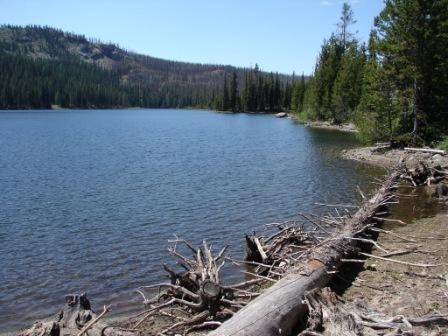
They named one of the high-country lakes Fish Lake. In the 1880s, they erected an 800-foot-long earthen dam along with a spillway and headgate made of logs and planks across the lake’s natural outlet. Fish Lake was still supplying irrigation water for our neighbors and us in 1952.
Through the years, this structure was known to fail, flood the canyons below, and leave the irrigated fields dry. An often-repeated story tells of a band of 2,000 sheep drowned during one such dam burst. Fear of another failure, followed by a year without water, loomed over us.
From the time I was about ten, I shouldered a shovel each spring and joined my dad and the other ranchers when we cleaned and repaired the maze of ditches, creeks, and dams that carried the water to our fields. Crawling around on moss-slick logs repairing Fish Lake Dam presented a persistent, dangerous challenge. After one such repair, the assembled ranchers decided they needed a new dam.
U.S Soil Conservation Service engineers designed the new dam and assigned a project engineer. Labor was to be provided by the landowners. My dad volunteered me as our laborer. I jumped at the chance. Any excuse to get off the ranch and try something new was good by me. Armed with some food, a bedroll, a pup tent, and a fishing pole, I became a member of the Fish Lake Dam construction crew.
I joined a small tent camp where the crew stayed. The crew consisted of the SCS project engineer, an equipment owner/operator, his wife, who served as camp cook, their two preteen kids, and two other landowner laborers in their twenties. Other workers came and went as the job progressed. Some stayed, and others commuted from the nearest town, Halfway, 20 miles of dirt roads and almost an hour away.
The crew was clearing overgrowth from the old dam when I got there. The other two laborers felled the bigger trees and bucked them into truck-ready logs using an old Mall two-man chainsaw. My job was choker setter. A choker is a heavy cable you wrap around the butt of a log and hook to a caterpillar tractor that drags it to a log deck. The log can make unpredictable moves and slam you if you don’t pay attention. I paid attention. When the trees were cleared, the equipment operator brought in a bulldozer and pushed the remaining tree stumps, small trees, and underbrush into slash piles for later burning.
I grew up using a variety of hand saws and power saws, but the chainsaw was new to me. Fascinated by its operation. I itched to fire it up and fell some big trees.
Tired of lugging the heavy machine around, it didn’t take much coaxing to get my companions to let me spell them off. The old saw was a noisy, heavy, pulsating beast that blew acrid exhaust in my face. It was not the fun toy I thought it would be, but I loved yelling timber and watching a big tree crash to the ground.
The camp’s alarm clock was the smell of wood smoke from the cook’s black iron cook stove mixed with coffee brewing and bacon frying. We sat on wood stumps and ate our fill of bacon and eggs, fried potatoes, hotcakes, and biscuits. My teenage appetite created the source of much good-natured ribbing. “Leave some for the rest of us,” someone would shout as I slathered butter and honey on yet another biscuit.
Winter comes early in the high country. We raced to complete the job before the snow flew. A big Le Tourneau earth mover scraped up dirt and spread it on the new dam. A rolling device called a sheep’s foot packed it in place. I watched in awe as the sweeping arc of the dam took form.
The hours were long, but no one complained. We were well fed, and each day ended with a sense of accomplishment. At day’s end, the crew gathered around a campfire, drank beer, and told stories.
Too young to drink beer, I would dig some worms, row the project’s boat out on the lake, and fish for trout until I caught about a dozen big enough to keep. Then I would row back in, clean the fish, and turn them over to the cook. We all loved her fresh trout, rolled in cornmeal and fried in bacon grease, added to our breakfast fare.
As the job progressed, I became increasingly accepted by my fellow workers. They would even share a beer with me if I promised not to tell my dad. My duties varied. I held the survey rod and drove stakes for the engineer. I delimbed logs for the logging truck. I continued to dodge logs and set chokers. Near the end of summer, we bulldozed the old spillway and headgate and filled the gap with dirt. A concrete contractor brought in his portable cement mixer. His son Tom, whom I knew from high school, accompanied him. I finally had someone near my age to talk to.
Tom’s dad put us to work building forms and hauling concrete in wheelbarrows for the headgate and spillway. That is how I finished the summer until school started. It was nice to get back home and sleep in a real bed. But after a summer of working with a construction crew and holding down a man’s job, the return to being a schoolboy was a huge letdown. I was forever changed by the summer of ’52.
An old schoolmate recently told me the dam we built that summer is still in use. It made me feel good somehow.
Tucked away deep in the mountains of North Idaho, a grove of ancient cedars silently watches the passage of time. When Wyatt, wife Sadie, and brother Jim Earp arrived at Eagle City in 1884, it was a bustling tent city—a gold rush town. The enterprising brothers purchased a round circus tent, 45 feet high and 50 feet in diameter, for $2,250 and opened a dance hall. Later, they opened the White Elephant Saloon. An advertisement in the Coeur d’Alene weekly called it “The largest and finest Saloon in the Coeur d’Alenes.” However, the Coeur d’Alene gold rush was short-lived, and today there is little to show that Eagle City ever existed. The site bears mute testimony to the temporary nature of man’s footprint with the passage of time.
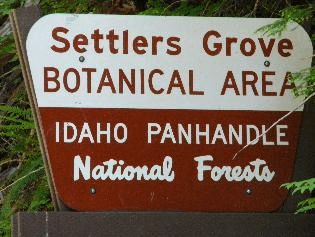
Exit Interstate 90 at Kingston, Idaho, and follow the Coeur D’Alene River for a little more than 20 miles across Prichard Creek. Turn right toward Murray for about 3.5 miles and cross Eagle Creek. Turn left, and you have arrived at Eagle City. From Eagle City, follow Eagle Creek and then West Eagle Creek for 5 or 6 miles to a Forest Service sign announcing, “Settlers Grove Botanical Area.”
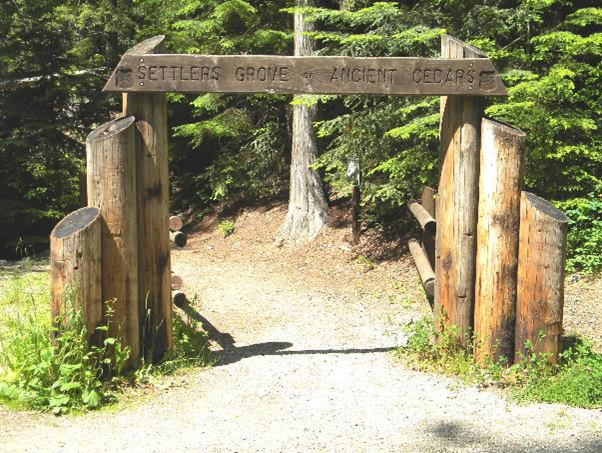
The road ends in a large parking area with permanent restrooms. Park your vehicle and step back in time under the lintel of the grove’s open gate.
Settlers Grove, at 182 acres, is one of the last large stands of Western Redcedars in Idaho. While these trees are called cedars, they are actually a part of the cypress family. Mature trees stand well over 200 feet tall, and in Settlers Grove range up to 7 feet in diameter. The oldest trees in the grove are estimated to be 700 to 1,000 years old. Western Redcedars are primarily found in the coastal forests of the Northwest. However, a disjunct inland population exists along the southern British Columbia-Alberta border and in northern Idaho and western Montana.
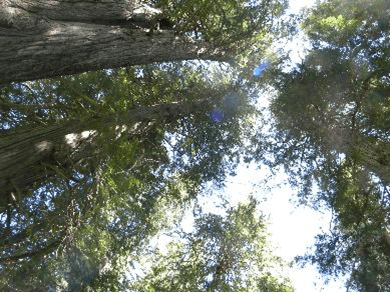
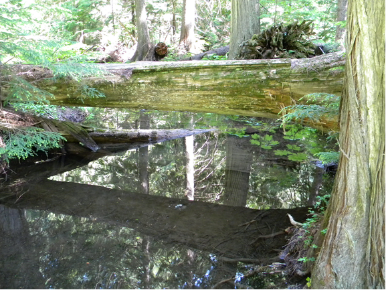
The trail through the grove is well-maintained and easy walking. The treetop canopy filters sunlight into a dreamlike array of lights and shadows.
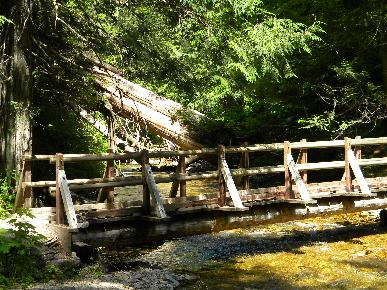
The creek winds along the trail and under bridges with an ever-changing pattern of bright refractions.
Sound becomes muted yet distinct: a bird’s chirp, a child’s voice, the babble of running water. The mind wanders, and time takes on a new dimension.
When Columbus proved the world was round, and Conquistadors first set foot on the golden shores of the New World, some of the trees standing in Settlers Grove had already lived 200 years or more.
When Lewis and Clark led the Corps of Discovery Expedition over the mountains a little south of the grove, these same trees had aged to 500 years.
During the building of the oldest manmade structure in Idaho, the Cataldo Mission, just downriver from the grove, the same trees had been alive for 550 years.
By the time of the Coeur d’Alene gold rush in the 1880’s, the trees were 580 years old.
The 130 or so years span from then until now represent little more than a single century out of seven to these ancient giants. Yet it covers our whole regional history.
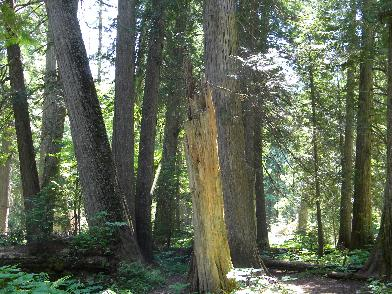
The trees have not gone unscathed. Uprooted trunks, broken-off stumps, and lightning scars lend stark evidence to the forces of nature the grove has endured.
Centuries of winter’s cold, summer’s heat, firestorms, ice storms, droughts, and floods have left their mark. Why did some fall and others still stand tall? The mystery remains the “secret of the grove.”
The Snake. In my youth, it ran wild and free through America’s deepest gorge, Hells Canyon. Upstream from the canyon, a placid surface cunningly hid eddies and undertows lurking to pull the unwary into its depths. Venomous reptiles occupied the river’s banks and bluffs, but its name is not for them. In sign language, the Shoshone people used swimming motions with their hands to indicate a river of many fish. Early explorers thought the motion signified a snake. Thus, the name: Snake River.
Annual migrations of those many fish (anadromous salmon and steelhead) fought their way upstream from the Pacific Ocean into the river’s tributaries to spawn and die where they were born. A few would pound their way up our little stream called Dry Creek as it roared through our ranch during spring runoff. Dad speared them with a pitchfork. I tried, but my weak, youthful thrusts bounced off harmlessly.
As I grew older, bait fishing became a passion. A good spot for steelhead and salmon fishing was near my hometown of Halfway, Oregon, where the Powder River cascaded into the Snake. On a sunny Sunday Spring morning, two buddies and I wetted our lines in the swirling waters there. We had been at it for about two hours with no luck. Pete Peterson was driving that day. Hunger took over, and Pete volunteered to get some hamburgers from the nearby town of Richland.
Just then, an unmanned sixteen-foot runabout came floating down the Snake. It caught in an eddy and floated close to the shore near us. I managed to grab its bowline and pull the derelict ship to shore.
At age fourteen or so, Bob Schultz and I quickly became experts in maritime law. In our view, we had salvaged an abandoned craft from imminent destruction on the rocks in the bowels of Hells Canyon. Therefore, it was ours.
Pete was a few years older and counseled moderation. His view was that the craft likely belonged to someone upriver who would soon be along looking for it. We were hearing none of that. We had salvaged it, and it was ours. Our only problem was how to get it out of the river and home. So, we crafted a plan.
We decided to float it downriver a few miles and hide it. I had an old pickup truck. We would come back the following weekend, load it up, and take it home. We would dock it up at our favorite lake, Fish Lake, and fish all summer. Maybe we could even save up and get a motor and water ski. We were dreaming big. We put away our fishing poles and found some driftwood to use as oars.
Pete told us he would catch up with us later and got in his car. We two brave sailors launched our craft, waved goodbye to our land-lubber friend, and set out on our new adventure.
The boat was sound and well-crafted for river running. That was a good thing. Two untested sailors with no life jackets, navigating one of the West’s most dangerous rivers with nothing but pieces of driftwood for oars… what could possibly go wrong?
The river ran fast. By the time Pete caught up with us, we had floated 10 or 15 miles downstream and were nearing the landmark bend in the river called the Oxbow. We had managed to cross the river to the Idaho side and back. That, in our youthful minds, made us worldly navigators. We sang snatches of Cruising Down the River as we floated along. It was an afternoon to remember.
We paddled into a secluded cove surrounded by brush and undergrowth and beached our prize, then piled into Pete’s car and devoured our burgers. We swore Pete to secrecy, and he went along with us. It was not the last adventure we would share, but it was the best to date.
An agonizing week-long routine of classroom boredom went by. Saturday finally arrived. Schultz and I got in my old truck and headed for the river. Our hiding place was still there, but the boat was gone. It was a disappointing end to a teenage dream. But the memory remains.
Starting in 1955, man tamed the wild river of my youth. It is now a series of three long lakes behind dams. Gigantic turbines spin out renewable energy to power our world. But the dams block the steelhead and salmon from their annual migration. They no longer pound their way up Dry Creek to spawn, die, and renew the species. Some call that progress. Some call it an ecological disaster. The debate goes on.
In primitive societies, men hunted, and women gathered. Those instincts still exist deep within our beings. When a man is on the hunt, his awareness narrows to just the task of capturing his quarry. Other senses and the passage of time become secondary. It is the way we are made. No amount of social engineering can eliminate it.
My second deer-hunting season began in 1951, when I was fourteen. I rode my mare, Paint, into the mountains above our Eastern Oregon ranch. As I approached an Aspen grove near the head of a canyon, a small herd of deer (a buck, two does, and two fawns) rose and clattered up the canyon wall. Before I could dismount and take a shot, they crested the ridge and disappeared.
I tied Paint to a tree and set out on foot in hot pursuit. At the top of the ridge, I watched the herd disappear over the next ridge. I tromped through the brush and timber of the canyon separating us to the top of that ridge, only to see my quarry disappear over the next ridge. It was like the deer were playing a game with me. Each time I caught sight of them, they somehow managed to disappear over the horizon. Time stood still. Distance ceased to have meaning. It was just me and the elusive prey—the hunter and the hunted.
My senses snapped back when I could no longer see the next ridge. Night had fallen. I did not know where I was. I had lost the hunt. My horse was tied to a tree several canyons back. All of my survival gear was tied behind the saddle. A deep forest and unfamiliar mountains surrounded me. It was dark. Stark reality replaced the exhilaration of the hunt.
I knew that I was in the mountains somewhere above Pine Valley. If I kept going downhill, I would eventually reach the valley floor. I just had no idea how far that would be. But the thought of spending the night with no blanket, no fire, and no shelter held no appeal. I started walking downhill.
It was rough going in the dark. Avoiding a fall challenged each step.
A welcome moon cleared the horizon. It provided a little light. I worked my way through the forest and undergrowth for what seemed an eternity. Finally, I stumbled onto a dirt road. I had no idea where it led, but there was a stream nearby. I stuck my hand in the water to feel the flow, then turned downstream and kept walking. The smooth road surface was welcome.
I must have walked for three or four miles when, off to my left, I made out the stacked logs, lumber, and equipment of a sawmill. With a sense of relief, I knew where I was. It was the East Pine Lumber Mill. Home was behind me. But to double back to the ranch meant navigating a maze of primitive roads. I decided it would be easier to continue down East Pine Creek for about three miles to the valley floor. Then I could hike on well-marked county roads the eight or so miles home.
The night wore on. I walked along country roads, past darkened farmsteads. Dogs barked at my passing, but none attacked. Cattle lowed, and horses snorted, disturbed by the dogs barking. No sign of human activity interrupted my passage. It was nearing dawn when I finally turned up Dry Creek Road for the last two miles home.
Faint pink light colored the eastern sky as I dragged my tired feet through the familiar picket fence gate of home. A kerosene lamp shining through the dining room window told me my parents were up. Caught up in my own dilemma, I had given little thought to what my mom and dad were going through. The fact that they must be worried suddenly occurred to me. I crossed the threshold and announced that I was home and sorry for any worry I had caused. Mom was in tears. Dad wanted to know what I had done with my horse. Dad’s reaction was easier to deal with than Mom’s.
After I described the events of the last twenty hours, Mom fixed me something to eat. I ate and fell into bed, exhausted. Dad let me sleep until the sun was well above the horizon. He roused me and told me it was high time to go rescue my horse. I did not complain. I, too, was worried about Paint.
In the light of day, it was no problem to retrace my route to the Aspen grove. When I got there, Paint was standing tied where I had left her. She looked around at me with inquiring eyes like, “Where did you go?” Then she expelled a little nicker like, “Good to see you.” I guess I was forgiven. I tightened the cinch, crawled up on her back, and we headed home. The hunt could wait for another day.