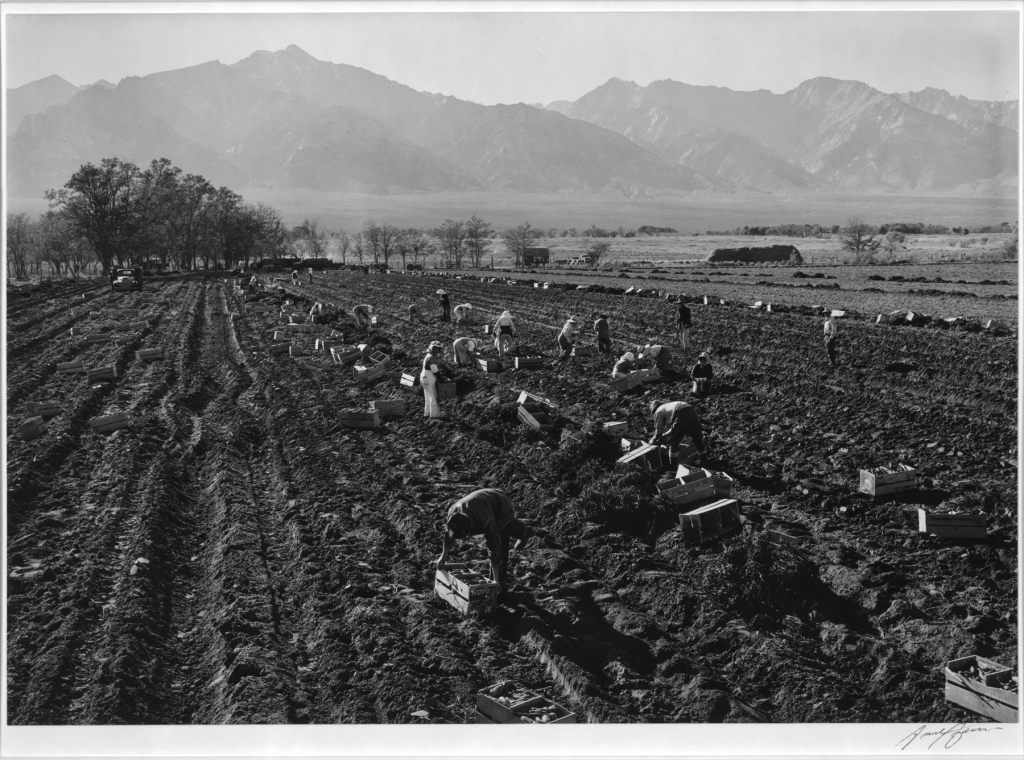
“Elgin, Elgin, come have a wee taste,” Mr. McMullen’s Scottish brogue rings out from his front porch. We climb the stairs, and I watch with the curiosity of a five-year-old as the two men share a glass of wine while discussing the status of the dairy and events of the day. I know my dad’s name is Eldon, and I wonder why Mr. McMullen always calls him Elgin.
We take our leave and walk on out toward the cow pasture. We pass McMullen’s walnut orchard. I listen curiously to men talking in Spanish as they tend the trees.
Dad opens the gate, and we follow the cattle down the lane to the holding pen outside the dairy barn.
The milkers take over and shout the cries of western herdsmen as they sort and move the milk strings into their respective stanchions.
Pete, the dairy operator, comes out of his house. He scoops me up, swings me around, and teases me in his Dutch-accented English. He sets me down, and he and my dad discuss the condition of the herd. When the cows are locked in their stanchions, Dad straps on his milking stool, sets his bucket under the first cow of his string, and the never-ending task of a dairy farm begins anew. Pete walks me back to our house and hands me over to my mom.
Mom is listening to the Hit Parade on the radio. She sends me out to play while she tends to her household chores. I approach the backyard fence and listen to the singsong voices of the orient coming from the truck farm next door. The people speaking are bent over tending their rows of plants. A pretty little girl about my age leaves the group and crosses the field toward me. She sits down across the fence from me, and we play in the dirt.
My parents have tried to explain that these people are Japanese and somehow different. I don’t understand. I can see that she is darker than Mr. McMullen’s redheaded granddaughter, Sharon. Her eyes are different. But she is just as fun to play with. We play with few words, but words are not needed. Still, the fence separates us. She does not come to my house, and I don’t go to hers.
The afternoon wears on. A woman comes and leads the girl away. The woman smiles and says something that I don’t understand. I watch as they walk toward their house. The girl turns, and her hand comes up in a small wave. I wave back.
Dad comes home from the afternoon milking. Mom sets out dinner, and we eat. After dinner, Dad and I go to the living room while Mom cleans up the kitchen and nurses my baby brother. Dad turns on the radio.
The smooth voice of Lowell Thomas comes over the airways. He tells us the news of the day. Most of what he has to say is about the war. The war is not news to me. Like the endless routine of the dairy, it has always been there. It is a part of our lives. We don’t feel it; it is far away. But we hear about it constantly. It is like the sound of the ocean when we camp on Laguna Beach. It rumbles in the background without end.
It is an afternoon like any other. Pete hands me off to Mother. I go out the back door to the yard. It is strangely quiet. I can hear the strains of the McGuire Sisters’ “Don’t Sit Under the Apple Tree” playing from inside the house. But no singsong voices come from the field next door. It is deserted. The plants still stand, green and growing. But no one is taking care of them. The people are gone. I sit by the fence for a while, alone. A death-like silence wraps around me.
I go back into the house and ask my mom where the people have gone. The Army took them away, she tells me. She tries to explain, but her words are not enough. Not enough to quell the fear welling up inside me. The first chink in my armor of innocence is gone.

9 responses to “Internment”
Wonderful and insightful memory.
I grew up on a dairy farm, too, and moved into a larger dairy farm located next to the original Satren farm around the square mile from my folks place. I asked for that job from a childhood friend of my dad’s and worked there as his hired man from 14 to 18.
The main difference in my experiences is that almost all of my neighbors, my whole small town in Southern Minnesota were Norwegian farmers, with one Finnish family with two older beautiful girls and one Catholic family in town. So we weren’t diverse like you in California. In fact I am related to Pete Hegseth’s paternal grandmother and his maternal grandfather. His mother and father were in sixth grade when I graduated from high school in 1965, but I didn’t know them. One of my classmates told me recently that she used to babysit both of them when she was in junior high school.
Good read,
Mike
LikeLike
I’ve used this dozens of times!!
LikeLike
Hey Mike, as one former teat puller to another, I prefer two fingers on the stick of a responsive aircraft with a bright blue horizon to bagging up those old mama’s and slapping the cups on. Double goes for the kickers! Bob
LikeLike
Me too!
I could always deal with the roundhouse kickers (usually first calvers) by keeping my feet way back and laying my head into the depression behind their stomach just in front of the leg joint. Then I could time my cleaning of teats and the first few pulls to get the milk started.
It’s the accurate side kickers that would occasionally get me good by surprise.
LikeLike
They would stand there and wait to remind you that you had forgotten the hobbles! It was a game!
LikeLike
My parents were raised on a dairy farm in southern California. That is how they met! Both of my grandparents worked the dairy. As a kid whenever we passed a horribly stinky dairy out in the country my mom would roll down the window for a deep breath to smell those cows and manure. She loved it! She went to school in La Puente. She told me about classmates (Japanese) who one day just didn’t show up to class. She was too young at the time to know why. Only later did she learn and comprehend what had happened to them. My parents were born in 1931, 1933.
LikeLike
Thank you for the comment. Cattle people call that smell “Money.” Bob
LikeLike
Bob has given us two powerful messagews here. One has to do with how humans can act contrary to their principles. The other is how one act can remain deeply embedded in our lives. I use Lash’s piece in my lectures.
BTW, I too am a former teat puller and Naval aviator.
C. D. Peterson
Brookfield , CT
LikeLike
Blue skies and tailwinds, and dodge the manure-laden tail!
Thanks, Pete,
Lash
LikeLike