Each picture was shown on an accompanying video screen.
A World In Flux
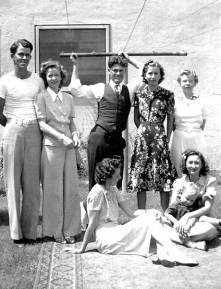
Back Row L to R: Uncle Len and Aunt Lee, Uncle Joe and Aunt Fran, Mom. Front Row: Aunt Sue, Aunt Rae, Me
I was born in the spring of 1937. The world was emerging from the Great Depression and on the brink of World War II. However, that was not of my concern.
As a firstborn son of the firstborn son, love and security surrounded me. A doting grandmother watched over me while my mom went to business school. Three aunts, ages 17, 19, and 21 when I was born, spoiled me. My world was safe.
I remember bits and pieces. Aunt Sue’s idea of babysitting was to strap me in the front seat of a Piper Cub and fly around Southern California as she built up flight hours. She let me take hold of the stick and bank, turn, climb, and dive. At least I thought I was in control. I loved it. Aunt Fran had married, and her father-in-law lived with them. He had a handcart that he pushed around the neighborhood, selling fruit and vegetables door to door. I delighted in tagging along as his “helper.” Aunt Rae was busy with nursing school, but always had time for a hug and a kiss for Bobby.
The magician we call memory has many tricks up his sleeve. Trivial things often stand out ahead of major events. His sleight of hand hides some experiences and makes others clear. Perhaps we choose what we remember; perhaps what we remember chooses us.
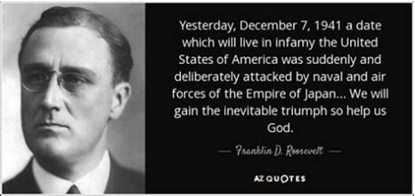
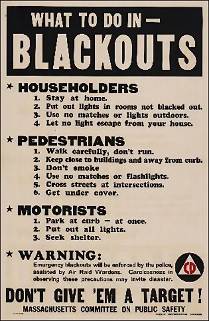
December 7, 1941, may have been “a date which will live in infamy” for President Roosevelt, but for a four-year-old, it marked the beginning of all kinds of strange and scary events. The wailing sirens and darkness of blackout drills stand out in my mind.
We lived on a dairy in Baldwin Park, California. Baldwin Park is located only about twenty miles from downtown Los Angeles. The area was still largely agricultural, with citrus groves, walnut orchards, and small farms dominating the community. The 1940 census recorded a population of 1671 residents.
Before supermarkets, dairies were often located near population centers. On-site retail marketing was a common practice. After the attack on Pearl Harbor, what had been considered a good location for dairy product retailing also came to be considered a prime target for a Japanese attack.
Before radar bomb sights, bombardiers relied on what they could see on the ground to figure out where to release their devastation. A primary means of civil defense against night attack was the blackout. If there was no light on the ground, the attackers could not identify their targets. The sound of blackout sirens in the night became a fact of life for us.
Rationing also became a fact of life. Living on a dairy, we had plenty of milk to drink, but meat was rationed even for us. To supplement our diet, Dad built some hutches and raised rabbits. He shared the fryers with the dairy’s owners, a Dutch family named Kohn, in exchange for alfalfa and grain. Mrs. Kohn also helped with caring for the animals.
One dark night, I was out by the hutches helping Mrs. Kohn when the sirens wailed, and the lights went out. She had come prepared for such an event with a flashlight. She handed me the flashlight to hold while she finished the chores. Like any kid of four, I proceeded to flash the light around and point it at the sky. Sweet, gentle Mrs. Kohn came unglued. She grabbed the offending torch from my little hands and explained to me in no uncertain terms that I could have caused us to be bombed. I suppose she was somewhat oversensitive about bombing since she still had family in Holland who had recently experienced the Blitzkrieg. But she scared the heck out of me. I quickly changed from being a carefree child piercing the night sky with a harmless flashlight to being a magnet for falling explosives.
To this day, I feel a stab of fright any time I let a flashlight beam wander above the horizon at night!
Japanese Internment, World War II
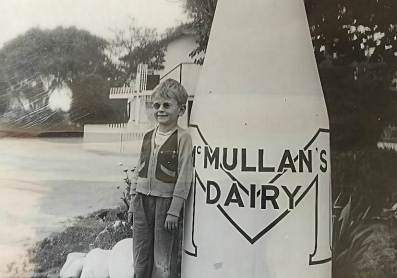
Yours Truly, (sunglasses because of recent bout of measles)
My dad often lets me tag along as he makes his rounds of the dairy. A cacophony of voices fills my memory of these adventures.
“Elgin, Elgin, come have a wee taste,” Mr. McMullen’s Scottish brogue rings out from his front porch. We climb the stairs, and I watch with the curiosity of a four-year-old as the two men share a glass of wine while discussing the status of the dairy and events of the day. I know my dad’s name is Eldon, and I wonder why Mr. McMullen always calls him Elgin.
We take our leave and walk on out toward the cow pasture. We pass McMullen’s walnut orchard. I listen curiously to men talking in Spanish as they tend the trees.
Dad opens the gate, and we follow the cattle down the lane to the holding pen outside the dairy barn.
The milkers take over and shout the cries of western herdsmen as they sort and move the milk strings into their respective stanchions.
Pete, the dairy operator, comes out of his house. He scoops me up, swings me around, and teases me in his Dutch-accented English. He sets me down, and he and my dad discuss the condition of the herd. When the cows are locked in their stanchions, Dad straps on his milking stool, sets his bucket under the first cow of his string, and the never-ending task of a dairy farm begins anew. Pete walks me back to our house and hands me over to my mom.
Mom is listening to the Hit Parade on the radio. She sends me out to play while she tends to her household chores. I approach the backyard fence and listen to the singsong voices of the orient coming from the truck farm next door. The people speaking are bent over,1u tending their rows of plants. A pretty little girl about my age leaves the group and crosses the field toward me. She sits down across the fence from me, and we play in the dirt.
My parents have tried to explain that these people are Japanese and somehow different. I don’t understand. I can see that she is darker than Mr. McMullen’s redheaded granddaughter, Sharon. Her eyes are different. But she is just as fun to play with. We play with few words, but words are not needed. Still, the fence separates us. She does not come to my house, and I don’t go to hers.
The afternoon wears on. A woman comes and leads the girl away. The woman smiles and says something that I don’t understand. I watch as they walk toward their house. The girl turns, and her hand comes up in a small wave. I wave back.
Dad comes home from the afternoon milking. Mom sets out dinner, and we eat. After dinner, Dad and I go to the living room while Mom cleans up the kitchen and nurses my baby brother. Dad turns on the radio.
The smooth voice of Lowell Thomas comes over the airways. He tells us the news of the day. Most of what he has to say is about the war. The war is not news to me. Like the endless routine of the dairy, it has always been there. It is a part of our lives. We don’t feel it; it is far away. But we hear about it constantly. It is like the sound of the ocean when we camp on Laguna Beach. It rumbles in the background without end.
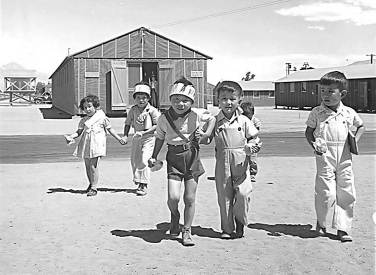
Children at Manzanar Internment Camp
It is an afternoon like any other. Pete hands me off to Mother. I go out the back door to the yard. It is strangely quiet. I can hear the strains of the McGuire Sisters’ “Don’t Sit Under the Apple Tree” playing from inside the house. But no singsong voices come from the field next door. It is deserted. The plants still stand, green and growing. But no one is taking care of them. The people are gone. I sit by the fence for a while, alone. A death-like silence wraps around me.
I go back into the house and ask my mom where the people have gone. The Army took them away, she tells me. She tries to explain, but her words are not enough. Not enough to quell the fear welling up inside me. The first chink in my armor of innocence is gone.
My world comes apart
In 1942, kindergarten caught up with me. I reveled in it. My grandfather was the Baldwin Park School Superintendent. If I received any celebrity or favoritism from that fact, I was unaware of it. I fell in love with Miss Rice, my teacher. At the end of the school year, our parting was heart-wrenching.
Even so, my sense of bliss was not being shared by the world at large. The world was at war. Lives everywhere were in a state of flux. Governments were intruding on people’s lives and becoming more and more controlling. My world was about to come apart.
When war broke out, my dad tried to enlist. He was deferred because he worked on a dairy farm and had two children. Three of his siblings did join up. Uncle Len joined the Navy and completed Officer Candidate School. Aunt Sue became a Women’s Army Service Pilot. Aunt Rae became a Navy Nurse. Dad and Aunt Fran stayed home.
In 1943, an event occurred that remains a mystery to me. But it changed my life forever. For reasons that were never made completely clear, we were suddenly uprooted and moved from Baldwin Park, 500 miles away, to Chico, California. It had something to do with the draft board and someone wanting Dad’s deferment. Whatever the reason, Dad was transferred from McMullan’s Dairy to a dairy on a large farming operation in the Sacramento Valley.
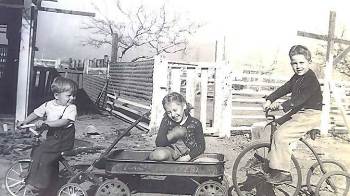
Brother Chip, Neighbor Girl, Yours Truly
The move was traumatic for the whole family. My parents were none too happy. We moved from a cozy bungalow on a showcase dairy to a shack in a row of farm workers’ quarters. Our new home could have been right out of John Steinbeck’s novel, “The Grapes of Wrath.” Dad was demoted from Dairy Foreman to common milker. I was torn away from everything I had known for the first six years of my life.
I started first grade in strange surroundings, knowing no one, afraid, and lonely. War on the home front had taken its toll. Miss Rice and my paths would never cross again.
The Chico Years
As a six-year-old, I don’t recall much about our move from the row of farm workers’ shacks, where Dad milked cows, to our own farm. In my memory, it is as if one day we were there and the next we were at our new home.
Our new 20-acre homestead consisted of a house, a barn, a small nut orchard, and a good-sized plot of fertile Sacramento Valley row-crop land. Dad went to work in the paint shop at the Chico Army Air Field. He also participated with the ambulance and accident cleanup crew. In 1944, Chico Air Base switched from basic training to fighter pilot training in P-38 Lightnings. Crashes and deaths doubled from 14 crashes and 8 deaths during the two years of basic training to 35 crashes and 16 deaths during the 16 months of fighter pilot training. That’s more than 2 crashes a month. The ambulance and cleanup crew stayed busy. Dad tried not to show it, but even I could tell that he was under a great deal of stress.
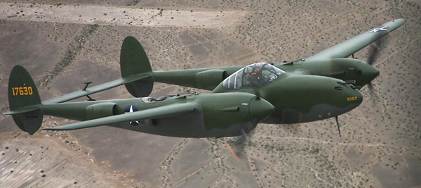
P-38 Lightening
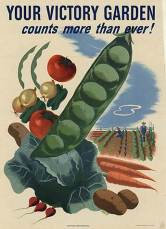
Mom’s parents and 11-year-old brother Jimmy moved in with us. Grandpa took over the farming operation. Our Victory Garden expanded to about 15 acres.
As life moved on from 1943 to 1944, my sister Deanne was born in August. The war continued unabated. I started second grade in September. The world at war, farming the land, P 38’s from the base buzzing overhead, bickering with my uncle Jimmy, and talk that the war would never end; these things all seemed normal to me. As a seven-year-old, they were all I knew. I had no other frame of reference. As Harry Truman famously said, “The only thing new is the history we don’t know.” We of my generation knew no history yet. The canvas remained to be painted.
War’s End on The Home Front
The end of World War II in 1945 brought many changes to the home front. Germany surrendered in May. In August, the world’s first atomic bombs were dropped on Hiroshima and Nagasaki, and Japan gave up. Living in the farmlands of the Sacramento Valley, I do not remember a lot about the celebrations that took place. I do remember that shortly thereafter, we were loaded up and off on a new adventure.
Migration from farm to city marked the American experience from the beginning of the Industrial Age. That movement accelerated during WWII. Although he would not have thought of it in exactly those terms, my dad determined to do the exact opposite. He decided to get as far away from city life as he could, own his own piece of land, and farm full-time. With the war over and the government’s control of his movements ended, Dad set about to fulfill his dream.
In short order, he sold our little farm in Chico, California, and quit his job at the air base. He loaded our belongings into the back of a 1937 Chevrolet pickup truck, loaded Mom and the three of us kids into the cab, and headed north. The young hobo of the depression had traded his knapsack in for a truckload of family and possessions. But he was determined to live by his own rules nonetheless.
The Road to Halfway
The Wallowa Mountains dominate the landscape of Oregon’s northeast corner. The Nez Perce Indians called this country The Land of Winding Waters. With the arrival of European settlers, these craggy mountains and picturesque valleys came to be known as the American Alps. To the east of the mountains, the Snake River slices through North America’s deepest river gorge, Hells Canyon. Nestled in one of the valleys above the canyon’s rim, the little town of Halfway is our destination.
We stop briefly in Nampa, Idaho, to visit an old friend and fellow worker from McMullan’s Dairy who has established a farming operation. From there, we follow along the old Oregon Trail to Baker, Oregon. Pioneers in covered wagons followed the same route starting in the 1840s. The route runs along the Snake River to a place called Farewell Bend. At Farewell Bend, the Snake turns north into Hells Canyon. The Oregon Trail, now called Highway 30, forks off northwest through the Burnt River canyon up to Baker Valley. We, pioneers of the 1940s, follow this historic route in our 1937 pickup truck.
From Baker, we turn east for the next sixty miles to our destination, Pine Valley. We cross the still-visible wheel ruts of the Oregon Trail through a dry, sage-covered plain of Virtue Flat. The dry landscape gives way to a stretch of lush green irrigated pastures and farmed fields. The paved road turns into gravel. Passengers in occasional oncoming vehicles wave a friendly greeting as we pass. We seem to travel through time to an earlier era. Cowboys and ranchers still tend their cattle on horseback. Stout draft horses still draw farm implements. The twentieth century has largely eluded the countryside.
A lettered road sign points left toward Halfway. We follow the sign and climb a steep grade with sharp switchbacks. Our loaded pickup grinds along in low gear. We top the hill and travel down through a wide swale. Cattle graze on the dry yellow grass below farmsteads set back against the hills. The yellow landscape turns to green, and Pine Valley opens before us.
We turn left at an intersection near a sawmill and follow the valley’s only paved road to Halfway. Halfway boasts a bank, two grocery stores, two bars, several churches, three gas stations, a drug and liquor store, and other related businesses. The Gray Gables Hotel houses one of the bars and offers rooms to rent. Three housekeeping cabins behind a white picket fence and a manicured green lawn flank one side of the hotel. We rented one of the cabins and set up housekeeping. It is a welcome relief to get off the road and out of the cramped pickup cab.
My eight-year-old mind does not grasp the significance of our travels. At eight, you do not question your parents’ actions. You accept whatever they do as the norm. Even so, I could sense that this small world was a complete change from the world I had experienced in California. My dad’s motivation will always remain a mystery. Perhaps he was a throwback to his grandparents’ generation. Perhaps he was a precursor to the counterculture of the 1960s. Maybe he just wanted to escape the controls that a wartime culture had placed on society. The cold, hard facts were that we had arrived in the strangely named little town of Halfway, Oregon, and there I would remain for the next ten years until I graduated from high school. My Post-War Home Front had just begun.
Pine Valley
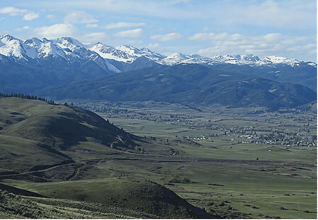
Pine Valley
A giant rock overlooks Pine Valley. We call it Granite Mountain. Gold was discovered there in 1884. Following that discovery, the Cornucopia Mines dominated the local economy until 1942, when the War Production Board’s Order No. 208 shut down gold mining in the United States.
Without the mines, Cornucopia became a ghost town, and Pine Valley’s economy became completely dependent upon agriculture and lumbering. The valley is about ten miles long and five miles wide. Even so, Pine Valley was still the home of the Baker County Fair. And when the longtime announcer stood in his booth over the bucking chutes each fall and told us, “This is where the pavement ends and the West begins,” he spoke straight truth. We definitely lived at the end of the road.
Typical of a rural, somewhat closed society, our arrival was regarded with a degree of suspicion by the residents. Dad was unabashed. His experiences during the depression, on the road, riding the rails, and living hand to mouth had taught him how to assimilate into varying social situations. He quickly found a job as a farmhand. The job came with an old farmhouse near Pine Town. We moved into the house, and Mom set up housekeeping. Mom had grown up traipsing around Arizona, following her dad from mining job to mining job. She was no stranger to household moving. When September rolled around, I started third grade in my fourth school in as many years.
Pine Town school consisted of two rooms, two outhouses, and a belfry. The extra room may have been utilized in years past, but by 1945, all eight grades were taught in one room by one teacher. Rows of desks bolted down to board rails lined the room. Students were assigned desks with each grade occupying a row or portion thereof. I don’t know how she did it, but our country schoolmarm was perfectly capable of maintaining discipline and advancing the three Rs to eight levels of learning without assistance. Perhaps some of today’s class size negotiators could use a lesson from Mrs. Krego.
The job Dad hired on to was for an elderly rancher, the descendant of a pioneering family. This gentleman no longer ran cattle but relied on pasture rental and hay sales to support his operation. When the growing season ended, so did the job. However, a neighboring rancher needed a man to feed his herd during the winter, so Dad took that job. We continued to live in the first rancher’s house.
For Eldon LaRue, this was a large departure from the dairy in Baldwin Park, California. Even so, he was doing something he loved again. He had escaped the clutches of the machinery of war. He was once more working with cattle. When thinking of an epitaph following his death, the best l could come up with was: “He was a herdsman by nature and damned good with cattle.” RIP to my father, who safely guided his family through the challenges of War on the Home Front.
Dry Creek: We set down roots.
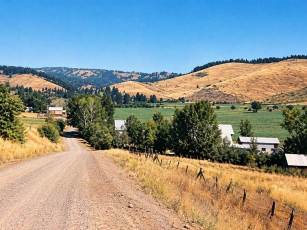
Dry Creek
A new world is dawning with the coming of Spring, 1946. I have survived my first winter in the North Country. March brings raw Chinook winds and the onset of spring runoff. Pristine snow-covered meadows and hillsides turn an ugly brown. Farmsteads and barnyards turn to muck. Icebound creeks and streams flow anew. Spring breakup is underway.
April follows with warm, gentle rains. The ground warms, and dormant flora takes on a new life. The brown world turns to green. My nine-year-old mind does not yet grasp it, but a new sense of promise stalks the land.
Far away from our small world, factories are retooling from wartime to peacetime production. The deprivations of rationing are ending. Consumers’ pockets are bulging with wartime savings. They are buying everything the factories produce as fast as it comes off the end of production lines. Shiny new cars of every color crowd America’s highways, even along the rutted gravel roads of Pine Valley. Sparkling white appliances adorn country kitchens for the first time.
Spring farming gets underway. Brightly painted new tractors pull plows and harrows through the fields. Mechanization invades the countryside. Pine Valley is coming of age. In the words of one of our neighbors, “Power machinery is taking over.”
Power machinery may be taking over, but somehow it misses us. My parents buy an eighty-acre farm in a little valley called Dry Creek. Dry Creek is something of a misnomer. The stream flows year-round and meanders through the valley from the mountains to the north. A narrow road cuts along the ridge on the west side of the canyon, leading up to the valley. Our new home is two miles from the nearest electric power pole. A single phone line serves the three families that populate the valley. Mr. Roosevelt’s Rural Electrification Administration must have missed Dry Creek. We take up a lifestyle more attuned to the nineteenth century than the twentieth.
As we settle into our new way of life, my busy summer passes quickly. Hard work does not seem a burden. Adapting to life without modern conveniences is more of an adventure than a problem. September arrives, and I start the fourth grade in the fifth school in as many years. My new school is in Halfway. It is a four-room school with two grades in each room. My brother starts first grade there. Pine Valley has no kindergarten. We walk two miles to the bus stop. Some other kids from a neighboring ranch accompany us. They are used to the walk and don’t complain. Post-war on the Home Front takes on many forms. We don’t analyze it. We just live it.
Country boy to Naval Aviator
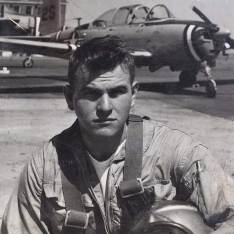
I graduated from high school in 1955. In September, I enrolled at Oregon State College. I lasted for two quarters and joined the Navy. The old country school marms must have done a pretty good job of instilling the three Rs. The Navy gave me a battery of tests and decided I was smart enough to qualify for pilot training.
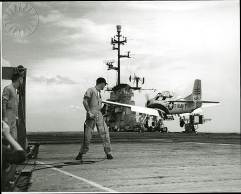
I managed to land a T-28 Trojan aboard the USS Antietam and winged as a Naval Aviator by skill and daring, and an Officer and Gentleman by act of Congress in 1958.
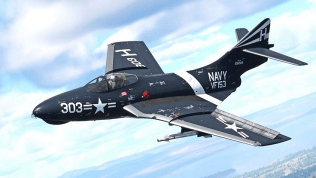
I went on to fly a variety of aircraft, including the F9F-8 Cougar,
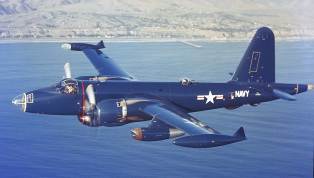
and the P2V Neptune.
It was a time of peace between the Korean War and the Vietnam War. When my active duty obligation ended, I chose to return to civilian life and go back to school.
Writer of stories to inform and entertain..
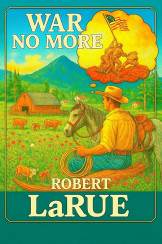
Born on the cusp of World War II, I watched as my parents, aunts, uncles, and friends shipped off to unknown lands and returned carrying the painful scars of war. I watched as these veterans adjusted to an ever-changing way of life and created the free world we were all to inherit. This novel is dedicated to those brave souls we now call “The Greatest Generation,” lest we forget.
From the jungles of Guadalcanal to the bloody beaches of Okinawa, Paul Harper learns the hard lessons of war. Now safely home in Otis Orchards, Washington, with his companions malaria and nightmares, he’s just trying real hard to adjust. A reunion of family and friends and even Mom’s home cooking does little to assuage the demons assailing him. Rebuilding a family-owned ranch in Idaho, fallen into disrepair, offers both challenge and salvation for his war-torn spirit.
Book Reading….

One response to “Transcript from my Veterans Day address at the Post Falls Museum”
great writing as always, Lash. Some was very familiar
LikeLike