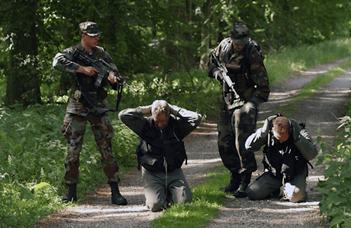
Unmerciful sun beat down on the mountainside. A helicopter plucked a sunstroke victim off a shale ledge and flew away. We kept a slow, steady pace. None of us wanted to be the guy on the helicopter.
The Korean War was history. Few Americans had even heard of Vietnam. Peace ruled the land in the late 1950s. But readiness was still the mission of the U.S. Navy.
As a newly minted Naval Aviator with shiny new gold bars on my collar and shiny new gold wings on my chest, I was still getting used to being called “Sir” when new orders read: “Report to Survival School.”
About 30 Navy personnel assembled in a building on North Island Naval Air Station for a short series of lectures on survival and prisoner of war conduct. When the lectures ended, we marched down to the beach.
Guards dressed in uniforms right out of a Hollywood war movie set handed us C-rations and disappeared.
Our senior officer, a Navy Commander, took charge. He divided us into two companies with two squads. With the rank of Ensign, I was assigned to lead one squad of six enlisted men.
As evening approached, we all gathered driftwood and started a bonfire.
An abandoned barrel, half-filled with water from the only tap on the beach, became our cooking vessel. We each donated one can from our C-rations for a hobo stew.
Some citizens were digging for clams and diving for abalone nearby. Trading with the natives seemed within the rules of war. We struck a deal for their catch.
Supposedly stripped of personal property except the clothes on our backs, how a bunch of penniless sailors pooled enough money to cumshaw those illicit crustaceans can only be described as the Navy Way. We threw the catch in the pot. The stew turned out surprisingly well.
Ocean survival drills filled our days. Wrapped up in parachute panels as makeshift sleeping bags, we tried to sleep at night. For the final drill, our captors herded us onto a boat and dumped us overboard in the open sea with nothing but a Mae West for flotation.
After what seemed an eternity, a helicopter hovered over me. It released a sling dangling from a cable. I slid my arms through the sling. They hoisted me aboard. Wet and shivering, I joined my fellow survivalists. The helicopter crew delivered us back to the beach to await our next adventure.
It came in the form of a bus ride over narrow, winding roads to Warner Springs Survival School.
The camp could have passed for the set of the movie, The Bridge on the River Kwai. Guards escorted us from the bus into the chain-link fenced compound and sat us down on long benches. They lectured us on desert survival and laid out the schedule for the next two days.
A mountain hovered over the camp. We were to hike up that mountain to a campsite where C-rations and water would be issued and spend the night there. The next day, we would hike back down that mountain. Marines from Camp Pendleton would try to capture us on the way down. If we reached a flagpole outside the compound without capture, our survival training would be over. If captured, the Marines would return us to the compound for a round of interrogation.
The hike began on a well-worn trail in cool early morning air. As the day wore on, the terrain became steeper and the trail less defined. The temperature soared, and the small canteen of water we carried soon went dry.
My squad of late teens and early twenty-year-olds had by now become a tight little group. We saw little of our company commander. He was a Navy Lieutenant, a seaplane pilot. He hung out with the senior officers most of the time.
At a shale-covered rise near the bottom of a canyon, we stopped for a break. Just ahead, a patch of sand with a few green bushes contrasted sharply with the desert browns and reds around it. We made for the shade of the bushes and sprawled on the ground.
As a country boy not long off the farm, I knew that where there’s green, there’s water. I dug in the sand with my hands and, about a foot down, found moisture. My companions joined in, and we soon had a basin dug with water rising from the bottom. We waited anxiously for the sediment to settle.
The voice of our seldom-seen company commander suddenly demanded. “What are you doing here?”
“Oh, just practicing survival,” I answered dryly.
“What’s that?” he asked, pointing at our spring.
“Looks like water,” I answered.
“What are you going to do with it?” he asked.
“Drink it. Care to join us?” I responded.
“You can’t drink that. Cows might have peed in it.” With that, the Lieutenant sat down, pulled off his boots, and stuck his feet in our pool. “Aah, that feels good,” he said.
I held my tongue, got my squad up, and moved out, leaving the Lieutenant sitting there with his feet in our water.
He soon overtook us and started barking orders, telling us to form up. He must have decided that our little group needed to rejoin the military. We just tightened ranks and hiked on up the hill.
Eventually, the heat and lack of water took their toll on the old seaplane pilot. Out of shape and exhausted, he sat down on a rock, looked up at me, and said, “I can’t go on any farther.”
At that point, rank and privilege ceased to exist. I got him back on his feet and moving. My young, in-shape companions gladly hiked on ahead. My charge became the Lieutenant.
I picked up a stick and prodded him up the hill. We eventually made it to the campsite. He drank some water, seemed to recover from his delirium, and rejoined the senior officers. The breakdown of discipline on the trail was never discussed.
The campsite had trees, and it was cooler. The guards issued C-rations. We ate hungrily. Tents made of parachutes hung from the trees. There was no singing around the campfire that night. Exhausted, we crawled into the tents and slept.
Reveille came early. A quick muster, and we were on our own. I took the evasion part of Survival, Evasion, Resistance, and Escape (SERE) seriously. I wanted none of the resistance part. We started down the hill. It was every man for himself.
I could see the line of Marines working their way up the mountain and the compound with its flag off in the distance. Some of the evaders took off running down the hill, hurrying to reach the flag. Soon, the pop-pop of M1 blank cartridges filled the air as the Marines captured them.
I decided to take “a path less traveled” and drifted away from the crowd. A barbed wire fence soon blocked my progress. A sign on a fencepost announced, “California Department of Corrections. Keep Out.”
It was decision time. I suspected that what awaited me if captured would not be pleasant. The question was, what would happen if the prison authorities caught me trespassing on their property?
What could they do? They certainly wouldn’t put me through the torture of the interrogation the SERE guards had in mind. What the heck, all’s fair in love and war. I crawled through the barbed wire and pressed on. If caught, I’d just play dumb and say I didn’t see the sign.
I took what cover I could find. Once, I thought a Marine spotted me, but he was busy taking another prisoner and either did not see me or chose to ignore me. Some guys in dungarees with DOC painted on the back of their shirts were sitting in the shade near a barracks. They waved. I waved back.
With the flagpole within sprinting distance, I hunkered down behind a clump of bushes and watched. A couple of Marines delivered a prisoner to the guard at the flagpole. They headed back to the action, and the guard escorted the prisoner to the compound. That was my opportunity. I grabbed a post and vaulted over the minimum security fence, sprinted to the flagpole, wrapped my arms around it, and hung on. The guard came back, spotted me with a surprised look on his face, and pointed me to a door outside the compound.
In a darkened room, my fellow escapees and I observed the compound yard through a one-way mirror. A guard led a captive on his hands and knees around with a leash like a dog. Other guards crammed a captive into a sweat box and slammed the lid down. They pulled a dazed captive from another sweat box, slammed him into a chair, and tied him tight with ropes. A scratchy speaker in the room provided sound from the drama in the yard. An interrogator across the table from the bound man directed him to sign a confession for committing war crimes. This seemed like a joke at first, but as the scene unfolded, it took on an air of reality. The interrogator called the man the son of a whore dog, insulted him and his wife and mother repeatedly, and bore down with insults and accusations until the poor fellow was reduced to tears. He finally signed the confession. These scenes continued until late afternoon.
The nightmare ended with a bus ride back to North Island and a new appreciation life as we live it. Along the way, the bus stopped at a roadside burger joint. The Navy treated us to the best darn hamburger I have ever eaten, bar none.

One response to “Survival, Evasion, Resistance, and Escape (SERE), 1958”
Hi Bob,
Good story about a survival school many have not encountered, including me.
Thanks,
Mike
LikeLike