Airmen on the line suffered a terrible toll during Operation Rolling Thunder, a codename for an American bombing campaign during the Vietnam War. Originally slated as an eight-week campaign in spring 1965, it lasted until October 1968. While Lyndon Johnson and Robert McNamara played war and handpicked targets from the armchair comfort of the White House, an estimated 900 aircraft went down as U.S. forces delivered 643,000 tons of destruction.
One of those downed aircraft was piloted by my friend Al Stafford. I first met Al when we were stationed at NAS Whidbey Island, Washington, in the late 1950s. Whidbey Island was a rather isolated duty station in those days, so the Officers Club served as the primary social outlet for young bachelor officers. There was an old upright piano collecting dust in one corner. Al could play a few chords. Not long after his arrival, he had a bunch of us gathering around the piano, singing old pilots’ favorites like “Torque me into the Runway” and songs remembered from college, such as “The Whiffenpoof Song.” We sang, sipped stingers, and smoked Pall Mall cigarettes into the night. We called ourselves the Sit, Sippin, and Singin Society. For some of us, that camaraderie would last a lifetime.
Al, Jim Turner, Chris Phelps, and I rented a house off base and formed what Naval Aviators call a Snake Ranch—a party pad occupied by bachelor officers. The house had an unfinished basement that we converted into a makeshift bar. For a time, the four of us presided over a version of Party Central until new assignments broke up the party, and we all moved on.
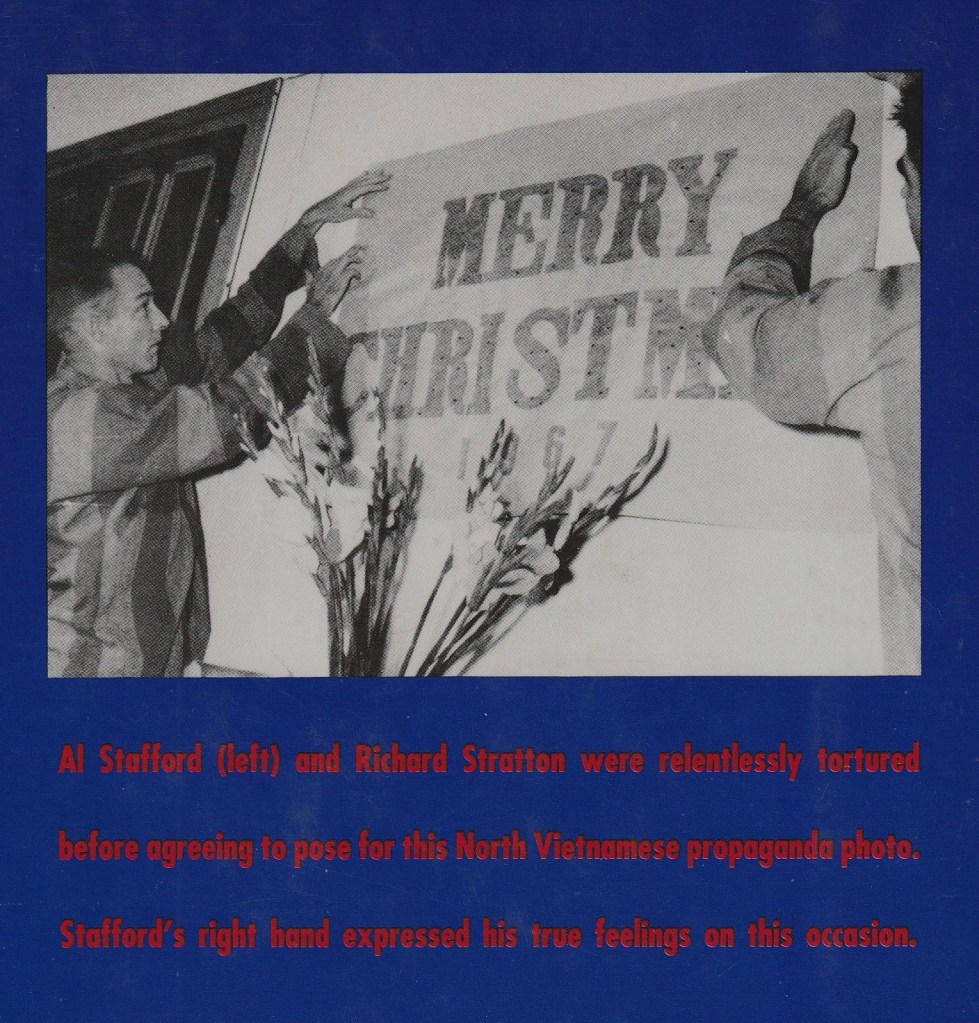
The next time I saw Al was ten years later on television. It was 29 January 1969. I was sitting comfortably in my suburban living room in San Jose, California, idly watching the evening news on NBC, when they showed a clip of two emaciated Vietnam POWs hanging a Merry Christmas sign on a wall. I did a double-take when I realized one was my old Sit, Sippin, and Singin Society buddy, Al Stafford. The other was Dick Stratton, whom I remembered from Chase Field in Texas. Until then, I had largely avoided all the controversy surrounding the war. I had put the military behind me and decided to let Johnson, McNamara, and the generals run the war. Suddenly, the war was right there in my living room. I was struck with a new understanding of why pundits were calling the Vietnam War “the living room war.”
What I didn’t understand at the time was the relentless torture the two men had undergone before agreeing to pose for the North Vietnamese propaganda photos. Nor did I notice Al’s right hand with the middle finger raised, expressing his true feelings about the occasion. However, Al told me later that US Military Intelligence took note, and his subtle message helped set policy at the time.
For most of America, the enormity of the Vietnam POW experience would not be realized until the victims could tell their stories after Operation Homecoming in 1973. While the conflict continued, the Johnson administration kept such information classified. I wrote letters to the Navy Department and State Department, asking how to contact POWs, and was referred to the Red Cross. So much for country boy naivety.
Al was flying an A-4 Skyhawk off the USS Oriskany when he was shot down over Hanoi in 1967. His replacement pilot was a fellow named John McCain, who was shot down a few months later.
In 1990, Al collaborated with author Geoffrey Norman and published a book called “Bouncing Back: How a heroic band of POWs survived Vietnam.” In it, he relates an interesting anecdotal insight into the Stafford-McCain relationship.
The Al Stafford I knew was a bit of a renegade. Incarceration did little to change that. He delighted in pushing his captors’ patience to the limit. Not surprisingly, he was rewarded with more than his fair share of time in solitaire. He was enduring an extended stay in an isolation cell called the Corncrib at the prison called the Plantation when he first encountered John McCain. The following excerpt from Bouncing Back describes that encounter.
“Then, one morning as he [Stafford] stood at the door, watching through the cracks, he saw a POW on crutches being led slowly across the yard by a guard. The man had shockingly white hair, almost as though he had suffered some traumatic fright. Stafford knew that the man had to be John McCain. Nobody else in the Navy had hair like that.
“…As Stafford watched, McCain detoured out of his assigned path and hobbled a painful fifteen or twenty feet on his crutches before the guard could stop him. By then, he was standing directly in front of Stafford’s cell.
“Hey, Al, baby,” he said cheerfully as though they were meeting on the street somewhere. “You hang in there, now. Don’t let the bastards grind you down.”
The Vietnam POWs networked in many ingenious ways. One method was to hide notes for each other in secret stashes. Al found one such note from McCain when he was allowed an infrequent bath. It explained that he [McCain] had been Stafford’s replacement in VA-163 on the Oriskany, and that, like Stafford, he had been shot down, captured, and through the all too familiar interrogation routines the POWs endured, including the torture chamber they called the Green Knobby Room at the Hanoi Hilton. McCain noted that he had also been moved to their present location, the prison they called the Plantation, and ended with these words: “Listen, Al, since I seem to be following you around, I would appreciate it if you didn’t do anything stupid and get us both in real trouble.” John McCain had his share of detractors in later political life, but they didn’t know him when he flew wing during trying circumstances.
Al and I reestablished contact a few years after his release in 1973 and kept in touch, more so with the advent of the internet. In 1999, I received an Email in which he stated that there was an upcoming POW reunion in Wenatchee, Washington. He planned to attend and make it a nationwide road trip from his home in Pensacola, Florida. He planned several stops before he got to my place in Hauser Lake, Idaho, followed by a stop in Spokane to visit fellow POW Jim Shively. From there, he planned to proceed to the reunion and then travel to San Diego to see his daughter before returning home via the southern route. He made the trip, and he and I had a grand reunion of our own.
In 2003, I received a notice from Al’s wife, Sharon, that he had flown west on 28 December 2003 at age 68. They held a memorial service for him at the Naval Aviation Museum in Pensacola. He is missed but not forgotten.

One response to “WINGMEN”
wow Bro! Thanks for sharing. Sis
LikeLike