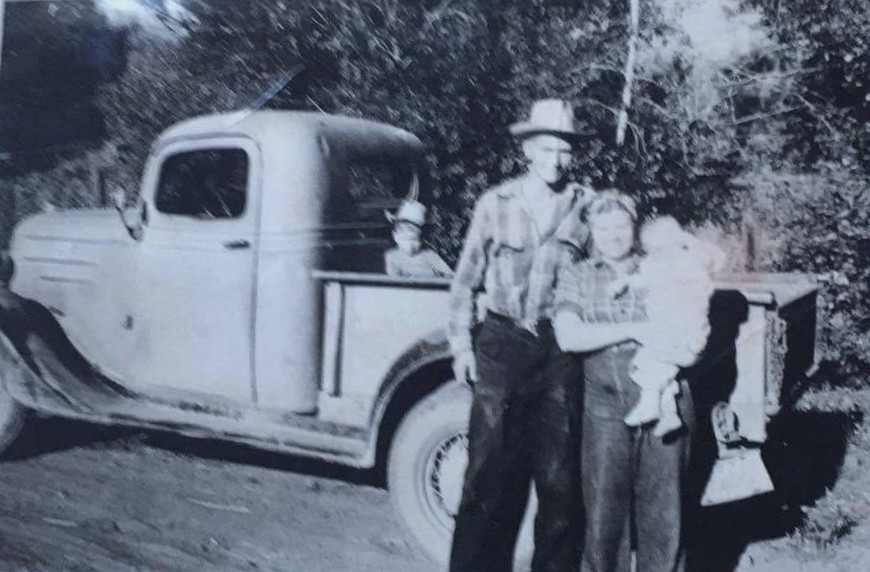
I don’t recall much about our move from the row of farm workers’ shacks, where Dad milked cows, to our own place. In my memory, it is as if one day we were there and the next we were at our new home.
Our new 20-acre homestead consisted of a house, a barn, a small nut orchard, and a good-sized plot of fertile Sacramento Valley row-crop land. The orchard consisted of almonds (or, as folks around Chico called them, ammonds) and walnuts. The cropland lay fallow. The house was much too small to accommodate two families. Grandma, Grandpa, and Jimmy needed a home of their own.
For Dad and Grandpa, building a house posed no problem. They were both good craftsmen. The problem arose when they tried to get their hands on framing lumber. Like everything else, lumber was in short supply. The war effort now devoured everything but life’s bare necessities. As happened all too often, they were put on a waiting list.
Once more, family came to the rescue. Dad’s uncle David and his family lived in Chico. Uncle David worked at a local sawmill. He knew how to cut through enough red tape to get the needed lumber delivered. Dad and Grandpa went to work.
The house went up rather quickly. I don’t think it was ever completely finished, but it was finished enough that Grandma reluctantly agreed to move in. At times, you just had to learn to make do on the home front.
In the meantime, Grandpa acquired an old horse and enough implements to start farming. Most folks during the war had small victory gardens. We soon had several acres of victory garden. Jimmy and I got our initiation into the meaning of hard work from that garden. At Grandpa’s direction, we learned to hoe around plants and nurture them into production. Lord help the offender who happened to uproot a watermelon seedling instead of a pigweed. Melons made up the main crop, but there were also beans, corn, tomatoes, and more. When each crop was ready, we picked and loaded it into Dad’s 1937 Chevrolet pickup truck and peddled it to stores around the valley. What we didn’t sell, Mom and Grandma canned. We were well fed.
When the nuts were ready in the orchard, we spread tarps on the ground under the trees. We shook the trees by pounding on the trunks with baseball bats padded with pieces of a rubber tire. The nuts fell to the ground, and we gathered them and put them in sacks. The almonds were easy to shake loose, the walnuts more difficult and required a lot of hand-picking on ladders. The whole family participated, even my brother Wes, who was three years my junior.
Dad continued working in the paint shop at the air base. He also continued with the ambulance and accident cleanup crew. In 1944, Chico Air Base switched from basic training to fighter pilot training in P-38 Lightnings. Crashes and deaths doubled from 14 crashes and 8 deaths during the two years of basic training to 35 crashes and 16 deaths during the 16 months of fighter pilot training. That’s more than 2 crashes a month. The ambulance and cleanup crew stayed busy. Dad tried not to show it, but even I could tell that he was under a great deal of stress.
Summers are hot in the Sacramento Valley. Air conditioning was not widely available in the early 1940s. Makeshift evaporative coolers consisting of wet burlap sacks hung from open window frames with fans in front were not very effective. The only real escape from the heat was finding cool water. There was a public swimming pool in Chico, but my parents were afraid of public pools. They believed them to be a likely place to contract the crippling disease polio. So we did not swim there. We did occasionally go down to the Sacramento River to fish, swim, and picnic. We were enjoying an outing with Dad’s friend from work, Les Robbins, and family, when I decided to take an unsupervised dip. I waded out from shore by myself with confidence. Suddenly, the current picked me up, and I bobbed downstream like a waterlogged cork. I remember looking up at a bluff, high above the river, and seeing my dad preparing to dive when I felt the welcome arms of Mrs. Robins envelope me. My movements were severely restricted following that incident.
Nineteen forty-three moved on into 1944. My sister Deanne was born in August. The war continued unabated. I started second grade in September. The world at war, farming the land, P 38’s from the base buzzing overhead, bickering with Uncle Jimmy, Dad shooting a rabid coyote lurking around our chicken coup, Grandpa trying to start his old car with a hand crank because batteries could not be had and his cussing at it and hitting it with the crank, talk that the war would never end; these things all seemed normal to me. As a seven-year-old, they were all I knew. I had no other frame of reference. As Harry Truman famously said, “The only thing new is the history we don’t know.” We of my generation knew no history yet. The canvas remained to be painted.

2 responses to “The Chico Years”
oh yes. This is what I always wanted know about this time. When I asked Mom about it she was always vague. It wasn’t the best of times for her. She felt close to Les Robbins. She told me that when he died he talked to her in a dream. He apparently had some thing to do with our move to Halfway.
LikeLike
Another great reminder of our youth, Lash. You are a very gifted writer.RD
LikeLike