The attached manuscript by my brother Wes offers a fresh look at what makes us unique in our little corner of the universe. It is offered as a theoretical framework for scientific investigation. Wes will appreciate any feedback you have to offer.
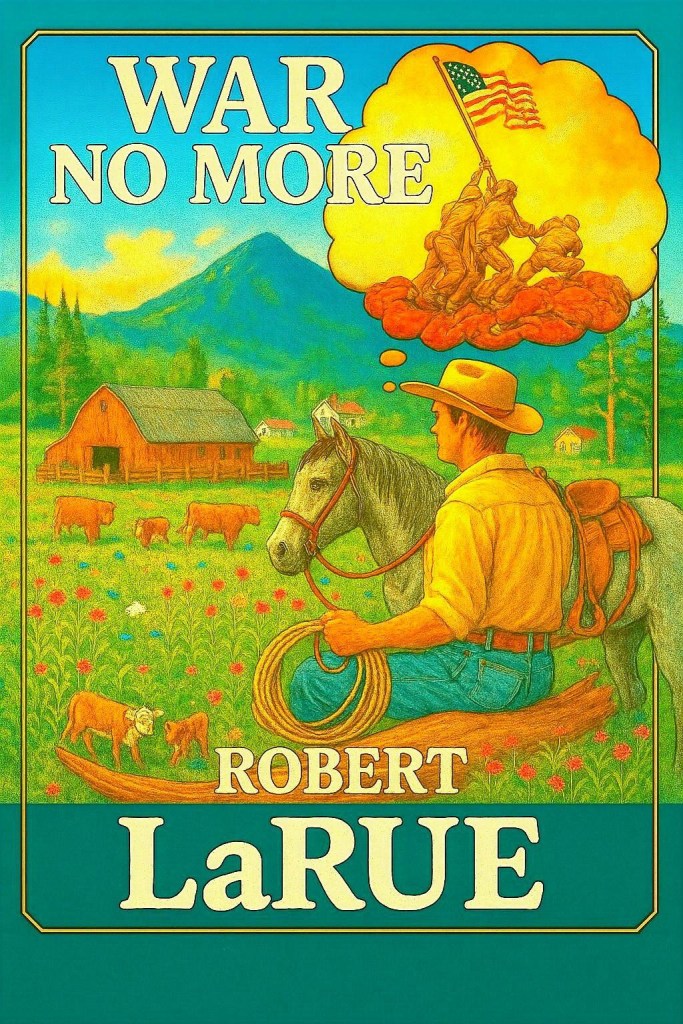
Opening Scene: Chapter 1 finds PFC Paul Harper far from home on the island of Guadalcanal in the South Pacific during World War II. Discover how he survives the perils of war and finds new life on a cattle ranch in the mountains of North Idaho.
Available on Amazon Kindle Unlimited for free, $3.99 to buy, or as a paperback, $14.99.
Paul Harper hunkered down in a shallow foxhole —his first taste of combat. The rest of his squad strung out in similar hastily dug foxholes to his left and to his right. He swatted at clouds of insects trying to eat him. He listened to sporadic gunfire raining down from the ridge above and kicking up small showers of dirt. While clinging close to the ground, he prayed silently, “Please don’t let one of those bullets find me.” He listened to the whine of mortar rounds flying overhead and exploding on the hill in front of him. The sound of screams as artillery found its mark sent shivers up his spine.
The death and destruction around him were not exactly what he had in mind when he signed up and swore to defend God and Country. This was not the larger-than-life hero’s role of protecting his country from a vicious yellow peril he had envisioned. Like thousands of fellow patriotic young men, Paul had peeled that role off a cinematic screen in two-dimensional images of black and white film. What he saw now included all three dimensions and came through in vivid living color. He was stuck on a small spit of land in the middle of the Pacific Ocean, risking life and limb to defend a ragged little airfield some fools had planted there. He could not see how this had anything to do with defending God and country. He was clear on the other side of the world.
Out of fear and confusion, Paul found an epiphany that day. Times were tough growing up during the Great Depression. His father struggled hard to keep food on the table. Like many of his neighbors in Otis Orchards, Washington, Sam Harper supplemented what the family grew in the garden and what he could afford at the grocery store with the meat of wild game from the surrounding mountains and countryside.
However, unlike the hunter-gatherers from generations past, he had to contend with game laws and hunting seasons. The age-old contest between prey and predator now held a new element. The prey now had the game warden and a network of spies and snitches to aid it in the age-old equation. Paul learned early on from his father not only how to stalk and kill wild game, but also how to do it without being seen. This was his epiphany. He had to figure out how to apply those same principles to his present predicament. He knew this from the bottom of his gut. The prey he now stalked could become the predator that would kill him if he failed to figure it out.
Paul peered over the lip of his foxhole. In front of him was an open area, cleared to expose anyone attempting to advance up the hill. Behind him and off to both sides was more of the seemingly endless deep jungle his platoon had been struggling through. The mortar rounds flying overhead and the rifle fire raining down the hill told Paul that he was directly in the line of fire between two opposing forces. He knew from training exercises that it was only a matter of time before the thump-thump of the battery behind him would cease, his sergeant would wave his arm forward, and pass the command, “Move out.” His squad would advance from the cover of the jungle and race fully exposed across the clearing. At that point, survival would have nothing to do with skill or cunning. It would simply be a matter of fate and statistics. The whole operation contradicted everything he had learned while growing up. In his world, you always maintained your cover.
At that point, Paul’s mind quit reasoning. Instinct took over. He slithered over the edge of the foxhole and crawled deeper into the undergrowth. He was back home on Mount Spokane, stalking a deer or elk. He crept through the jungle and worked his way to the right side of his platoon, off to where running water formed a small cut down the hillside. He buried himself in that shallow canyon and climbed about halfway up the hill before the rest of his platoon started its advance.
Paul looked back to his left as the platoon began its charge across the clearing. First one man, then another, and then still another fell as the main force of stooped-over running men moved forward. Medics ran out of the trees and gathered the wounded and dead as the charge continued. Paul resumed his advance, swimming and crawling up the muddy canyon. He reached the summit and dropped into the cover of jungle growth.
He watched as his platoon mates struggled up the hill against a withering rat-a-tat of machine gun and pop, pop, pop of rifle fire. He could see along the ridge where Japanese soldiers formed a line, well dug in and fortified. By now, his platoon was about halfway up the hill and stalled. Confusion reigned as the platoon lieutenant moved squads from one position to the next, trying to break through the gunfire.
Between his vantage point and the enemy line, he spotted a figure hiding in the branches of a tall tree. At first, he thought it was an animal. He shifted his position a little to get a better line of sight through the dense growth of his cover. He could now see clearly that it was a man. He watched as the spotter, sniper, or whatever he was, put something to his mouth and pointed with his free hand. Instantly, the machine guns on the hill re-aimed and chattered in rapid fire. Paul then sensed his mission. The man in the tree relayed his platoon’s every move to the machine gun battery. He had to be silenced.
Paul gauged the distance between his position and the man in the tree. He knew from hunting game that it was too great to ensure a clean kill. His father’s words came back to him. Make sure you are in a position to get a good, clean kill. The last thing you want to do is track a bleeding deer across an open snow-covered field.
He smiled a bit at the irony of the comparison. The chance of snow on Guadalcanal was about the same as the chance of snow in Hell. Even so, the principle remained the same. He did not want his quarry to spot him and give away his position. He inched forward toward the man in the tree.
At about 75 yards, Paul flattened out on the ground in a patch of tall grass. He parted the blades carefully, just enough for a clear line of sight to his quarry. He eased his rifle to his shoulder and carefully aimed from the prone position. He watched as the spotter lifted his radio microphone to his mouth, then squeezed off a single round. Instantly, the radio went flying and crashed to the ground. The man stretched and shuddered for an instant, then tumbled through the branches until some combination of limbs caught him, and he just hung there. Paul beat a hasty retreat to his hiding place, knowing that the enemy would be all over the place as soon as they realized they had lost their spotter.
Without the spotter’s eyes and ears for guidance, the machine guns quickly lost their effectiveness. Paul’s platoon promptly took advantage of the situation, and soon soldiers were pouring over the crest of the hill. Rifles fired, grenades exploded, bayonets thrust, and in short order, the hill’s ownership transferred to American hands. A squad of Americans advanced toward three Japanese soldiers milling around under the tree where the dead spotter hung. It was not Paul’s squad, but he unobtrusively joined in as the Americans overwhelmed and disarmed the Japanese. One of the Americans spotted the man hanging from the tree in a Japanese uniform with his head blown partly away, said, “What in the hell is that?”
“Looks like a Jap with his head half blown off,” another soldier said.
The squad leader, a battle-hardened sergeant, looked up. “Appears to me that somebody got himself a spotter here,” he allowed. He looked around and riveted Paul with a steady gaze. “Would that be you, Private?”
“Yes, Sergeant,” Paul answered.
“What the hell were you doing here? Where’s your outfit, and why aren’t you with them?”
“Well, I saw this guy in this here tree signaling somebody when we were pinned down on the hill down yonder, and so I just snuck up on him and shot him.”
“And just who in the hell told you to do that?”
“Well, actually, nobody. I just kinda did it.”
“Okay, Private, I don’t know whether to put you on report or pin a medal on you. I’ll let your squad leader decide about that. For right now, we need to get this pile of shit bunch of gooks over there with that other bunch of bastards we captured this afternoon. Move ’em out, men.”
News travels fast. When Paul rejoined his squad, his exploits were already general knowledge. His squad leader, Sergeant Kelly, first dressed him down for getting lost from his comrades and then congratulated him on his kill. His platoon leader, ninety-day-wonder master of eloquence Lieutenant Pringle, singled him out for “exhibiting unusual personal initiative in the face of danger by taking out a strategic member of the enemy force single-handedly” in front of the whole platoon when they camped that evening. The fact that he had managed to keep himself out of the line of fire was enough for Paul. The accolades were gravy. He knew he could just as well be receiving reprimands. A favorite platitude among the troops was “There’s a right way, a wrong way, and the Army way.” Paul Harper was beginning to understand what it meant.
Like a wagon train of The Old West, we get in line with a collection of about thirty other vehicles—everything from cars with tents tied on top, to 40-foot motor homes, to our 23-foot travel trailer. Our Wagon Master (tour guide) waves us forward—our destination, San Felipe, Baja California Norte, Mexico, on the Sea of Cortez.
It is January 1983. Wife Margaret and I are in year three of a life-on-wheels adventure. In our mid-forties, we have explored much of the western United States and Canada. It is time to take on Mexico.
Snowbirds gather along the southern U.S. border each winter. The brave venture into border towns to pick up cheap meds and liquor, and to get their teeth worked on. Most go no further. But brave and timid alike, they revel in retelling horror stories about travel in Mexico. With each telling, the stories become more terrifying. We listen to the stories. To play it safe, we joined this Yuma, Arizona, and San Felipe Chambers of Commerce-sponsored caravan.
At the Mexicali Port of Entry, guards check our IDs and wave us through. Life in the third world begins. Familiar rules of the road no longer apply. Traffic signs, printed in Spanish, are small and almost hidden. No one seems to obey them anyway. We follow the rig ahead of us, blindly.
An escort of motorcycle cops joins in. With red lights flashing and sirens blaring, they herd us along. Confusion reigns. Horns honk as cars, trucks, and buses crowd in and out of our line of vehicles. With one foot on the gas pedal and the other on the brake, I strive to keep up without crashing. We finally reach the outskirts south of the city. Traffic eases, and the scene turns rural. My white knuckles on the steering wheel take on a renewed lifelike color.
The Mexican part of the Imperial Valley is not unlike the farming areas around El Centro and Brawley on the U.S. side. Crops grow even in winter, and men wearing straw hats and women wearing bandanas work the fields.
The valley ends, and the landscape turns to desert. No shoulders border the narrow pavement. The road follows the hilly terrain with little cut and fill. Patches of broken asphalt and detours around boulders blocking deep potholes slow our progress. After about 100 miles, we spot the upper reaches of the Sea of Cortez. We are nearing our destination.
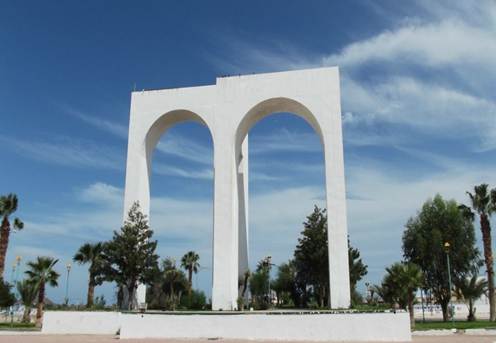
The Gateway to the Sea of Cortez, a sixty-foot-high pair of white arches, welcomes us to San Felipe. Our guides lead us to a modern trailer park called Ruben’s Camp. It fronts the beach, and palm trees wave in the breeze. We settle in for a week of exploration.
San Felipe is a quiet fishing village in the throes of transition to a tourist destination. The streets are still mostly dirt. The town is built along the arc of a picturesque beach lining an open bay. A large square breakwater provides shelter for the fishing fleet.
Most of the folks in our caravan are typical tourists, worried about drinking the water and complaining about the culture. They complain that businesses close in the afternoon for siesta and that the people do not speak English. The fictional Ugly American plays out in little San Felipe, a mere 122 miles from the border.
I quickly learn that the expatriates who spend winters at Ruben’s Camp gather in the combination office/clubhouse for café (coffee) and pan dulce (doughnuts and sweet rolls) each morning. I joined them and began my Mexican travel education. There are many details to digest, but the main points are to not drive after dark, use main highways, stay in recognized campgrounds, and that the horror stories I have heard are way overblown. When the week comes to an end, and our fellow tourists line up for the trip north, we bid them farewell and stay put. We relax and start to enjoy the Latin American way of life.
Spectacular sunrises greet us each morning. Birds fill the skies and dive for their breakfasts. Pangas race across the bay on their way to deep-water fishing. Our days are filled with exploring the town and the surrounding area. A surprising number of American expatriates, some in rented houses and some camped out in the desert, seem safely assimilated into the culture.
We befriend fellow greenhorns. Lee and Lennie, in their thirties from McCall, Idaho, are bent on sailing a 22-foot sloop to La Paz. A storm producing 10-foot swells blows through on their first day out. They retreat, and we spend good times clamming and picnicking on the beach with them. They finally get underway, and according to mutual acquaintances we meet later in McCall, make it to La Paz safely.
Al and Carol (Carol is the sister of actress Madelyn Rhue) camp next to us. Al and I charter a panga and spend a good day fishing. We buy clams and mussels from a local vendor called the Clam Man, whose mantra is, “My clams make you horny, guaranteed!” We enjoy a good clam feed. But the jury is still out on the Clam Man’s slogan.
Three weeks pass, and we are ready to take on Mexico—alone this time. We return to Yuma to collect the mail, pay the bills, and do a little shopping. The trip through Mexicali goes much smoother without the motorcycle cops helping us. A week later, we set out on our next south-of-the-border adventure with a newfound sense of confidence.
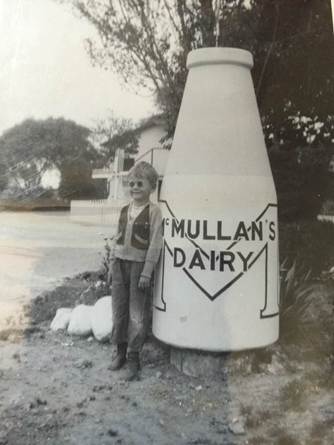
The author poses at the dairy entrance, with dark glasses as a result of a recent bout with measles.
December 7, 1941, may have been “a date which will live in infamy” for President Roosevelt, but it was the beginning of all kinds of strange and scary events for a four-year-old. The wailing sirens and darkness of blackout drills stand out in my mind.
We lived on McMullan’s Dairy in Baldwin Park, California. Baldwin Park is located only about twenty miles from downtown Los Angeles. In the days before supermarkets, it was not uncommon for dairies to be located near population centers. On-site retail marketing was a common practice. After the attack on Pearl Harbor, what had been considered a good location for dairy product retailing also came to be considered a prime target for a Japanese attack.
Before radar bomb sights, bombardiers relied on what they could see on the ground to figure out where to release their devastation. A primary means of civil defense against a night attack was the blackout. If there was no light on the ground, the attackers could not identify their targets. The sound of blackout sirens in the night became a fact of life for us.
Rationing also became a fact of life. Living on a dairy, we had plenty of milk, cheese, and butter, but meat was rationed, even for us. To supplement our diet, Dad built some hutches and raised rabbits. He shared the fryers with the dairy’s owners, a Dutch family named Kohn, in exchange for alfalfa and grain. Mrs. Kohn also helped with caring for the animals.
One dark night, I was out by the hutches helping Mrs. Kohn when the sirens wailed, and the lights went out. She had come prepared for such an event with a flashlight. She handed the flashlight to me to hold while she finished the chores. Like any kid of four, I proceeded to flash the light around and point it at the sky. Sweet, gentle Mrs. Kohn came unglued. She grabbed the offending torch from my little hands and explained to me in no uncertain terms that I could have caused us to be bombed. I suppose she was somewhat oversensitive about bombing since she still had family in Holland who had recently experienced the Blitzkrieg. But she scared the heck out of me. I quickly changed from being a carefree child piercing the night sky with a harmless flashlight to being a magnet for falling explosives.
To this day, I feel a stab of fright any time I allow a flashlight’s beam to wander above the horizon at night!
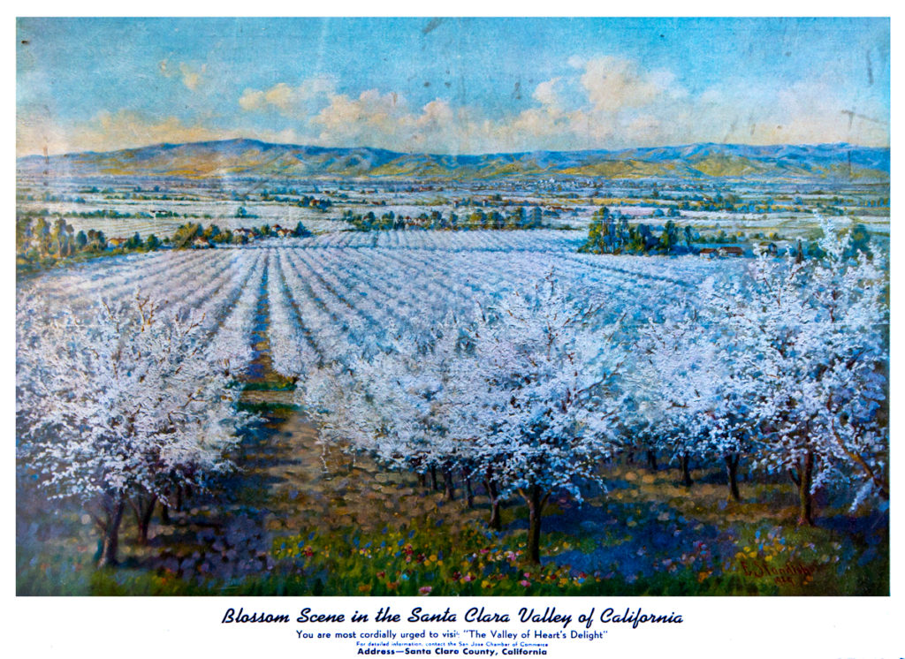
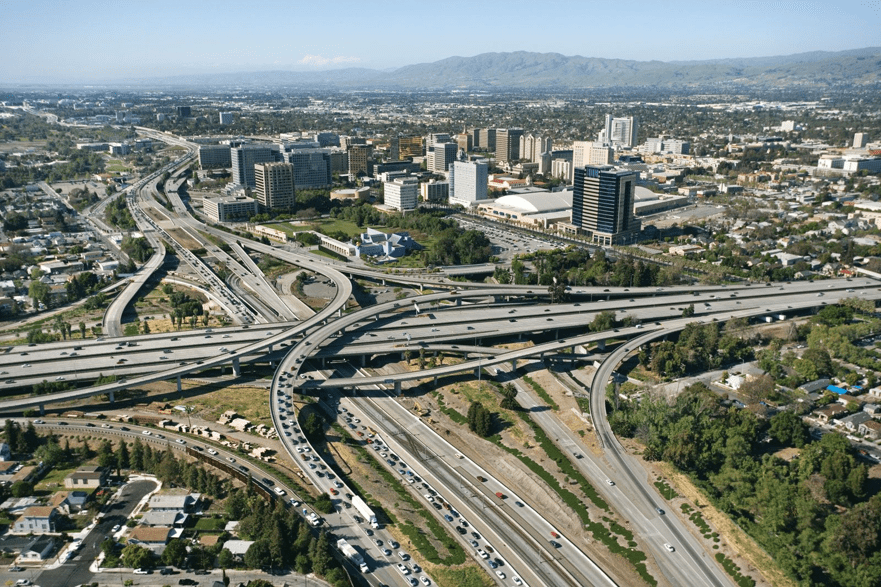
A Half Century of Progress? (Note the same mountains in the background)
When the ancients wrote of the Garden of Eden, they may well have used California’s Santa Clara Valley as their model. “And out of the ground made the Lord God to grow every tree that is pleasant to the sight, and good for food ….” Genesis 2:9. Or so it seemed until an enigma called Silicon Valley took root.
The valley, named after the Spanish Mission Santa Clara, was long known as the Valley of Heart’s Delight for its high concentration of orchards, flowering trees, and plants. Until the 1960s, the Santa Clara Valley, with 39 canneries, was one of the largest fruit-producing and packing regions in the world. That all ended as a new class of urban developers descended like locusts to root the trees and trample the land like a herd of Monterey Wild Boar in a cabbage patch.
Bulldozers uprooted orchards and vineyards. Cookie-cutter housing tracts popped up in their wake. Strip malls, shopping centers, factories, and office buildings sprang up where quaint homesteads and villages once stood. Ever-widening streets and new freeways couldn’t keep up with the demands of ballooning traffic.
Fresh out of the Navy, I hit the Bay Area in 1960, driving a 1958 Chevy Bel Air with payments due and about $200 in my pocket. Nine years later, I had a wife, two kids, a house in the suburbs with a 30-year mortgage, a 1969 Ford Country Squire station wagon with fake wood trim, and a 1963 Austin Healey 3000 sports car. I worked as a scientific computer programmer in the Information Sciences Department of Fairchild Semiconductor International, Inc.—the seat of the new silicon technology. Some would say that I had made it. I was not so sure.
Sitting in my Austin Healey with the top down, awaiting a turn to get on the new 280 freeway, I watched the river of traffic flow by. The smell of horse manure caught my attention as a pickup truck towing a horse trailer rattled down the highway. I was transported back to my youth, growing up on a ranch in Eastern Oregon. The old saying—you can take the boy out of the country, but you can’t take the country out of the boy—invaded my mind as I joined the throng of indistinguishable commuters on their way to work.
What should I do? Conventional wisdom told me “Stay where you are.” My gut told me “It’s time to move on.”
I compiled a list of every small-town business and institution in the area west of the Rockies I could locate that used a computer. I mailed an unsolicited job resume to each of them. That effort did not involve a lot of resumes at that time in history, but it did result in a job offer from Boise Cascade Corporation in Boise, Idaho.
In the autumn of 1969, amidst much wailing and gnashing of teeth by my in-laws over the tearing away of their only daughter and two grandsons, we watched as the moving van pulled away from our driveway on its way to Idaho. My wife, two sons, and I followed shortly thereafter—on our way to new beginnings. Our lives would be forever changed. My sports car would soon be transformed into a pickup truck. Hard work and clean air would be our future. Silicon Valley would be our past.
The Back to the Land movement of the seventies was just beginning. I don’t know if I was a part of that movement, or if I was simply returning to my roots. But I guess I lived it. How could a country boy know for sure?
Unmerciful sun beat down on the mountainside. A helicopter plucked a sunstroke victim off a shale ledge and flew away. We kept a slow, steady pace. None of us wanted to be the guy on the helicopter.
The Korean War was history. Few Americans had even heard of Vietnam. Peace ruled the land in the late 1950s. But readiness was still the mission of the U.S. Navy.
As a newly minted Naval Aviator with shiny new gold bars on my collar and shiny new gold wings on my chest, I was still getting used to being called “Sir” when new orders read: “Report to Survival School.”
About 30 Navy personnel assembled in a building on North Island Naval Air Station for a short series of lectures on survival and prisoner of war conduct. When the lectures ended, we marched down to the beach.
Guards dressed in uniforms right out of a Hollywood war movie set handed us C-rations and disappeared.
Our senior officer, a Navy Commander, took charge. He divided us into two companies with two squads. With the rank of Ensign, I was assigned to lead one squad of six enlisted men.
As evening approached, we all gathered driftwood and started a bonfire.
An abandoned barrel, half-filled with water from the only tap on the beach, became our cooking vessel. We each donated one can from our C-rations for a hobo stew.
Some citizens were digging for clams and diving for abalone nearby. Trading with the natives seemed within the rules of war. We struck a deal for their catch.
Supposedly stripped of personal property except the clothes on our backs, how a bunch of penniless sailors pooled enough money to cumshaw those illicit crustaceans can only be described as the Navy Way. We threw the catch in the pot. The stew turned out surprisingly well.
Ocean survival drills filled our days. Wrapped up in parachute panels as makeshift sleeping bags, we tried to sleep at night. For the final drill, our captors herded us onto a boat and dumped us overboard in the open sea with nothing but a Mae West for flotation.
After what seemed an eternity, a helicopter hovered over me. It released a sling dangling from a cable. I slid my arms through the sling. They hoisted me aboard. Wet and shivering, I joined my fellow survivalists. The helicopter crew delivered us back to the beach to await our next adventure.
It came in the form of a bus ride over narrow, winding roads to Warner Springs Survival School.
The camp could have passed for the set of the movie, The Bridge on the River Kwai. Guards escorted us from the bus into the chain-link fenced compound and sat us down on long benches. They lectured us on desert survival and laid out the schedule for the next two days.
A mountain hovered over the camp. We were to hike up that mountain to a campsite where C-rations and water would be issued and spend the night there. The next day, we would hike back down that mountain. Marines from Camp Pendleton would try to capture us on the way down. If we reached a flagpole outside the compound without capture, our survival training would be over. If captured, the Marines would return us to the compound for a round of interrogation.
The hike began on a well-worn trail in cool early morning air. As the day wore on, the terrain became steeper and the trail less defined. The temperature soared, and the small canteen of water we carried soon went dry.
My squad of late teens and early twenty-year-olds had by now become a tight little group. We saw little of our company commander. He was a Navy Lieutenant, a seaplane pilot. He hung out with the senior officers most of the time.
At a shale-covered rise near the bottom of a canyon, we stopped for a break. Just ahead, a patch of sand with a few green bushes contrasted sharply with the desert browns and reds around it. We made for the shade of the bushes and sprawled on the ground.
As a country boy not long off the farm, I knew that where there’s green, there’s water. I dug in the sand with my hands and, about a foot down, found moisture. My companions joined in, and we soon had a basin dug with water rising from the bottom. We waited anxiously for the sediment to settle.
The voice of our seldom-seen company commander suddenly demanded. “What are you doing here?”
“Oh, just practicing survival,” I answered dryly.
“What’s that?” he asked, pointing at our spring.
“Looks like water,” I answered.
“What are you going to do with it?” he asked.
“Drink it. Care to join us?” I responded.
“You can’t drink that. Cows might have peed in it.” With that, the Lieutenant sat down, pulled off his boots, and stuck his feet in our pool. “Aah, that feels good,” he said.
I held my tongue, got my squad up, and moved out, leaving the Lieutenant sitting there with his feet in our water.
He soon overtook us and started barking orders, telling us to form up. He must have decided that our little group needed to rejoin the military. We just tightened ranks and hiked on up the hill.
Eventually, the heat and lack of water took their toll on the old seaplane pilot. Out of shape and exhausted, he sat down on a rock, looked up at me, and said, “I can’t go on any farther.”
At that point, rank and privilege ceased to exist. I got him back on his feet and moving. My young, in-shape companions gladly hiked on ahead. My charge became the Lieutenant.
I picked up a stick and prodded him up the hill. We eventually made it to the campsite. He drank some water, seemed to recover from his delirium, and rejoined the senior officers. The breakdown of discipline on the trail was never discussed.
The campsite had trees, and it was cooler. The guards issued C-rations. We ate hungrily. Tents made of parachutes hung from the trees. There was no singing around the campfire that night. Exhausted, we crawled into the tents and slept.
Reveille came early. A quick muster, and we were on our own. I took the evasion part of Survival, Evasion, Resistance, and Escape (SERE) seriously. I wanted none of the resistance part. We started down the hill. It was every man for himself.
I could see the line of Marines working their way up the mountain and the compound with its flag off in the distance. Some of the evaders took off running down the hill, hurrying to reach the flag. Soon, the pop-pop of M1 blank cartridges filled the air as the Marines captured them.
I decided to take “a path less traveled” and drifted away from the crowd. A barbed wire fence soon blocked my progress. A sign on a fencepost announced, “California Department of Corrections. Keep Out.”
It was decision time. I suspected that what awaited me if captured would not be pleasant. The question was, what would happen if the prison authorities caught me trespassing on their property?
What could they do? They certainly wouldn’t put me through the torture of the interrogation the SERE guards had in mind. What the heck, all’s fair in love and war. I crawled through the barbed wire and pressed on. If caught, I’d just play dumb and say I didn’t see the sign.
I took what cover I could find. Once, I thought a Marine spotted me, but he was busy taking another prisoner and either did not see me or chose to ignore me. Some guys in dungarees with DOC painted on the back of their shirts were sitting in the shade near a barracks. They waved. I waved back.
With the flagpole within sprinting distance, I hunkered down behind a clump of bushes and watched. A couple of Marines delivered a prisoner to the guard at the flagpole. They headed back to the action, and the guard escorted the prisoner to the compound. That was my opportunity. I grabbed a post and vaulted over the minimum security fence, sprinted to the flagpole, wrapped my arms around it, and hung on. The guard came back, spotted me with a surprised look on his face, and pointed me to a door outside the compound.
In a darkened room, my fellow escapees and I observed the compound yard through a one-way mirror. A guard led a captive on his hands and knees around with a leash like a dog. Other guards crammed a captive into a sweat box and slammed the lid down. They pulled a dazed captive from another sweat box, slammed him into a chair, and tied him tight with ropes. A scratchy speaker in the room provided sound from the drama in the yard. An interrogator across the table from the bound man directed him to sign a confession for committing war crimes. This seemed like a joke at first, but as the scene unfolded, it took on an air of reality. The interrogator called the man the son of a whore dog, insulted him and his wife and mother repeatedly, and bore down with insults and accusations until the poor fellow was reduced to tears. He finally signed the confession. These scenes continued until late afternoon.
The nightmare ended with a bus ride back to North Island and a new appreciation life as we live it. Along the way, the bus stopped at a roadside burger joint. The Navy treated us to the best darn hamburger I have ever eaten, bar none.
The end of World War II in 1945 brought many changes to the home front. Germany surrendered in May. In August, the world’s first atomic bombs were dropped on Hiroshima and Nagasaki, and Japan gave up. Living in the farmlands of the Sacramento Valley, I do not remember a lot about the celebrations that took place. I do remember that shortly thereafter, we were loaded up and off on a new adventure.
Migration from farm to city marked the American experience from the beginning of the Industrial Age. That movement accelerated during WWII. Although he would not have thought of it in exactly those terms, my dad determined to do the exact opposite. He decided to get as far away from city life as he could, own his own piece of land, and farm full-time. With the war over and the government’s control of his movements ended, Dad set about to fulfill his dream.
In short order, he sold our little farm in Chico, California, and quit his job at the air base. He loaded our belongings into the back of a 1937 Chevrolet pickup truck, loaded Mom and the three of us kids into the cab, and headed north. The young hobo of the depression had traded his knapsack in for a truckload of family and possessions. But he was determined to live by his own rules nonetheless.
Dad drove, Mom sat on the right side holding baby sister Deanne. I sat in the middle, straddling the gear shift lever. Little brother Wes variously stood and lay down at Mom’s feet. Our route over the Sierras remains unknown to me. I do remember stopping at a wayside, perhaps around Lake Almanor, for lunch. A cool breeze wafted through towering Ponderosa Pines, a welcome relief from the summer heat of the Sacramento Valley. The scent of the pines, combined with the delicious pan-fried pheasant Aunt Marie had packed in our lunch hamper, remains with me to this day.
We pressed on to Alturas, a small ranching center in the northeast corner of California. We arrived in the late afternoon. The town was in a festive mood with banners stretched across the main street announcing its annual fair and rodeo. Cowboys and cowgirls, afoot and horseback, lined the streets and sidewalks. We found this all very exciting until we discovered that there was no lodging available. The war was over, and it was time to celebrate. People coming out of the hills and valleys surrounding the town had taken every room available.
Lakeview, Oregon, is about 55 miles north of Alturas. It was dark by the time we got there. It too was full up with the overflow crowd from its neighbor.
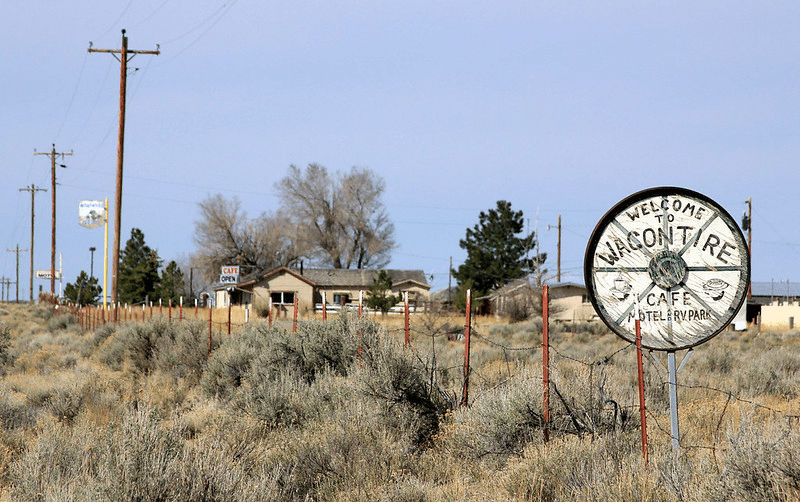
With the aid of a flashlight, Dad found a dot on the map about 85 miles north of Lakeview called Wagontire. We passed through the dark, starry night until a small sign and darkened buildings announced our destination. A gas pump, a café, and living quarters for the owners made up the entire town. A lighted window in the living quarters indicated that someone was still awake. Dad knocked on the door with the intention of asking if we could camp in their parking lot.
Perhaps it was learned behavior from his hobo days, or perhaps it was just in his makeup. My dad always exuded an air of quiet confidence and honesty. I like to think it was the latter. Anyway, he explained our plight to the man of the house. The man looked us over, invited us in, and put us up for the night. Who knows how often the Wagontire proprietors were called upon to tender such an act of charity along that lonely stretch of highway? I can only attest to this one event. And I have no way of knowing if any money changed hands. I am sure that we patronized their café before we departed.
That’s just the way things were done out in the country, on the home front, in 1945.
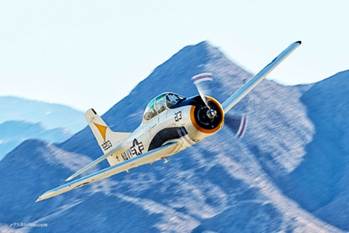
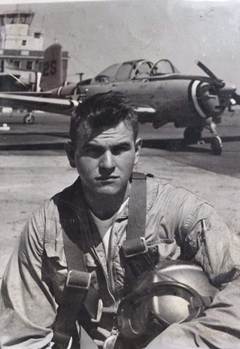
The author, w/Beechcraft T-34 Mentor trainer in the background. Naas Saufley Field, 1957.
The Nez Perce tribe called it the Land of Winding Waters. When the late nineteenth-century European immigrants arrived, they dubbed it the American Alps. It is that jumble of scenic mountains and valleys that make up the northeast corner of Oregon.
At the end of World War II, my dad loaded our family of five and all our belongings into a 1937 Chevy pickup and moved us from Chico, California, to one of those scenic little alpine valleys. I started third grade there in a one-room school, with about 20 other kids, grades one through eight.
Pine Valley had managed to survive the first 45 years of the twentieth century without yielding much. Farmers still tilled and harvested with horses, and mounted cowboys moved the livestock around. Dad bought a ranch about eight miles from the main town of Halfway, and that was home until I graduated from high school in 1955.
When I was thirteen or fourteen, we got our first tractor. It was a little Ferguson. I loved that tractor. Unlike a team of horses, you did not have to feed it, harness it, put up with its cantankerous behavior, or scoop its poop. It would not kick you, or bite you, or balk. When you wanted it to go, you simply mounted up, put it in gear, pulled the throttle lever back, released the clutch, and off you roared.
High school was a game for me. It provided welcome relief from the drudgery of ranch work. I played football, participated in Future Farmers of America (FFA), joined the debate team, and tipped over outhouses on Halloween. Even so, I was glad to see it end when our class of seven students finally graduated.
I enrolled at Oregon State College and lasted two quarters until my savings ran out. Working my way through college, washing dishes held little attraction, so I joined the Navy.
Naval Training Center (NTC) boot camp in San Diego was hardly a vacation of sunshine and beaches. But nothing they threw at me could compare to ten hours in the hot summer sun, bucking bales. Besides that, it was finite. I knew it would be over in six weeks.
Toward the end of boot camp, my company, along with several others, was assembled in a large hall and presented with a series of timed tests. The results of the General Classification Test/Arithmetic Reasoning Inventory (GCT/ARI) tests would determine the level of training we qualified for after graduation.
When we reassembled to learn our test results, the announcer started naming the recruits who had qualified for officer training. I was surprised to hear my name called. Those old country schoolmarms must have done something right. I could select either Officer Candidate School (OCS) or Naval Aviation Cadet (NAVCAD) training. I seized on the chance to fulfill a lifelong secret desire to be a pilot. Following an intensive screening process, I reported to the seat of naval aviation, Naval Air Station (NAS) Pensacola, Florida.
Preflight was 16 more weeks of boot camp, only considerably more intensive than anything NTC San Diego had to offer. It finally ended, and I started Primary Flight Training flying the Beechcraft T34 Mentor. I survived the familiarization phase (Riding in the back seat while an instructor pilot performs a full regimen of aerobatic maneuvers) without puking, then learned basic maneuvers and started landing practice. Every day was an exciting new challenge.
During an early session of shooting touch-and-go landings (Landing and taking off without stopping), I entered the final wide of the landing approach path. While trying to figure out how to correct things, I heard the word “power” from my backseat instructor over the intercom (IC). I reacted quickly and pulled the throttle back just like I had on the old Ferguson. The ensuing silence was deafening.
The throttle took on a life of its own and slammed forward. “I’ve got it,” the instructor yelled into the IC as the engine roared back to life. He took over, flew the airport landing pattern, and set us on the ground.
During the long walk to the debriefing room, my rattling on about the difference between a tractor throttle and an airplane throttle fell on deaf ears.
The debrief was very brief. “You could have killed us up there,” the instructor stated as he handed me my first down.
No more needed to be said. The message was clear. This was not a game. What we were doing was real. Few of life’s lessons would ever be so clear. I was 19 years old and growing up fast.
Final note: I completed training and earned my Wings of Gold as a designated Naval Aviator in June of 1958, three months after my twenty-first birthday.