Robert LaRue
The Nez Perce tribe called it the Land of Winding Waters. When the late nineteenth-century European immigrants arrived, they dubbed it the American Alps. It is that jumble of scenic mountains and valleys that make up the northeast corner of Oregon.
At the end of World War II, my dad loaded our family of five and all our belongings into a 1937 Chevy pickup and moved us from Chico, California, to one of those scenic little alpine valleys. I started third grade there in a one-room school, with about 20 other kids, grades one through eight.
Pine Valley had managed to survive the first 45 years of the twentieth century without yielding much. Farmers still tilled and harvested with horses, and mounted cowboys moved the livestock around. Dad bought a ranch about eight miles from the main town of Halfway, and that was home until I graduated from high school in 1955.
When I was thirteen or fourteen, we got our first tractor. It was a little Ferguson. I loved that tractor. Unlike a team of horses, you did not have to feed it, harness it, put up with its cantankerous behavior, or scoop its poop. It would not kick you, or bite you, or balk. When you wanted it to go, you simply mounted up, put it in gear, pulled the throttle lever back, released the clutch, and off you roared.
High school was a game for me. It provided welcome relief from the drudgery of ranch work. I played football, participated in Future Farmers of America (FFA), joined the debate team, and tipped over outhouses on Halloween. Even so, I was glad to see it end when our class of seven students finally graduated.
I enrolled at Oregon State College and lasted two quarters until my savings ran out. Working my way through college, washing dishes held little attraction, so I joined the Navy.
Naval Training Center (NTC) boot camp in San Diego was hardly a vacation of sunshine and beaches. But nothing they threw at me could compare to ten hours in the hot summer sun, bucking bales. Besides that, it was finite. I knew it would be over in six weeks.
Toward the end of boot camp, my company, along with several others, was assembled in a large hall and presented with a series of timed tests. The results of the General Classification Test/Arithmetic Reasoning Inventory (GCT/ARI) tests would determine the level of training we qualified for after graduation.
When we reassembled to learn our test results, the announcer started naming the recruits who had qualified for officer training. I was surprised to hear my name called. Those old country schoolmarms must have done something right. I could select either Officer Candidate School (OCS) or Naval Aviation Cadet (NAVCAD) training. I seized on the chance to fulfill a lifelong secret desire to be a pilot. Following an intensive screening process, I reported to the seat of naval aviation, Naval Air Station (NAS) Pensacola, Florida.
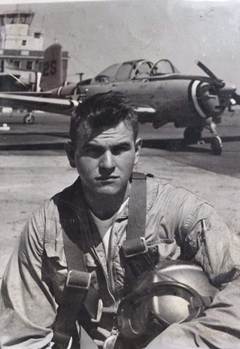
Preflight was 16 more weeks of boot camp, only considerably more intensive than anything NTC San Diego had to offer. It finally ended, and I started Primary Flight Training flying the Beechcraft T34 Mentor. I survived the familiarization phase (Riding in the back seat while an instructor pilot performs a full regimen of aerobatic maneuvers) without puking, then learned basic maneuvers and started landing practice. Every day was an exciting new challenge.
During an early session of shooting touch-and-go landings (Landing and taking off without stopping), I entered the final wide of the landing approach path. While trying to figure out how to correct things, I heard the word “power” from my backseat instructor over the intercom (IC). I reacted quickly and pulled the throttle back just like I had on the old Ferguson. The ensuing silence was deafening.
The throttle took on a life of its own and slammed forward. “I’ve got it,” the instructor yelled into the IC as the engine roared back to life. He took over, flew the airport landing pattern, and set us on the ground.
During the long walk to the debriefing room, my rattling on about the difference between a tractor throttle and an airplane throttle fell on deaf ears.
The debrief was very brief. “You could have killed us up there,” the instructor stated as he handed me my first down.
No more needed to be said. The message was clear. This was not a game. What we were doing was real. Few of life’s lessons would ever be so clear. I was 19 years old and growing up fast.
Final note: I completed training and earned my Wings of Gold as a designated Naval Aviator in June of 1958, three months after my twenty-first birthday.
