Author’s note: Written in 2020 during the COVID pandemic.
ABC—Atomic, Biological, and Chemical warfare. Weapons of Mass Destruction strike fear in our hearts during times of war and lurk in the shadows of our minds during times of peace.
I still recall watching the training film, “ABC Warfare, Defense Ashore,” with a group of my identically dressed cohorts, courtesy of the US Navy in the 1950s. It began with a loud blast and a mushroom cloud, followed by a quiet shadow creeping around buildings and across the land. All the while, the well-modulated narrator explained that while we could expect atomic weapons in any future war, biological and chemical weapons could also quietly extinguish us.
After the film, a senior petty officer took over. He passed out gas masks and showed us how to put them on and use them. With masks securely in place, we were marched into an airtight chamber. There, we were allowed to mill around and get used to breathing with and seeing out of the masks while the chamber was flooded with mild tear gas. We were then ordered to remove our masks. With burning eyes and nostrils, we were finally let out of the chamber, a bit worn but wiser for the experience.
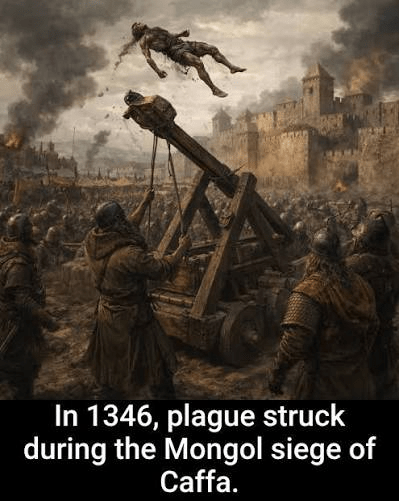
In 1910, Jack London peered into the future and penned the dystopian short story, “The Unparalleled Invasion.” At the time, London was not clairvoyant enough to envision the unleashing of WWI’s chemical and WWII’s atomic weapons, but he could imagine the use of biological weapons. Germ warfare had been in man’s arsenal throughout the ages. Some believe the Black Death plague of the fourteenth century was the result of the Golden Horde throwing plague-stricken corpses over the walls of Caffa, Crimea, in 1346.
Earlier, London had accepted an assignment by the San Francisco Examiner to cover the Russo-Japanese War. Following three arrests by the Japanese authorities for unruly behavior, he was released through the personal intervention of President Theodore Roosevelt and departed the front after six months. Nevertheless, he was able to use that experience to plot “The Unparalleled Invasion”. The storyline begins with Japan’s victory over Russia and its subsequent entry into the comity of nations. Flush with newfound imperial designs, Japan awakens the sleeping giant of China and brings it into the twentieth century. China responds and methodically grows in population from 400 million to 800 million by the American bicentennial year of 1976. It then sets out on a path of world domination. The story climaxes with the Western nations retaliating with biological weapons delivered by infected mosquitoes and destroying the Chinese population. It ends with the world outlawing biological weapons.
“The Unparalleled Invasion” has been criticized for describing genocide as the solution to the “yellow peril” and has been cited as evidence of Jack London’s racism.
Even so, London foretold many of the problems we face today. China’s population grew as predicted and has now reached 1.4 billion. China’s Communist Party does seek world domination—economically if not militarily. And in a reversal of the use of biological weapons, whether by accident or design, the rest of the world is currently under attack by a deadly virus originating from China.
The Covid 19 virus, thought by many to have originated from a Wuhan, China research laboratory, did not begin with a quiet shadow creeping across the land or infected mosquitoes. It began with infected Chinese citizens spreading from Wuhan Province and passing the disease on to the world of the twenty-first century. With a population of 1.4 billion warm bodies, perhaps the Chinese Communist Party has no need for mosquitoes to deliver its mischief. Like the Golden Horde of old, the CCP can use infected bodies to spread disease. In this case, however, the bodies are alive and can navigate to their targets on their own—whether by accident or design.

One response to “The ABCs of Warfare”
I would love to layer AI on to your pithy note! Good writing, as always.
LikeLike