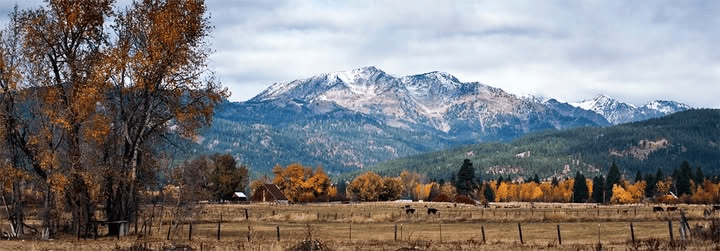
In 1945, the LaRue family leaves California and moves to the bucolic world of Northeastern Oregon.
The Wallowa Mountains dominate the landscape of Oregon’s northeast corner. The Nez Perce Indians called this country The Land of Winding Waters. With the arrival of European settlers, these craggy mountains and picturesque valleys came to be known as the American Alps. To the east of the mountains, the Snake River slices through North America’s deepest river gorge, Hells Canyon. Nestled in one of the valleys above the canyon’s rim, the little town of Halfway is our destination.
Before Halfway, however, we make a stop at Nampa, Idaho. An old friend and fellow worker from McMullan’s Dairy had established a farming operation there. Dad wants to visit with his friend and check out the area.
Our host saddles a horse for me to ride. It is my first experience riding a real working saddle horse, and I am hooked. I spend every waking hours riding around the ranch until we leave.
The road leading from Nampa to Halfway follows along the old Oregon Trail to Baker, Oregon. Pioneers in covered wagons followed the same route starting in the 1840s. The route runs along the Snake River to a place called Farewell Bend. At Farewell Bend, the Snake turns north into Hells Canyon. The Oregon Trail, now called Highway 30, forks off northwest through the Burnt River canyon up to Baker Valley. We, pioneers of the 1940s, follow this historic route in our 1937 pickup truck.
From Baker, we turn east for the next sixty miles to our destination, Pine Valley. We cross the still visible wheel ruts of the Oregon Trail running through a dry sage-covered plain of Virtue Flat. The dry landscape gives way to a stretch of lush green irrigated pastures and farmed fields. The paved road turns into gravel. Passengers in occasional oncoming vehicles wave a friendly greeting as we pass. We seem to travel through time to an earlier era. Cowboys and ranchers still tend their cattle on horseback. Stout draft horses still draw farm implements. The twentieth century has largely eluded the countryside.
The road unexpectedly changes back to pavement. The landscape changes to a narrow canyon. We follow the Powder River through deep cuts and winding turns to Eagle Valley. Eagle Valley reveals another landscape of green pastures and farmed fields. We pass through the small cluster of homes and businesses called Richland. The valley closes back to a narrow canyon as we approach the Powder’s confluence with the Snake.
A lettered road sign points left toward Halfway. We follow the sign and climb a steep grade with sharp switchbacks. Our loaded pickup grinds along in low gear. We top the hill and travel down through a wide swale. Cattle graze on the dry yellow grass below farmsteads set back against the hills. The yellow landscape turns to green, and Pine Valley opens before us.
We turn left at an intersection near a sawmill and follow the valley’s only paved road to Halfway. Halfway boasts a bank, two grocery stores, two bars, several churches, three gas stations, a drug and liquor store, and other related businesses. The Gray Gables Hotel houses one of the bars and offers rooms to rent. Three housekeeping cabins behind a white picket fence and a manicured green lawn flank one side of the hotel. We rented one of the cabins and set up housekeeping. It is a welcome relief to get off the road and out of the cramped pickup cab.
My eight-year-old mind does not grasp the significance of our travels. At eight, you do not question your parents’ actions. You accept whatever they do as the norm. Even so, I could sense that this small world was a complete change from the world I had experienced in California. My dad’s motivation will always remain a mystery. Perhaps he was a throwback to his grandparents’ generation. Perhaps he was a precursor to the counterculture of the 1960s. Maybe he just wanted to escape the controls that a wartime culture had placed on society. The cold, hard facts were that we had arrived in the strangely named little town of Halfway, Oregon, and there I would remain for the next ten years until I graduated from high school. My Post-War Home Front had just begun.
