Growing up on a ranch in the mountains of Eastern Oregon, my exposure to live music was an occasional Saturday night at the local VFW dance hall, listening to local ranch hands and loggers tune up acoustic guitars and fiddles and perform songs like Hank Williams’s Your Cheating Heart. At home, we listened to tunes like The Wreck of the Old 97 on a few scratchy 78 rpm records on an old-fashioned wind-up RCA Victor phonograph, its logo featuring Nipper the dog next to a speaker horn. We also heard the Hit Parade on Mom’s radio whenever Dad got around to buying a battery for it. Anyway, music was not a high priority in our world.
I graduated from high school in the spring of 1955 and traveled across the state the following September to join the freshman class at Oregon State College in Corvallis. It was quite a lifestyle transformation for a country boy fresh off the farm. I pledged to a fraternity and set about learning a new way of life.
I met a cute coed who mentioned an upcoming Duke Ellington concert she was eager to attend. I had no clue who Duke Ellington was or what a concert entailed, but I told her I would take her. Any chance to date her was okay with me.
The concert was held in a gym with ample dance space. The sweet, melodic sounds of Ellington’s swing jazz opened my ears to a new realm of music. And when Louie Bellson performed his drum solo, I was mesmerized. My date and I danced the night away. It was a magical experience for a country boy.
My academic career lasted for two quarters until I ran out of money. Like many of my generation, I joined the Navy to see the world. I qualified for flight training and became a Naval Aviator by hard work and determination, and an Officer and Gentleman by act of Congress.
During those years, I was introduced to many kinds of music in bars and gin mills and on the radio wherever I flew. I heard jazz in New Orleans, country in Texas, pop in movie theaters, and rock and roll everywhere. I acquired a cabinet stereo and a collection of LP albums with everything from Lena Horne blues to Mort Sahl comedy. But I always remembered the sound of Duke Ellington, live, with his big-band jazz orchestra, back in the gym at Oregon State.
After the Navy, I settled in the San Francisco Bay Area to go back to college at San Jose State and complete my education. I entered the workforce and worked nights at Lockheed Missiles and Space Company. During that time, I met a beautiful young lady named Kathy. She loved jazz. Her private collection of LP albums included jazz artists Dizzy Gillespie, Ahmad Jamal, Dave Brubeck, and many more icons of the genre. She would bring her albums to my place, and we would invite friends and party all night long while listening to good jazz on my stereo. We had so much fun, I ended up marrying her.
The Bay Area was a mecca for jazz lovers during the sixties. Kathy kept her eye out for live performance advertisements nearby. The first recital we attended was with the Dave Brubeck quartet near the San Jose State campus. It was held in a small, second-story walk-up auditorium, a surprising venue for one of the leading progressive jazz artists of the day. We sat on folding chairs and listened to Brubeck’s jazz magic with famous numbers, including Take Five. A highlight of the evening occurred when Mongo Santamaria sat in, drumming solos on the conga and bongos with his fingers. There was no dancing. The only audience participation was limited to toe tapping, finger snapping, and lightly clapped applause at the end of each number.
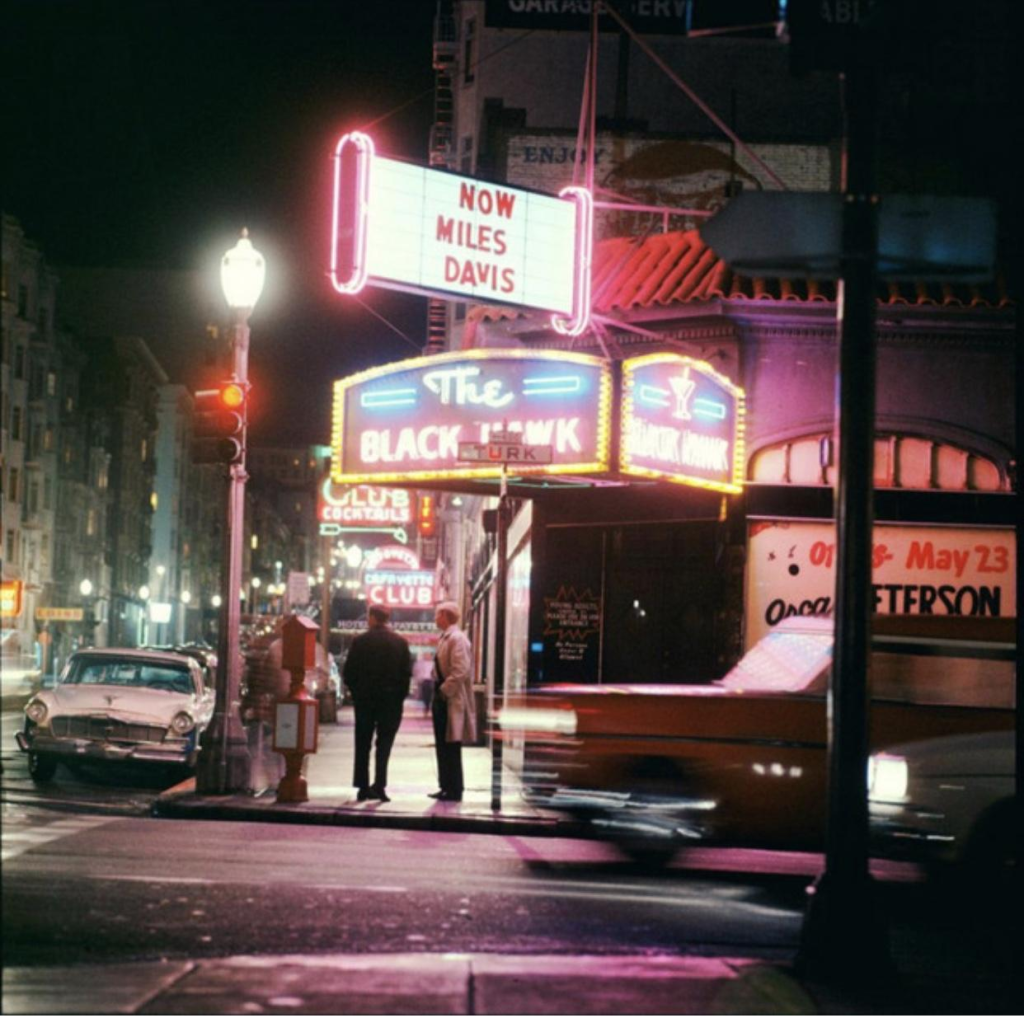
Kathy and I soon discovered the Blackhawk Jazz Club in San Francisco’s Tenderloin District. In the mid-20th century, the Tenderloin provided work for many musicians in the neighborhood’s theaters, hotels, burlesque houses, bars, and clubs. The premier jazz club was the Black Hawk at Hyde and Turk Streets. There, jazz musicians Dave Brubeck, Miles Davis, Thelonious Monk, Gerry Mulligan, and others recorded live albums in the late 1950s and early 1960s. You could hear legendary jazz icons like John Coltrane, Art Pepper, and Stan Getz on saxophone, Dizzy Gillespie, Miles Davis, Shorty Rogers, Art Farmer, and Chet Baker on trumpet, vocals by Mary Stallings and Johnny Mathis, Art Blakey on drums, Gerry Mulligan on baritone sax or clarinet, Thelonious Monk, Horace Parlan, Dave Brubeck, and Andre Previn on piano, and Russ Freeman on guitar. And when Charlie Parker was supposed to be opening across town at the Say When Club, he could be found instead jamming on saxophone at the Hawk. The Blackhawk offered good drinks, friendly service, and great jazz in a dark, smoke-filled atmosphere. No one danced; you came to listen. We even saw George Shearing demonstrate his famous fugue on piano. With my tin ear, I had no idea of what he was talking about. But I could fake it like an aficionado by just knowing the term. We were saddened when the Blackhawk closed in 1963.
Sometime later, Kathy spotted a small ad in the San Jose Mercury newspaper announcing an appearance by the Cal Tjader band at a nightclub on Telegraph Avenue in Oakland. Telegraph Avenue runs through downtown Oakland to the edge of the University of California, Berkeley campus. I assumed the venue would be near the U.C. campus and cater to the college crowd. It seemed like a fun thing to do, so we decided to take it in.
I guided my 1958 two-tone tan Chevy Bel Air hardtop up the Nimitz Freeway from San Jose to Oakland and exited onto Telegraph Avenue. Kathy watched for the street number in the ad. After a few blocks, she pointed excitedly and said, “There it is.”
“Naw,” I replied. “This is the colored part of town. We need to be farther up toward Berkeley.” I kept driving.
After driving about four miles through stop-and-go traffic, a sign showed, “Entering Berkeley.” Kathy reminded me that the ad said Oakland, so I turned around and backtracked to the location of her original sighting. A small sign over the door identified the place as the advertised venue. I parked, but was reluctant to go in. At Kathy’s insistence, she was a huge fan of the celebrated vibist Cal Tjader. I finally relented, carefully locked the car, and escorted her to the entrance.
A well-dressed Black hostess greeted us nonchalantly. “Here for the band?”
I said yes, and she guided us to a table. A polite, friendly Black waitress took our order and served our drinks. Looking around the crowded room, I noticed only one other white couple. I nodded, and they half-smiled back. Everyone else was black except for a few white women accompanied by Black men.
The crowd cheered enthusiastically when Cal Tjader’s Modern Mambo Quintet walked into the room and took their places—Cal behind the vibraphone he was famous for, brothers Manuel and Carlos Duran on piano and bass, Benny Velarde on timbales, bongos, and congas, and Luis Miranda on congas. They started their first number. The audience rose en masse and started dancing. We could not sit still and joined in after a couple of numbers. It was a memorable evening. It was the first time I had danced to jazz music since the evening with Duke Ellington back at Oregon State.
Admittedly, Tjader’s Caribbean Afro-blues and Ellington’s big band sounds made dancing more engaging than the resonances of modern jazz. But the exuberance I had felt in the college gym and now in the black nightclub went beyond that. The audience response was different. They did not just hear the music; they lived it. And the band played its hearts out to an enthusiastic audience.
Race issues were at the forefront of the turbulent sixties. But during that evening with the Cal Tjader band in downtown Oakland, we were all just Americans enjoying the magic of the best music of all time, America’s Classical Music called jazz. It made no difference where you came from.
