Like a wagon train of The Old West, we get in line with a collection of about thirty other vehicles—everything from cars with tents tied on top, to 40-foot motor homes, to our 23-foot travel trailer. Our Wagon Master (tour guide) waves us forward—our destination, San Felipe, Baja California Norte, Mexico, on the Sea of Cortez.
It is January 1983. Wife Margaret and I are in year three of a life-on-wheels adventure. In our mid-forties, we have explored much of the western United States and Canada. It is time to take on Mexico.
Snowbirds gather along the southern U.S. border each winter. The brave venture into border towns to pick up cheap meds and liquor, and to get their teeth worked on. Most go no further. But brave and timid alike, they revel in retelling horror stories about travel in Mexico. With each telling, the stories become more terrifying. We listen to the stories. To play it safe, we joined this Yuma, Arizona, and San Felipe Chambers of Commerce-sponsored caravan.
At the Mexicali Port of Entry, guards check our IDs and wave us through. Life in the third world begins. Familiar rules of the road no longer apply. Traffic signs, printed in Spanish, are small and almost hidden. No one seems to obey them anyway. We follow the rig ahead of us, blindly.
An escort of motorcycle cops joins in. With red lights flashing and sirens blaring, they herd us along. Confusion reigns. Horns honk as cars, trucks, and buses crowd in and out of our line of vehicles. With one foot on the gas pedal and the other on the brake, I strive to keep up without crashing. We finally reach the outskirts south of the city. Traffic eases, and the scene turns rural. My white knuckles on the steering wheel take on a renewed lifelike color.
The Mexican part of the Imperial Valley is not unlike the farming areas around El Centro and Brawley on the U.S. side. Crops grow even in winter, and men wearing straw hats and women wearing bandanas work the fields.
The valley ends, and the landscape turns to desert. No shoulders border the narrow pavement. The road follows the hilly terrain with little cut and fill. Patches of broken asphalt and detours around boulders blocking deep potholes slow our progress. After about 100 miles, we spot the upper reaches of the Sea of Cortez. We are nearing our destination.
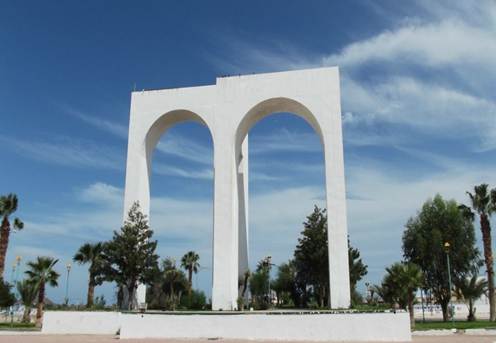
The Gateway to the Sea of Cortez, a sixty-foot-high pair of white arches, welcomes us to San Felipe. Our guides lead us to a modern trailer park called Ruben’s Camp. It fronts the beach, and palm trees wave in the breeze. We settle in for a week of exploration.
San Felipe is a quiet fishing village in the throes of transition to a tourist destination. The streets are still mostly dirt. The town is built along the arc of a picturesque beach lining an open bay. A large square breakwater provides shelter for the fishing fleet.
Most of the folks in our caravan are typical tourists, worried about drinking the water and complaining about the culture. They complain that businesses close in the afternoon for siesta and that the people do not speak English. The fictional Ugly American plays out in little San Felipe, a mere 122 miles from the border.
I quickly learn that the expatriates who spend winters at Ruben’s Camp gather in the combination office/clubhouse for café (coffee) and pan dulce (doughnuts and sweet rolls) each morning. I joined them and began my Mexican travel education. There are many details to digest, but the main points are to not drive after dark, use main highways, stay in recognized campgrounds, and that the horror stories I have heard are way overblown. When the week comes to an end, and our fellow tourists line up for the trip north, we bid them farewell and stay put. We relax and start to enjoy the Latin American way of life.
Spectacular sunrises greet us each morning. Birds fill the skies and dive for their breakfasts. Pangas race across the bay on their way to deep-water fishing. Our days are filled with exploring the town and the surrounding area. A surprising number of American expatriates, some in rented houses and some camped out in the desert, seem safely assimilated into the culture.
We befriend fellow greenhorns. Lee and Lennie, in their thirties from McCall, Idaho, are bent on sailing a 22-foot sloop to La Paz. A storm producing 10-foot swells blows through on their first day out. They retreat, and we spend good times clamming and picnicking on the beach with them. They finally get underway, and according to mutual acquaintances we meet later in McCall, make it to La Paz safely.
Al and Carol (Carol is the sister of actress Madelyn Rhue) camp next to us. Al and I charter a panga and spend a good day fishing. We buy clams and mussels from a local vendor called the Clam Man, whose mantra is, “My clams make you horny, guaranteed!” We enjoy a good clam feed. But the jury is still out on the Clam Man’s slogan.
Three weeks pass, and we are ready to take on Mexico—alone this time. We return to Yuma to collect the mail, pay the bills, and do a little shopping. The trip through Mexicali goes much smoother without the motorcycle cops helping us. A week later, we set out on our next south-of-the-border adventure with a newfound sense of confidence.
