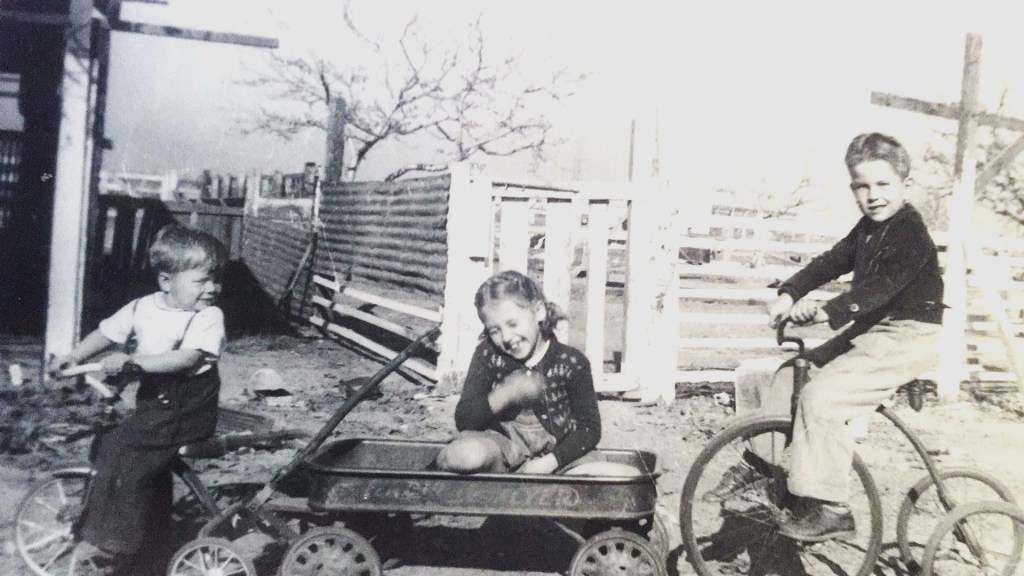
Even as a six-year-old, I could sense the change in my parents. I understood my own anxiety. The move from Baldwin Park to Chico had toppled my entire world. But grownups were not supposed to have those feelings. I could only hope that our lives would somehow get back to normal.
I did not have long to wait. My dad was a very resourceful man. When the stock market crashed in 1929, he had just turned seventeen. He entered adulthood during very trying times. He was a product of the Great Depression.
His parents were schoolteachers. Thus, education was paramount in their lives. Dad tried to keep the peace in the family by remaining in school. But money was short, and he was of an independent nature. For the next seven years until he was 24, he alternated between academic pursuits at Northern Arizona State College in Flagstaff and Arizona State College in Tempe, and the “school of hard knocks,” riding the rails and living in hobo jungles throughout the United States. He learned at an early age to be “quick on his feet.” Survival required it.
The free life ended in 1936 when he married my mom. They were married on the first of June, shortly after Mom graduated from high school. I was born nine months later on March 24. Dad was now a family man.
Dad was up to the task. With the help of my grandparents, he bought a lot in Baldwin Park, California, and built a home for us. He went to work for McMullan’s Dairy milking cows. He worked his way up to foreman, and we moved into the foreman’s quarters on the dairy. My mom helped in the little store where they sold the dairy products they produced. Despite the war, their life seemed secure.
Therefore, it came as a shock when the government suddenly transferred my dad away from the life they had built. The consequences of war had robbed them of their independence. Their secure life had suddenly evaporated. They were reduced to living in a farm worker’s shanty. Dad was back to starting over as a common hand on a large farming operation, milking cows. The war had taken control of their lives.
Ever the man of action, Dad set about righting things. Over the next few months, he turned our life back around. He met with the draft board, or whoever controlled such things, and managed to transfer from the dairy to Chico Army Air Field. He bought a twenty-acre farm and moved us into the old house that came with it. Our new home was far from luxurious, but it was far better than the farm worker’s quarters we moved from. My parents were happier. They were regaining control.
The move was like an answer to my prayers. I hated the school I was enrolled in. I felt like I had been dropped into an alien world without a friend in sight. The move came with a change in schools. Whereas the old school had seemed large and impersonal, the new school felt warm and welcoming. It was a rural two-room facility that had grades one through four in one room and grades five through eight in the other. The teachers and other students made me feel at home. I could walk to school from our house without taking a bus.
Chico Army Airfield, called “the base” in everyday conversation, was established in 1941 to train pilots. Dad worked in the paint shop. He also rode on or drove the ambulance whenever there was an accident. I can remember him coming home visibly shaken following some of those accidents. He detested that part of his job. But like almost every citizen at the time, he pitched in and did what he had to do to help win the war.
It soon became apparent that being on ambulance call, working full-time in the paint shop, and trying to farm all at the same time formed an impossible task. I don’t know how it worked, but apparently, when you worked for the Army during World War II, you didn’t just up and quit because you had something you’d rather be doing. As a consequence, my mom’s parents, along with my uncle Jim, who was about five years older than me, came out from Arizona to live with us. Grandpa Thompson was a hard-rock miner and a farmer. Dad continued to work at the base, and Grandpa took over the farm. Sometimes it took a family’s teamwork to survive on the home front.
Eldon LaRue had not forgotten his survival skills. He was still “quick on his feet.”
