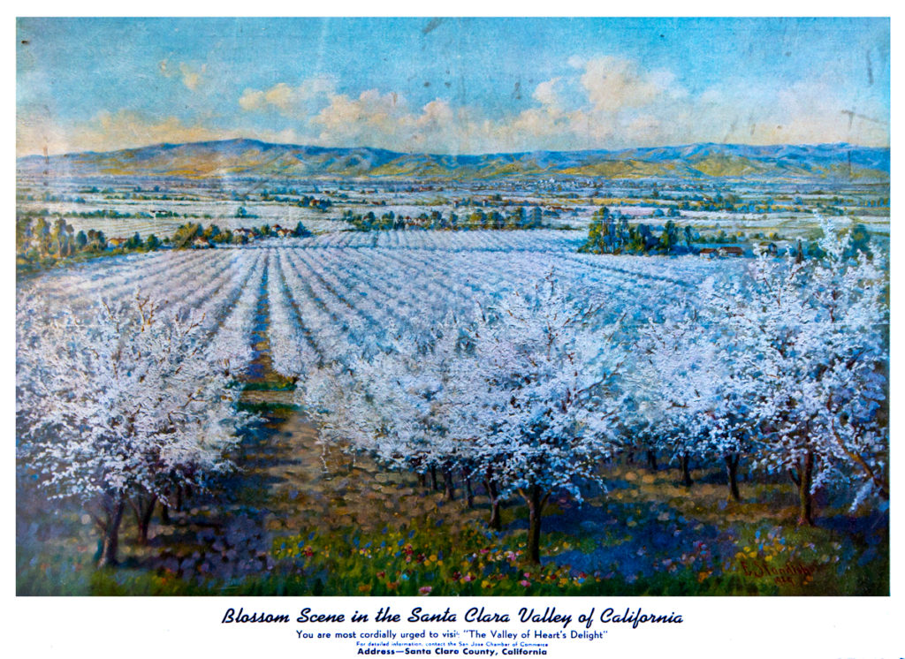
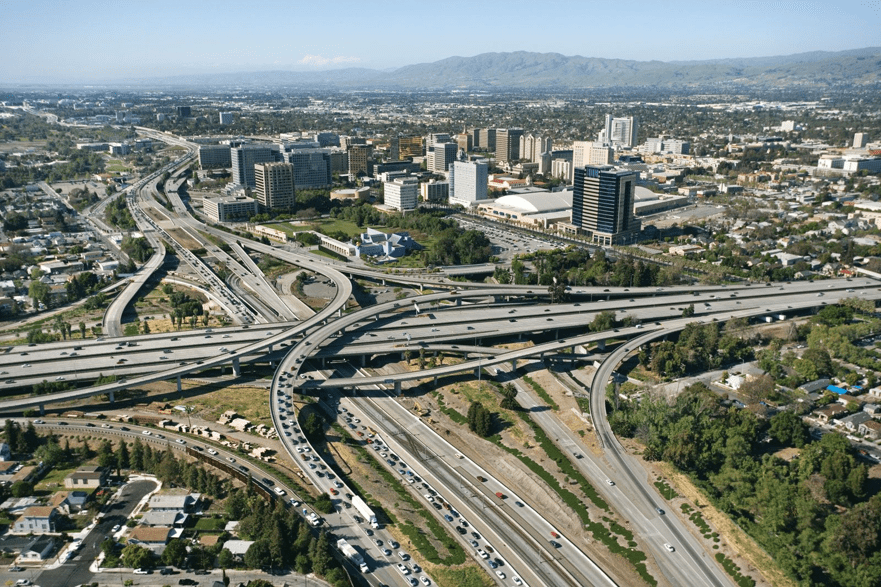
A Half Century of Progress? (Note the same mountains in the background)
When the ancients wrote of the Garden of Eden, they may well have used California’s Santa Clara Valley as their model. “And out of the ground made the Lord God to grow every tree that is pleasant to the sight, and good for food ….” Genesis 2:9. Or so it seemed until an enigma called Silicon Valley took root.
The valley, named after the Spanish Mission Santa Clara, was long known as the Valley of Heart’s Delight for its high concentration of orchards, flowering trees, and plants. Until the 1960s, the Santa Clara Valley, with 39 canneries, was one of the largest fruit-producing and packing regions in the world. That all ended as a new class of urban developers descended like locusts to root the trees and trample the land like a herd of Monterey Wild Boar in a cabbage patch.
Bulldozers uprooted orchards and vineyards. Cookie-cutter housing tracts popped up in their wake. Strip malls, shopping centers, factories, and office buildings sprang up where quaint homesteads and villages once stood. Ever-widening streets and new freeways couldn’t keep up with the demands of ballooning traffic.
Fresh out of the Navy, I hit the Bay Area in 1960, driving a 1958 Chevy Bel Air with payments due and about $200 in my pocket. Nine years later, I had a wife, two kids, a house in the suburbs with a 30-year mortgage, a 1969 Ford Country Squire station wagon with fake wood trim, and a 1963 Austin Healey 3000 sports car. I worked as a scientific computer programmer in the Information Sciences Department of Fairchild Semiconductor International, Inc.—the seat of the new silicon technology. Some would say that I had made it. I was not so sure.
Sitting in my Austin Healey with the top down, awaiting a turn to get on the new 280 freeway, I watched the river of traffic flow by. The smell of horse manure caught my attention as a pickup truck towing a horse trailer rattled down the highway. I was transported back to my youth, growing up on a ranch in Eastern Oregon. The old saying—you can take the boy out of the country, but you can’t take the country out of the boy—invaded my mind as I joined the throng of indistinguishable commuters on their way to work.
What should I do? Conventional wisdom told me “Stay where you are.” My gut told me “It’s time to move on.”
I compiled a list of every small-town business and institution in the area west of the Rockies I could locate that used a computer. I mailed an unsolicited job resume to each of them. That effort did not involve a lot of resumes at that time in history, but it did result in a job offer from Boise Cascade Corporation in Boise, Idaho.
In the autumn of 1969, amidst much wailing and gnashing of teeth by my in-laws over the tearing away of their only daughter and two grandsons, we watched as the moving van pulled away from our driveway on its way to Idaho. My wife, two sons, and I followed shortly thereafter—on our way to new beginnings. Our lives would be forever changed. My sports car would soon be transformed into a pickup truck. Hard work and clean air would be our future. Silicon Valley would be our past.
The Back to the Land movement of the seventies was just beginning. I don’t know if I was a part of that movement, or if I was simply returning to my roots. But I guess I lived it. How could a country boy know for sure?
