By Robert LaRue
Photos by the author.
Tucked away deep in the mountains of North Idaho, a grove of ancient cedars silently watches the passage of time. When Wyatt, wife Sadie, and brother Jim Earp arrived at Eagle City in 1884, it was a bustling tent city—a gold rush town. The enterprising brothers purchased a round circus tent, 45 feet high and 50 feet in diameter, for $2,250 and opened a dance hall. Later, they opened the White Elephant Saloon. An advertisement in the Coeur d’Alene weekly called it “The largest and finest Saloon in the Coeur d’Alenes.” However, the Coeur d’Alene gold rush was short-lived, and today there is little to show that Eagle City ever existed. The site bears mute testimony to the temporary nature of man’s footprint with the passage of time.
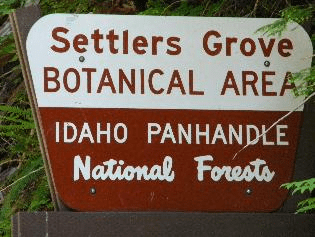
Exit Interstate 90 at Kingston, Idaho, and follow the Coeur D’Alene River for a little more than 20 miles across Prichard Creek. Turn right toward Murray for about 3.5 miles and cross Eagle Creek. Turn left, and you have arrived at Eagle City. From Eagle City, follow Eagle Creek and then West Eagle Creek for 5 or 6 miles to a Forest Service sign announcing, “Settlers Grove Botanical Area.”
The road ends in a large parking area with permanent restrooms. Park your vehicle and step back in time under the lintel of the grove’s open gate.
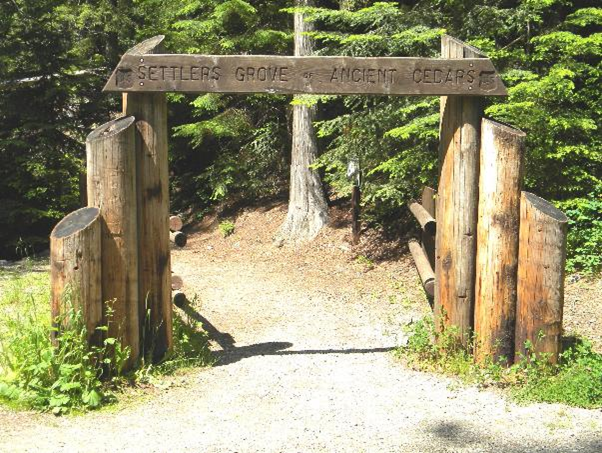
Settlers Grove, at 182 acres, is one of the last large stands of Western Redcedars in Idaho. While these trees are called cedars, they are actually a part of the cypress family. Mature trees stand well over 200 feet tall, and in Settlers Grove range up to 7 feet in diameter. The oldest trees
in the grove are estimated to be 700 to 1,000 years old. Western Redcedars are primarily found in the coastal forests of the Northwest. However, a disjunct inland population exists along the southern British Columbia-Alberta border and in northern Idaho and western Montana.
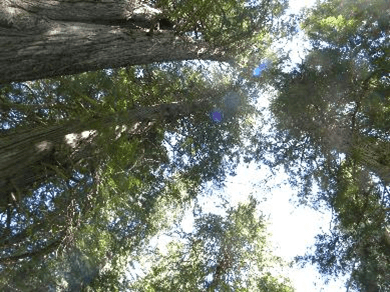
The trail through the grove is well-maintained and easy walking. The treetop canopy filters sunlight into a dreamlike array of lights and shadows.
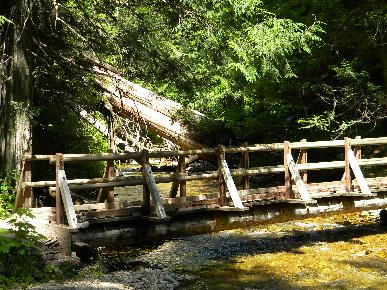
The creek winds along the trail and under bridges with an ever-changing pattern of bright refractions.
Sound becomes muted yet distinct: a bird’s chirp, a child’s voice, the babble of running water. The mind wanders, and time takes on a new dimension.
When Columbus proved the world was round, and Conquistadors first set foot on the golden shores of the New World, some of the trees standing in Settlers Grove had already lived 200 years or more.
When Lewis and Clark led the Corps of Discovery Expedition over the mountains a little south of the grove, these same trees had aged to 500 years.
During the building of the oldest manmade structure in Idaho, the Cataldo Mission, just downriver from the grove, the same trees had been alive for 550 years.
By the time of the Coeur d’Alene gold rush in the 1880’s, the trees were 580 years old.
The 130 or so years span from then until now represent little more than a single century out of seven to these ancient giants. Yet it covers our whole regional history.
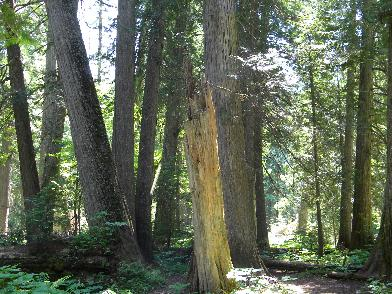
The trees have not gone unscathed. Uprooted trunks, broken-off stumps, and lightning scars lend stark evidence to the forces of nature the grove has endured.
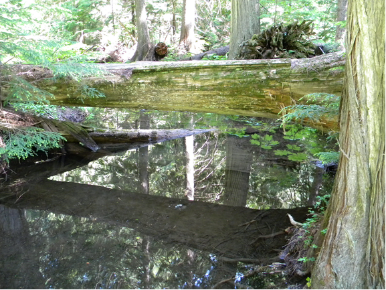
Centuries of winter’s cold, summer’s heat, firestorms, ice storms, droughts, and floods have left their mark. Why did some fall and others still stand tall? The mystery remains the “secret of the grove.”
